

Clinical trial start-up is complex by design. Regulatory approvals, contracts, site readiness, database build, training, supplies, and operational planning all need to come together before enrollment can begin.
That complexity cannot be removed, and many timelines remain outside a sponsor’s direct control. But there is still significant room to make the controllable parts of start-up more efficient, better coordinated, and easier for study teams to manage.
Why clinical trial start-up takes time
Start-up is not one process. It is a network of connected workstreams.
Research into global randomized clinical trials has identified regulatory activities, contracts and budgets, insurance, clinical supplies, site identification and selection, site activation, and operational processes among the areas that can contribute to start-up delays.[1]
Some of these activities are essential safeguards rather than inefficiencies. ICH E6(R3), for example, establishes clear expectations around investigator qualifications, adequate resources, IRB/IEC review, training, sponsor oversight, data governance, and fit-for-purpose computerized systems.[2]
The opportunity is therefore not to remove necessary steps. It is to organize them more effectively.
While an ethics committee reviews a submission, other activities may be able to progress in parallel. The clinical database can be designed and tested. Training materials can be prepared. User access can be configured. Operational milestones can be tracked.
A well-managed start-up makes productive use of the time the study already requires.
Start-up delays matter, but context matters too
A delayed site activation does not automatically mean poor site performance.
Sites that activate later than planned may still recruit successfully, depending on the study, patient population, local environment, competing trials, and site capabilities.
Recent Tufts Center for the Study of Drug Development benchmarking illustrates how much site performance varies. A 2024 analysis identified differences in activation and enrollment performance across regions and site types, while actual enrollment exceeded planned enrollment in a majority of the studies evaluated.[3]
The broader timeline still matters financially. A 2024 Tufts CSDD analysis estimated average direct clinical trial operating costs of approximately $23,737 per day for Phase II studies and $55,716 per day for Phase III studies.[4]
These figures are not the cost of one delayed site or one additional start-up day. They do, however, put the economics of clinical development into perspective. When avoidable internal delays contribute to a longer overall study timeline, even relatively small efficiencies can become meaningful.
For sponsors and CROs, this creates a practical objective: focus improvement efforts on the start-up activities they can genuinely influence.
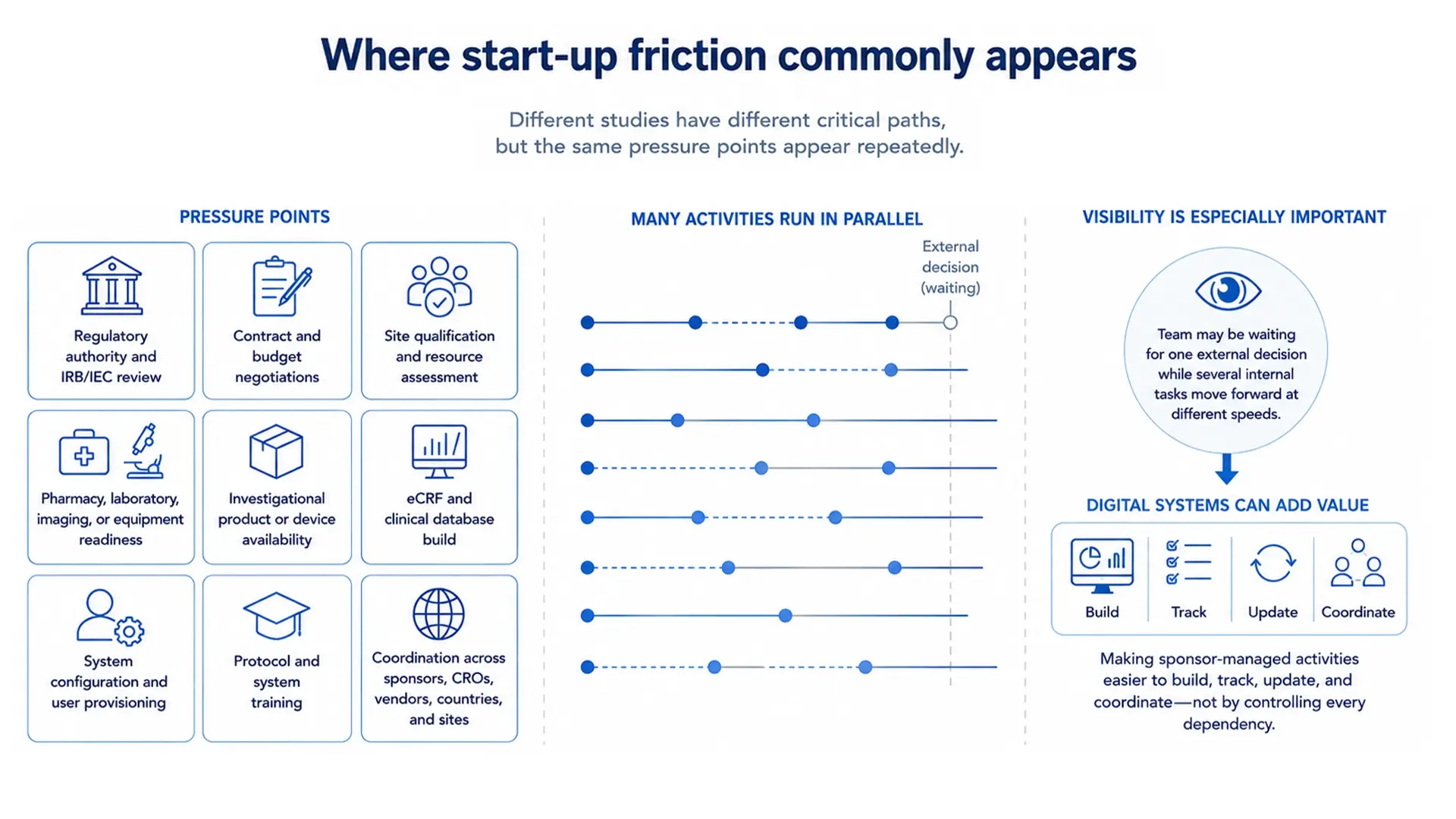
Where start-up friction commonly appears
Different studies have different critical paths, but the same pressure points appear repeatedly.
These can include:
- Regulatory authority and IRB/IEC review
- Contract and budget negotiations
- Site qualification and resource assessment
- Pharmacy, laboratory, imaging, or equipment readiness
- Investigational product or device availability
- eCRF and clinical database build
- System configuration and user provisioning
- Protocol and system training
- Coordination across sponsors, CROs, vendors, countries, and sites
Many of these activities run in parallel, which makes visibility especially important. A study team may be waiting for one external decision while several internal tasks are moving forward at different speeds.
That is where digital systems can add value. Not by controlling every dependency, but by making sponsor-managed activities easier to build, track, update, and coordinate.
Protocol amendments can multiply start-up work
Protocol amendments add another layer because one change can affect several workstreams at once.
A 2024 Tufts CSDD analysis of 950 Phase I to IV protocols and 2,188 amendments found that the proportion of protocols with at least one amendment increased from 57% to 76% compared with 2015 benchmarks. The average number of amendments rose from 2.1 to 3.3 per protocol.[5]
Importantly, the same study classified 77% of amendments as unavoidable. Regulatory requests, changes in study strategy, emerging information, and other legitimate factors can make protocol changes necessary.[5]
The challenge is therefore not simply to prevent amendments. It is to manage their downstream impact well.
A protocol change may require revisions to eCRFs, validation logic, training, study materials, system configurations, and operational plans. The easier those updates are to implement and review, the easier it becomes for teams to keep the study moving.
This is where modern eClinical technology becomes particularly relevant.
Match each start-up challenge to the right technology
The most effective approach is not one system doing everything. It is using the right technology for the right part of the workflow.
| Start-up area | Where technology can help | Medigen Suite product |
| Clinical database readiness | Clinical database readiness eCRF design, edit checks, versioning, testing, and user setup | Catchtrial® EDC+ and Fastrial® AI+ |
| Study-specific training | Training delivery, assessments, completion tracking, and retraining | Mastertrial® LMS+ |
| Operational planning | Study, country, and site milestones, timelines, and activation status | Maptrial® CTMS+ |
| Regulatory and ethics review | Internal preparation and status tracking | Maptrial® CTMS+ |
| Local site readiness | Tracking known prerequisites where relevant | Maptrial® CTMS+ |
The key is to identify which start-up delays are actually addressable through technology. External approvals and site-specific constraints will follow their own timelines, but stronger execution across sponsor-controlled activities can help prevent internal work from becoming the next critical-path constraint.
From protocol to eCRF with Catchtrial and Fastrial AI+
Clinical database build is one of the clearest start-up activities that sponsors and CROs can directly improve.
A complex protocol has to be translated into visits, forms, fields, eligibility criteria, procedures, safety data, edit checks, and study-specific workflows. Traditionally, much of that first build involves detailed manual review and transcription.
Catchtrial EDC+ provides the environment for designing and managing that clinical database, with configurable visits, eCRFs, fields, edit checks, user roles, conditional logic, and eCRF versioning. It can also support different CRF versions according to the protocol version applicable at a site.
Fastrial AI+ takes this one step further by assisting with the first eCRF draft.
The Clinical Protocol and CRF Specialist can process the protocol as a complete PDF or Word document and generate selected eCRF definitions, including forms for areas such as eligibility, procedures, and safety. The output is returned as structured JSON with CDISC ODM-compliant structures and can be imported into Catchtrial EDC+ for further configuration.
Instead of starting with repeated manual association and transcription of protocol content, the study team begins with an AI-assisted draft.
That changes where expert time is spent.
Data Managers and study experts remain responsible for reviewing and editing the proposed forms and integrity checks. The study is then built in Preview, validated, subjected to user acceptance testing, and approved before Production. The existing validation and UAT process remains in place.
Depending on protocol complexity and internal review practices, Medigen Suite estimates that a first complete eCRF draft can be produced in hours rather than weeks.
Make training part of the start-up workflow
Database readiness is only one part of activation. Study personnel also need the right training before performing their assigned trial activities.
Mastertrial® LMS+ gives sponsors and CROs a structured environment for delivering protocol, system, and study-specific training across distributed teams.
Digital training can be assigned to the relevant users, completed asynchronously where appropriate, assessed, and documented centrally. This is particularly useful when studies span multiple countries and time zones or when new personnel join after the initial training period.
It also becomes valuable when a protocol amendment requires targeted retraining.
Rather than recreating the training process each time, teams can distribute updated content and maintain a clearer record of completion. Live investigator meetings, CRA interaction, and study-specific discussion still have an important role, while the LMS adds structure around the activities that benefit from standardized digital delivery.
Keep operational readiness visible with Maptrial
Maptrial CTMS+ complements the data and training workflows by giving clinical operations teams a broader view of study readiness.
Start-up involves multiple milestones across studies, countries, and sites. Maptrial is designed to help teams organize and follow those operational activities, including timelines, milestones, activation status, and site-level progress.
Its value is visibility.
Consider a multicountry medical device study where regulatory reviews and contracts are progressing according to different local timelines. At the same time, the sponsor can continue preparing the database in Catchtrial, generate and refine eCRFs with Fastrial AI+, assign required training through Mastertrial, and monitor operational readiness through Maptrial.
No system makes the external dependencies disappear. But the work that remains within the study team’s control can continue moving.
That is where an integrated eClinical environment becomes most useful: not by promising a shortcut around clinical trial requirements, but by helping teams make better use of every stage of start-up.
Faster start-up still starts with readiness
ICH E6(R3) encourages clinical trials to be operationally feasible and to avoid unnecessary complexity while maintaining participant protection, data reliability, appropriate training, and proportionate quality controls.[2]
That principle applies equally to technology.
AI-assisted eCRF generation should not remove expert review. Digital training should not become a box-checking exercise. A CTMS should not replace operational judgement.
The strongest technology reduces administrative effort around qualified people rather than trying to remove qualified people from the process.
This is also the philosophy behind the Fastrial AI+ workflow. AI-generated content remains suggestive by design, and sponsors and CROs retain responsibility for the content, accuracy, and approval of every eCRF released to Production.
Turn start-up time into productive time
Clinical trial start-up will always involve moving parts. Some depend on regulators. Some depend on sites. Some depend on suppliers, institutions, or local processes.
But others sit directly within the sponsor’s or CRO’s operating model.
A useful start-up review therefore asks:
- Which activities are genuinely driving our critical path?
- Which waiting periods are outside our direct control?
- What can progress safely in parallel?
- Where are experts still spending time on repetitive configuration or transcription?
- Which activities are still being coordinated through disconnected systems or manual tracking?
For many studies, those questions point directly toward data build, training, and operational coordination.
Catchtrial EDC+ provides the foundation for clinical database design and data capture. Fastrial AI+ can assist with translating protocol requirements into the first structured eCRF draft. Mastertrial LMS+ organizes study-specific training, while Maptrial CTMS+ supports operational planning and oversight.
Together, these capabilities give sponsors and CROs a practical way to improve the parts of clinical trial start-up they can influence, while respecting the regulatory, scientific, and site-level processes that require their own time and expertise.
Visit the Medigen Suite product pages or request a demo to see how Catchtrial EDC+, Fastrial AI+, Mastertrial LMS+, and Maptrial CTMS+ could fit into your next study start-up.
Frequently Asked Questions
What causes clinical trial start-up delays?
Clinical trial start-up delays usually arise from several overlapping workstreams. Regulatory and ethics reviews, contracts, site readiness, clinical supplies, database build, system configuration, and training can all affect the timeline. The relative importance of each factor varies by study, country, and site, which is why start-up is most effectively managed as a coordinated process rather than a single milestone.
Does delayed site activation mean a site will perform poorly?
No. Activation timing alone does not determine future enrollment performance. Patient availability, therapeutic area, competing studies, protocol design, site resources, and local conditions all influence recruitment. A site that activates later than planned may still become a highly productive site, so activation speed is best considered alongside broader measures of site readiness and performance.
Can AI help reduce clinical trial start-up work?
Yes, particularly in structured activities such as initial study build. Fastrial AI+ can generate draft eCRF definitions directly from a clinical protocol for import into Catchtrial EDC+. The study team then reviews, edits, validates, tests, and approves the configuration before Production, keeping qualified human judgement at the center of the workflow.
How does Catchtrial EDC+ contribute to trial start-up?
Catchtrial EDC+ supports one of the most technology-dependent parts of start-up: translating the protocol into a functioning clinical database. Its configurable eCRFs, edit checks, conditional logic, versioning, user management, and related study-design capabilities give data management teams a structured environment for preparing the EDC before enrollment begins.
What role does Mastertrial LMS+ play during site activation?
Mastertrial LMS+ supports the organization and documentation of study-specific training. Sponsors and CROs can use an LMS to distribute protocol and system training, manage assessments, track completion, and coordinate additional training following relevant study changes. This can make training easier to manage across geographically distributed study teams.
Can a CTMS prevent clinical trial start-up delays?
A CTMS is best used to improve visibility and coordination rather than to promise prevention of every delay. Maptrial CTMS+ supports operational planning across studies, countries, and sites, helping clinical operations teams follow milestones, timelines, activation progress, and outstanding activities while other systems manage specialized data, training, regulatory, or site-level processes.
Primary Sources
- Lai J, Forney L, Brinton DL, Simpson KN. Drivers of Start-Up Delays in Global Randomized Clinical Trials. Therapeutic Innovation & Regulatory Science.
- International Council for Harmonisation. ICH Harmonised Guideline E6(R3): Guideline for Good Clinical Practice. Final version adopted January 6, 2025.
- Lamberti MJ, Dirks A, Kikuchi N, Patel Cervantes N, Getz K. Benchmarking Site Activation and Patient Enrollment. Therapeutic Innovation & Regulatory Science, 2024.
- Smith ZP, DiMasi JA, Getz KA. New Estimates on the Cost of a Delay Day in Drug Development. Therapeutic Innovation & Regulatory Science, 2024.
- Getz K, Smith Z, Botto E, Murphy E, Dauchy A. New Benchmarks on Protocol Amendment Practices, Trends and their Impact on Clinical Trial Performance. Therapeutic Innovation & Regulatory Science, 2024.
- U.S. Food and Drug Administration. Electronic Systems, Electronic Records, and Electronic Signatures in Clinical Investigations: Questions and Answers. Final Guidance.
Table of Contents
Latest Articles

Unblinding in Clinical Trials Done Right, One Patient at a Time
A treatment assignment must remain concealed until disclosure is [...]

Where the Benefits of Electronic Data Capture Really Come to Life
Replacing paper case report forms does not automatically improve [...]
Practical Clinical Trial UAT Before Study Go-Live
A study database can pass technical checks and still [...]
This article provides general information and does not constitute regulatory, legal, clinical, or compliance advice. Requirements and appropriate processes may vary by study, product, jurisdiction, and organization. Medigen Suite functionality should be used in accordance with applicable regulations, study documentation, and internal procedures.