Table of Contents:
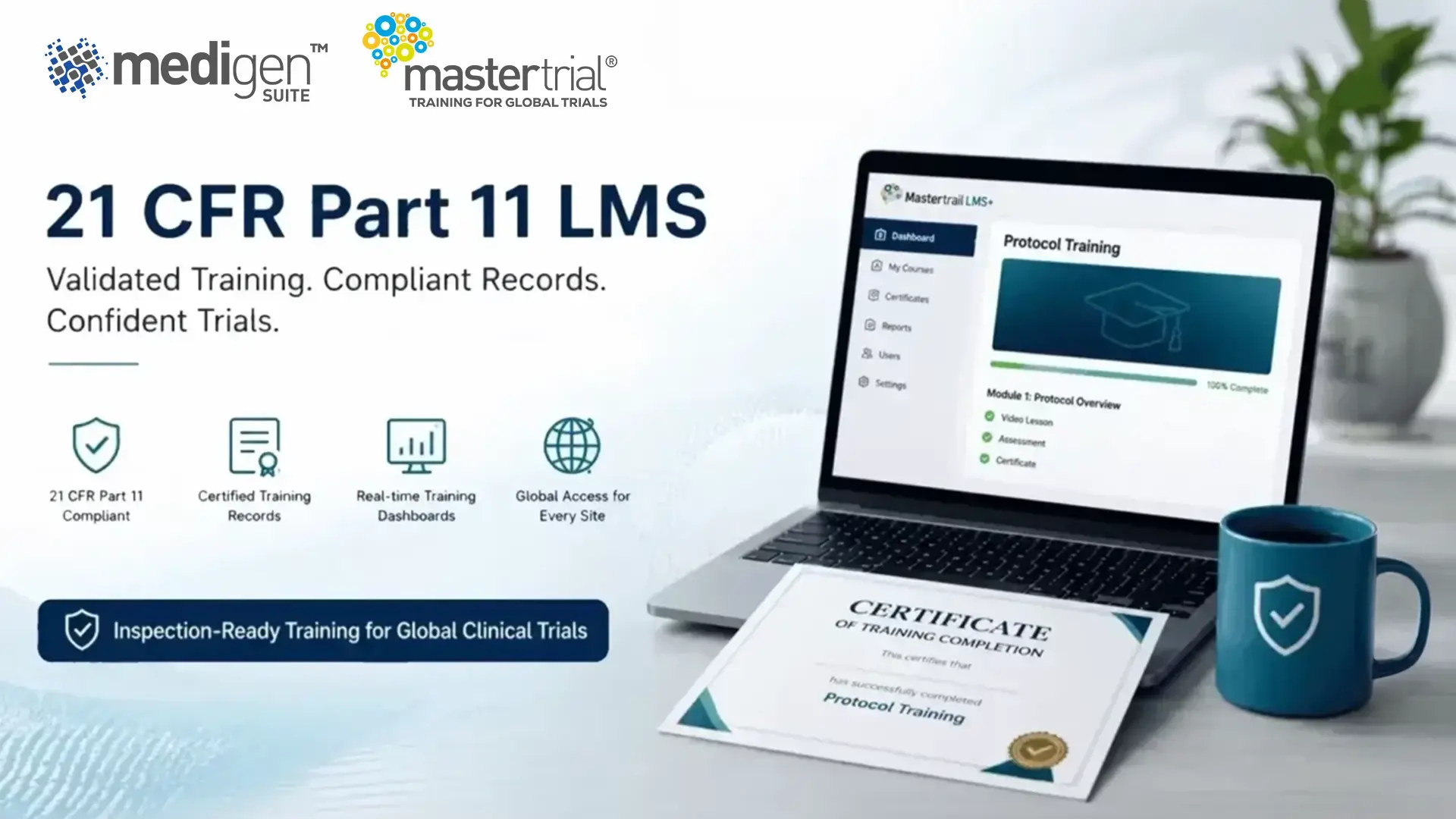
Clinical trial training is not just a logistical exercise. It is a regulated process that directly affects protocol compliance, inspection readiness, and study execution. Choosing a 21 CFR Part 11 LMS (Learning Management System) is therefore less about delivering online courses and more about creating a validated environment that produces trustworthy training records throughout the clinical trial lifecycle.
Sponsors and CROs conducting global studies need confidence that investigators, site coordinators, clinical research associates (CRAs), and sponsor personnel receive consistent protocol training while every completion record can withstand regulatory scrutiny. An LMS that lacks validation, traceability, or controlled documentation can quickly become a compliance risk instead of an operational advantage.
Build a Stronger 21 CFR Part 11 LMS Validation Strategy
An inspector asks for proof that every investigator at every site completed protocol training before enrolling the first subject. If that proof lives in scattered PDFs, sign-in sheets, and someone’s email inbox, the answer takes days to assemble instead of minutes. This is the moment sponsors and CROs discover whether their training infrastructure was ever built to withstand scrutiny.
A 21 CFR Part 11 LMS is the answer to that gap. It is a learning management system engineered so that every training record, electronic signature, and completion certificate meets the FDA’s requirements for electronic records and signatures. For clinical trial teams running multicenter studies, this is not a nice-to-have. It is the difference between a clean audit and a finding that delays a submission.
Why Training Documentation Is a Regulatory Exposure Point
Training gaps are among the more common findings in FDA inspections and sponsor audits, because training is often treated as an administrative task rather than a regulated process. When a site coordinator cannot produce a dated, signed record showing they completed protocol training before study start, the inspector has grounds to question data integrity across that site’s entire dataset.
The stakes compound in global multicenter studies, where dozens or hundreds of sites each generate their own training paperwork. Without a centralized, standardized system, sponsors have no reliable way to confirm that every investigator, sub-investigator, and study coordinator received consistent, role-appropriate protocol training, on time, with a traceable record. Instructor-led training sessions, in particular, can introduce scheduling delays that push back site activation and leave gaps in documentation when a session is missed or rescheduled.
A validated LMS reframes training from a paperwork exercise into a controlled process with the same rigor applied to EDC (electronic data capture) systems or eTMF (electronic trial master file) content.
What “Validated” Actually Means for an LMS
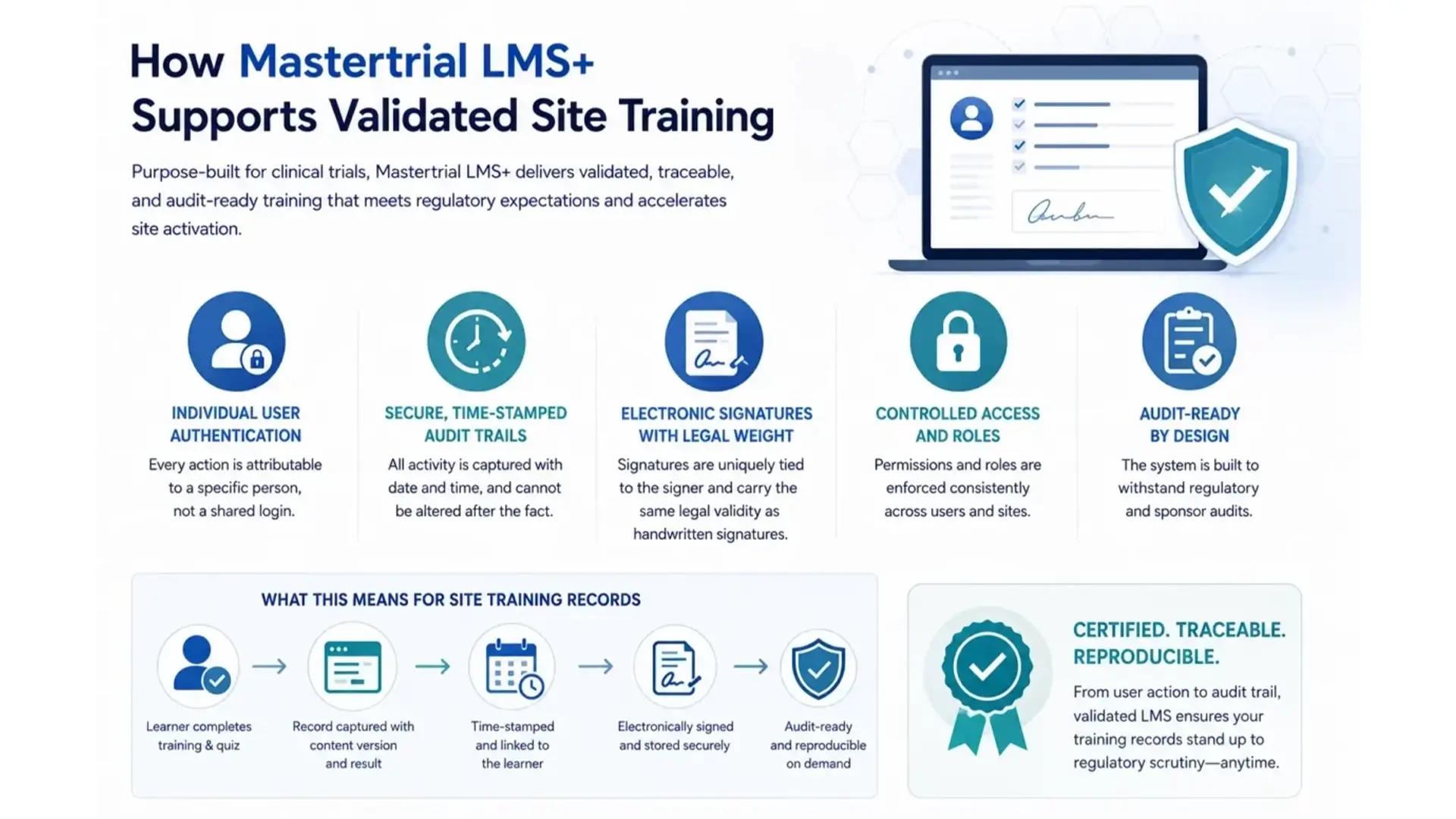
Vendors use “validated” loosely. In a regulated clinical context, it has a specific meaning tied to 21 CFR Part 11, which governs electronic records and electronic signatures used in FDA-regulated environments. A system operating under Part 11 principles needs to demonstrate, among other things:
- Individual user authentication, so every action in the system is attributable to a specific person, not a shared login
- Secure, time-stamped audit trails that cannot be altered after the fact
- Electronic signatures that carry the same legal weight as a handwritten signature, tied to the identity of the signer
- Controlled access, so permissions and roles are enforced consistently across users and sites
For site training specifically, this translates into training records that are certified, traceable, and reproducible on demand. A learner completing a protocol module and passing an embedded quiz should generate a record that an auditor can pull up months later, showing who trained, on what version of the material, when, and with what result.
Protocol Amendments and the Retraining Problem
Protocols change. Amendments happen mid-study, sometimes more than once, and each one can trigger a retraining requirement across every active site. This is where many training approaches break down. If the original training was delivered in person, retraining the same study personnelon an amendment means rescheduling sessions across time zones, tracking who attended, and manually updating records.
A study-specific training program built into an LMS handles this differently. When a protocol amendment goes live, the updated module is pushed to the relevant learner population, completion is tracked automatically, and a new certified record is generated the moment each learner passes the associated quiz. No sign-in sheets and no manual reconciliation of spreadsheets.
Comparing Training Approaches for Site Activation
The table below outlines how common approaches to investigator and site training compare against the requirements a validated LMS is built to meet.
| Approach | Individual Authentication | Audit-Ready Records | Retraining on Amendments | Speed to Site Activation |
| In-person instructor-led training | Manual (sign-in sheets) | Inconsistent, paper-based | Requires rescheduling sessions | Slow, dependent on scheduling |
| Generic corporate LMS (non-validated) | Yes, but not Part 11 aligned | Limited audit trail depth | Manual reassignment | Moderate |
| Validated 21 CFR Part 11 LMS | Yes, per-user credentials | Automated, time-stamped, certified | Automatic push and tracking | Fast, remote, anytime access |
The pattern is consistent: general-purpose systems can deliver content, but they may not be built to produce the kind of documentation an FDA inspector or sponsor auditor expects to see.
How Mastertrial LMS+ Supports Validated Site Training
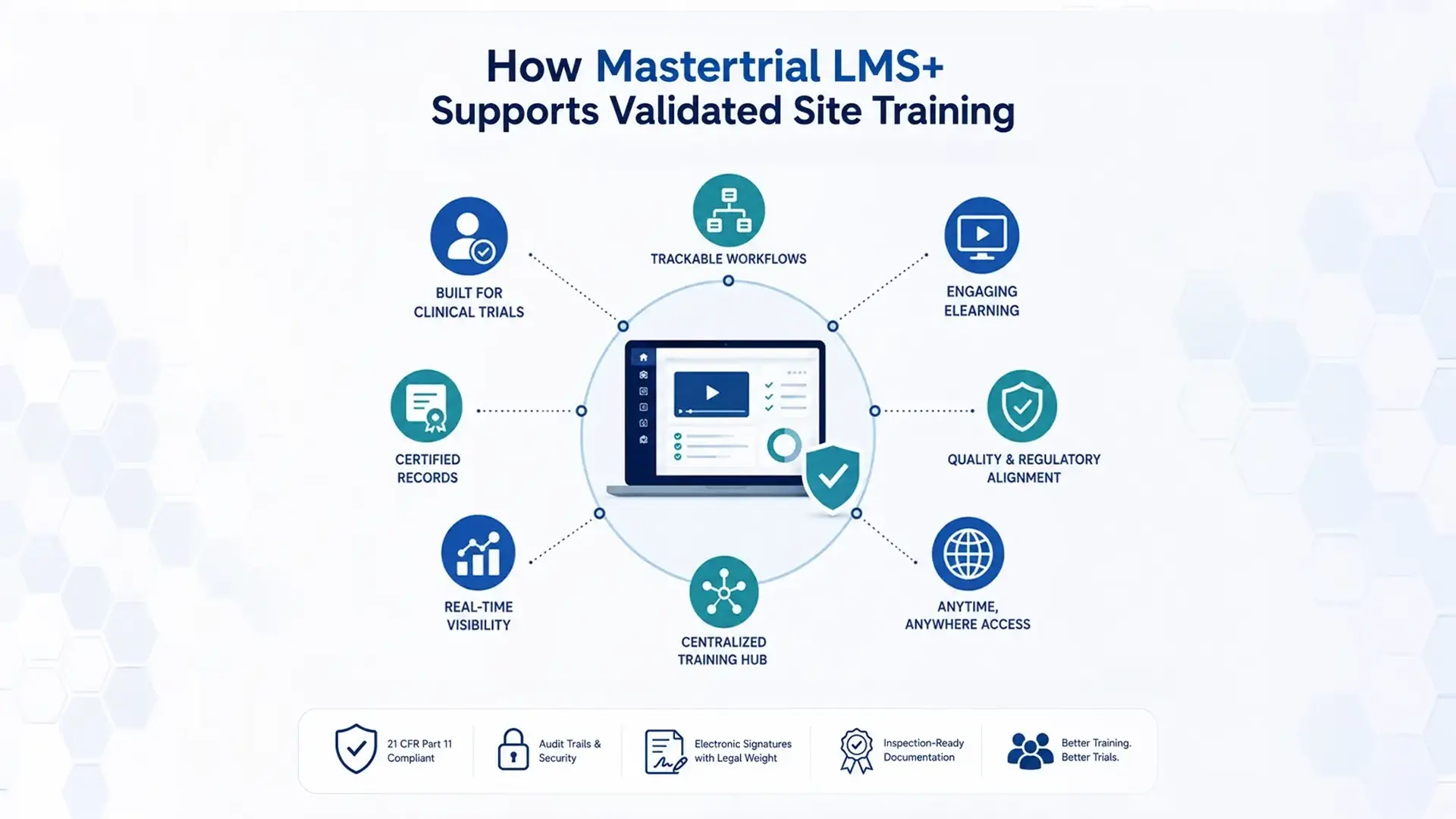
Mastertrial LMS+ is built specifically for clinical trial investigator and site training, not adapted from a corporate learning platform. It supports protocol training, system onboarding, and protocol amendment training as distinct, trackable workflows, which matters when a sponsor needs to prove that retraining happened after an amendment, separately from initial onboarding.
The platform delivers structured, video-based eLearning modules with integrated quizzes, so learner understanding is checked at the point of training rather than assumed. Every completion automatically generates a certified training record, with support for customized training certificates that match sponsor or CRO branding and documentation standards. Individual user authentication ensures every record is attributable to a specific investigator, CRA, study monitor, or sponsor team member, not a shared account.
Because training programs are developed within a quality framework aligned with ICH GCP training expectations, ISO 14155 clinical investigation standards, ISO 9001 quality management principles, and ISO 14971 risk management principles, the resulting documentation holds up under the same scrutiny applied to other regulated trial systems. Real-time training completion dashboards give sponsors and CROs visibility into which sites and individuals have completed required training at any point in the study, rather than waiting for a manual roll-up before an audit.
Training is centralized across study protocols, protocol amendments, EDC systems, ePRO tools, medical devices, wearables, study workflows, operational procedures, imaging core labs, and specialized vendors, so a site does not need a separate system for each training requirement. Because it is delivered remotely through an anytime, anywhere eLearning platform, new site personnel can be onboarded throughout the study lifecycle without waiting for the next scheduled instructor-led session, which helps accelerate site activation timelines.
The Compliance Angle: Why This Matters at Inspection Time
Regulatory inspection readiness is not something a team can build retroactively once an inspection is announced. It depends on records that were correct and traceable from the moment training occurred. A 21 CFR Part 11 LMS produces exactly that kind of record by design: time-stamped, attributable to an individual, and generated automatically rather than assembled after the fact from disparate sources.
This also supports sponsor oversight obligations under ICH GCP, which require sponsors to confirm that investigators and site staff are qualified and trained for the protocol they are running. A centralized, validated LMS gives sponsors a single source of truth for that confirmation across every site in a multicenter or global study, rather than relying on site-by-site self-reporting.
Choosing the Right Approach for Your Study
For a single-site, early-phase study with a small, stable investigator team, the documentation burden may be manageable with more manual methods, though the risk of gaps remains. For any multicenter or global study, and for any program expecting FDA inspection at some point, a validated LMS is the more defensible choice from day one, not a retrofit applied after a finding.
The questions worth asking before choosing a system: Does it enforce individual user authentication? Does it generate certified, time-stamped records automatically? Can it push updated training the moment a protocol amendment is approved? Does its quality framework reference ICH GCP, ISO 14155, ISO 9001, or ISO 14971? If the answer to any of these is no, the system was not built for this use case.
Standardized, validated training also reduces variability in investigator education across sites, which supports more consistent protocol adherence and, ultimately, cleaner data across the study.
See Mastertrial LMS+ in Action
If your team is evaluating how to bring investigator and site training up to the standard your next inspection will expect, it is worth seeing how a purpose-built system handles it in practice. Visit the Mastertrial LMS+ page within Medigen Suite or request a demo to walk through protocol training, amendment retraining and audit-ready reporting with your own study scenario in mind.
Latest Articles

A Proven Hybrid Clinical Trial Model for Global Compliance
Table of Contents: A Proven Hybrid Clinical [...]

ALCOA++ Data Integrity Principles for Cleaner Clinical Trial Data
Table of Contents: Every regulatory submission rests on [...]
How a Dedicated ePRO App Can Strengthen Patient Data Quality
Table of Contents: ePRO Apps Deliver Cleaner [...]