
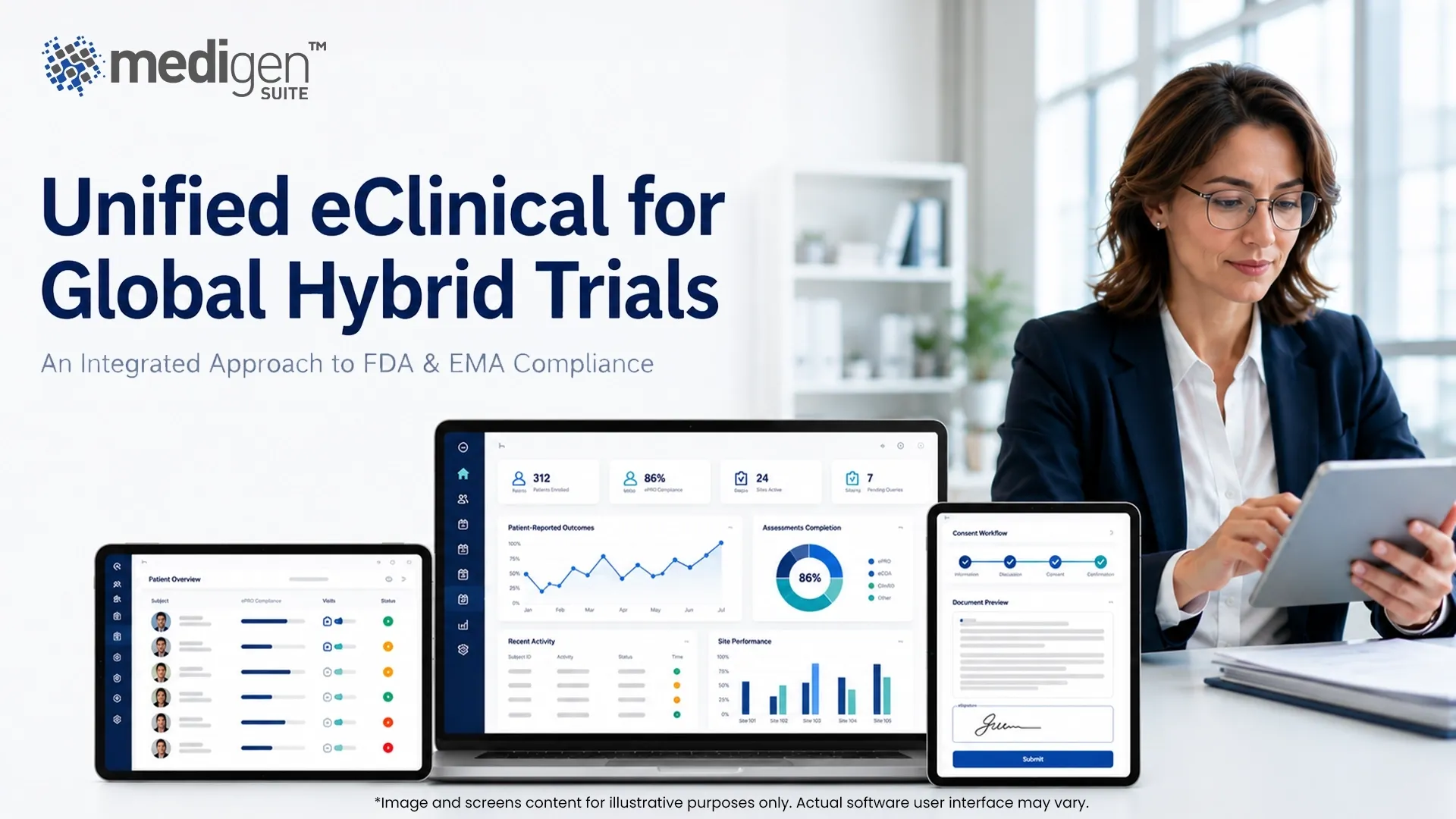
Hybrid Clinical Trials: Combining On-Site and Remote
Sponsors conducting multi-regional clinical trials face dual imperatives: delivering the flexibility and convenience patients demand while maintaining the rigorous oversight, safety monitoring, and data integrity expected by global regulators. A thoughtfully designed hybrid clinical trial, combining in-person and remote elements, fits the requirements of most protocols more closely than either extreme.
When executed effectively, this approach can drive faster enrollment, improved retention, and high-quality data that withstands scrutiny across jurisdictions. The result is a more patient-centric, efficient, and compliant study that supports successful regulatory submissions.
Why the Hybrid Model Has Become the Preferred Standard
Fully decentralized trials are generally suitable for a limited subset of investigational products or interventions with straightforward administration and well-established safety profiles. For most studies involving complex dosing regimens, in-clinic assessments, or specialized sample collection, a hybrid clinical trial model often provides an appropriate balance between participant convenience and the need for on-site oversight.
This model preserves essential site-based activities for safety and data quality while shifting suitable elements, such as patient-reported outcomes, routine check-ins, consent discussions, and certain clinician assessments, to convenient remote and digital channels. Sponsors benefit from broader patient participation without compromising the scientific rigor regulators require.
EMA vs. FDA: Comparing Regulatory Approaches to Decentralized Clinical Trials
The FDA’s September 2024 guidance, Conducting Clinical Trials with Decentralized Elements defines decentralized elements as trial-related activities occurring at locations other than the traditional site, and contemplates fully decentralized designs for investigational products with well-characterized safety profiles that do not require complex administration or in-person assessment.
The EMA’s Recommendation Paper on Decentralised Elements in Clinical Trials, first published in December 2022 and updated in October 2025, takes a different starting point, framing decentralization as the use of technology to make trials more accessible and participation more convenient, rather than defining it by location. Because EU trials span multiple member states with their own national guidance, the EMA’s framework generally leans toward hybrid designs over fully remote ones, and is explicit that sponsors and investigators retain their respective responsibilities for participant safety under ICH E6, regardless of whether activities are conducted on-site or remotely.
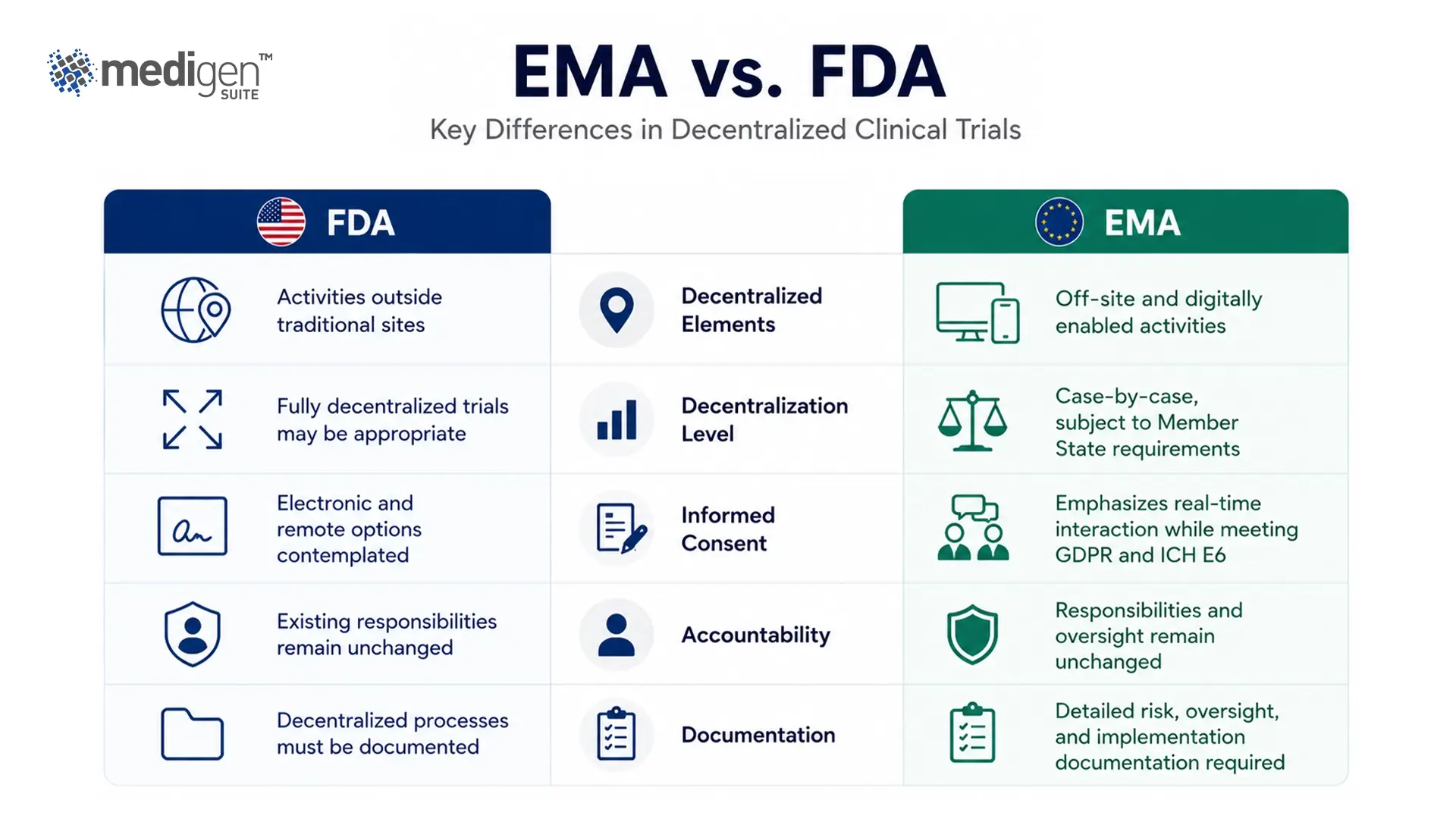
The practical takeaway: a decentralized or hybrid clinical trial model built only around FDA recommendations may require adaptation for use in the EU, particularly because implementation is also shaped by Member State requirements. Sponsors running trials across both regions should develop a unified design that satisfies the applicable FDA, EU, and national requirements from the outset.
Benefits and the Regulatory Flexibility that Enables Them
The benefits of a hybrid clinical trial depend partly on the regulatory framework within which a sponsor is designing the trial.
Under the FDA’s framework, sponsors of well-characterized products can lean further into remote data collection and even remote consent, potentially widening the eligible patient pool to include people who live far from a site, have mobility limitations, or cannot take time off during the day. That can improve recruitment and lower dropout, since patients are not carrying the full burden of in-person visits.
Under the EMA’s framework, the benefit may appear differently. Because decentralized elements are assessed case by case and remain subject to Member State requirements, hybrid designs may often be more practical than fully remote ones. The gains are therefore less about eliminating site visits and more about making the essential visits more efficient, supported by continuous data collection between them. Electronic patient-reported outcome (ePRO) tools capture symptom and quality-of-life data daily rather than relying on a patient’s recall of the past two weeks at a single visit, potentially improving data quality regardless of which framework a sponsor is designing under.
Risks Embedded in the Compliance Gaps Between FDA and EMA Requirements
Most of the risk in a hybrid clinical trial model does not come from the concept itself. It comes from designing around one regulator’s flexibility and assuming it will satisfy the other’s requirements.
The clearest example is informed consent: an FDA-compliant remote eConsent workflow may not automatically satisfy applicable EU and Member State expectations concerning real-time interaction, participant choice, data protection, and documentation. A second is accountability. Both regulatory frameworks make clear that sponsors and investigators retain their respective oversight responsibilities whether an activity is remote or on-site. A hybrid design therefore needs documented oversight for each delegated remote task. A third is documentation burden itself: EU clinical trial applications may require decentralized elements, consent procedures, and task locations to be described in sufficient detail for regulatory and ethical review. The FDA also expects these processes to be documented, although not necessarily in the same form.
Sponsors that build their hybrid clinical trial model against a single framework may discover these differences only once a second region’s ethics committee or IRB reviews the protocol.
The Hidden Cost of Fragmented eClinical Systems
Even sponsors that understand these regulatory gaps may still encounter them operationally, because the ePRO tool, the eCOA tool, and the consent platform were bought from three different vendors at three different times. Each system keeps its own audit trail. Reconciling them into one coherent record for a monitoring visit or an inspection becomes a manual exercise that eats into the timeline savings the hybrid model was supposed to deliver in the first place.
This is the operational cost that rarely makes it into a regulatory comparison but can affect hybrid clinical trial models in practice: differences between FDA, EU, and national requirements are already complex to manage on paper. Managing them across systems that were not designed to share a common data model can make the process harder still.
Built for Both Frameworks: How Medigen Suite Helps Close the Gap
This is the problem Medigen Suite is designed to address, by keeping patient-reported data, clinician-reported data, and consent documentation inside one platform instead of three.
Catchtrial ePRO captures patient-reported outcomes on the schedule a protocol requires, whether that means daily symptom logs or periodic quality-of-life instruments. Every entry carries a time stamp against a single audit trail, so the continuous data collection that supports both FDA and EMA expectations does not depend on reconciling exports from a separate patient-facing app after the fact.
Catchtrial eCOA extends that same audit trail to clinician-reported and observer-reported assessments, supporting consistent administration of the same instrument whether a visit happens at the site or remotely. For sponsors running a hybrid clinical trial model, this helps reduce data-quality risks arising from inconsistent assessment methods across different settings.
Catchtrial eConsent supports documented electronic consent workflows aligned with applicable FDA and EU requirements. Its audit-trailed processes help sponsors document consent activities consistently, reducing the need to reconstruct records when submissions undergo regulatory review.
Medigen Suite ties these three data streams, ePRO, eCOA, and eConsent software, into a single system of record rather than treating them as disconnected point solutions. For a sponsor running a hybrid clinical trial model across both US and EU sites, that means one audit trail a monitor or inspector can review, one place where accountability for remote and on-site activities is documented consistently, and one vendor relationship instead of three separate integration projects. It helps bridge the gap between a hybrid model described in the protocol and one that remains traceable and inspection-ready in practice.
Meeting FDA and EMA Requirements Without Rebuilding Your Stack
Regulatory credibility in this space depends on details that are easy to overlook until an inspection or audit identifies them: 21 CFR Part 11 compliant electronic signatures, complete audit trails, and data handling that satisfies GDPR for any EU-collected data. A hybrid clinical trial model that relies on disconnected tools can create gaps between system records, making end-to-end traceability more difficult. Building on a platform designed around ICH GCP principles from the outset can reduce the risk of findings that may delay a submission.
Choosing Between Hybrid and Fully Decentralized Designs
The right hybrid design depends on the investigational product’s safety profile, the patient population’s access to technology, and the regulatory footprint of the trial. A study running only in the US may have greater scope for full decentralization than one spanning both US and EU sites, where the design needs to satisfy all applicable EU, US, and Member State requirements from day one. Sponsors evaluating their next protocol should map out which activities genuinely require a site visit, then work backward to determine what proportion of the trial can move to remote or hybrid delivery without compromising participant safety, data quality or regulatory acceptance.
If you are designing a hybrid clinical trial model for a multi-region study, it is worth reviewing how your current ePRO, eCOA, and consent tools would hold up under both FDA and EMA scrutiny. Visit the Catchtrial ePRO and Catchtrial eCOA product pages, or request a Medigen Suite demo, to explore how an integrated platform can address requirements across both regulatory regions.
Table of Contents
- Hybrid Clinical Trials: Combining On-Site and Remote
- Why the Hybrid Model Has Become the Preferred Standard
- EMA vs. FDA: Comparing Regulatory Approaches to Decentralized Clinical Trials
- Benefits and the Regulatory Flexibility that Enables Them
- Risks Embedded in the Compliance Gaps Between FDA and EMA Requirements
- The Hidden Cost of Fragmented eClinical Systems
- Built for Both Frameworks: How Medigen Suite Helps Close the Gap
- Meeting FDA and EMA Requirements Without Rebuilding Your Stack
- Choosing Between Hybrid and Fully Decentralized Designs
Latest Articles

21 CFR Part 11 password requirements: what the regulation actually says
A 90-day password change is not a 21 CFR [...]
Clinical trial software for the connected study stack
Clinical trials are generating more data from more sources, [...]

A practical guide to the main types of clinical trials
The type of clinical trial you run shapes almost [...]
This article provides general information and does not constitute regulatory, legal, clinical, or compliance advice. Requirements and appropriate processes may vary by study, product, jurisdiction, and organization. Medigen Suite functionality should be used in accordance with applicable regulations, study documentation, and internal procedures.