
A study database can pass technical checks and still be unsuitable for the protocol it is meant to support. Clinical trial UAT, or user acceptance testing, checks whether the study-specific configuration meets approved requirements before the system is used for live trial activities.
For sponsors, CROs, and data managers, the question is not simply whether a form opens. It is whether users can complete the intended workflow, access the right records, and handle exceptions as planned, with evidence to support the go-live decision.
Why Clinical Trial UAT Matters After Study Build
A completed clinical study build is not the same as an accepted study configuration. Electronic data capture (EDC) platforms combine standard software functions with protocol-specific settings, including electronic case report forms (eCRFs), visit schedules, permissions, edit checks, and sometimes enrollment or randomization logic.
A vendor’s internal software testing addresses different questions from acceptance testing by the team responsible for the study. For example, a field may save successfully, yet its permitted values or conditional display rules may not match the approved annotated CRF. The software function works, but the study requirement remains unmet. Vendor-side testing is covered in more depth in our guide to computer system validation for clinical trial software.
Consider a hypothetical multicenter device study with varied site roles and a specific screening pathway. Testing isolated screens would not establish whether eligible participants can progress through planned visits or ineligible participants are blocked.
UAT can find these mismatches while there is still time to correct and retest them.
Build Clinical Trial UAT Test Cases From Approved Study Requirements
A reliable test protocol starts with the study’s actual requirements, not a generic software checklist. Before execution, teams should agree which documents define the expected behavior and which configuration version is under review.
Typical inputs include the protocol, annotated CRF, data management plan, study-specific requirements, user-access matrix, edit-check specifications, alert rules, and randomization specifications where applicable.
Each test case identifies its objective, requirement, prerequisites, user role, actions, and expected results. Clear acceptance criteria make results testable.
For example, “The eligibility workflow behaves correctly” is too broad. “When an exclusion criterion is met, the participant cannot proceed to randomization” is testable, provided that rule exists in the approved requirements.
Traceability matters as well. The European Medicines Agency’s (EMA) 2023 guideline on computerized systems states that trial-specific configurations should be documented and tested before production release, with requirements linked to test cases or equivalent activities according to risk [1]. The same traceability supports clinical data management guided by ALCOA++ once the study is live.
The UAT/PQ plan should also identify the test environment, configuration and software versions, intended execution period, responsible reviewers, evidence expectations, and acceptance criteria.
Test the Workflows That Matter Most to Data Quality
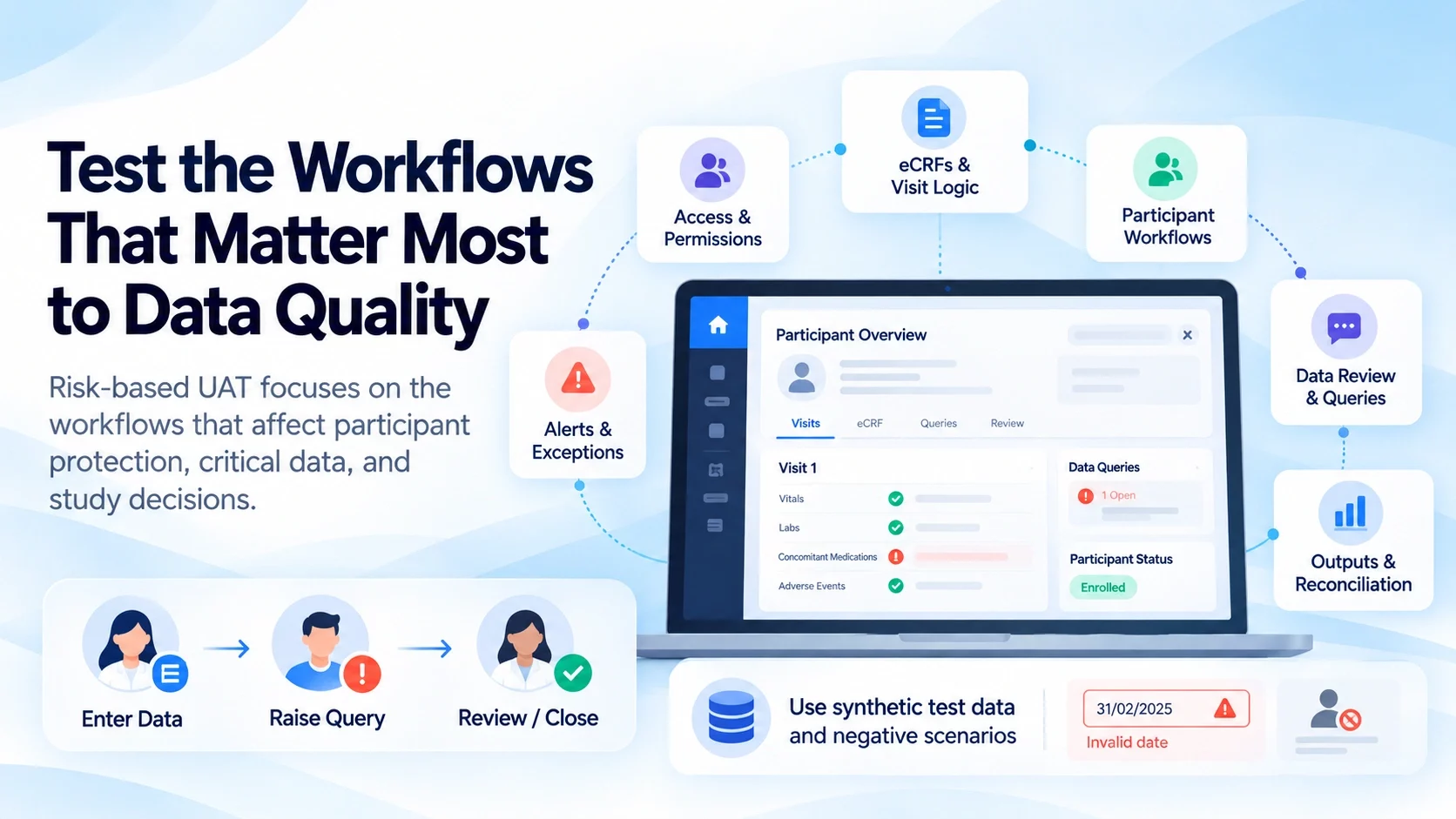
Risk-based UAT in clinical data management focuses on what could affect participant protection, critical data, and study decisions. Routine presentation checks have a place, but greater attention belongs to workflows that create or change clinically significant records.
A practical study-specific test scope may include:
- Study access and permissions: Confirm that authorized roles see the correct study, sites, records, and permitted actions, including restrictions on unauthorized operations.
- eCRFs and visit logic: Check fields, labels, permitted values, mandatory entries, conditional displays, and the relationship between forms and visits.
- Participant workflows: Verify identifier generation, screening, eligibility, enrollment, and randomization where those functions are configured.
- Data review and queries: Exercise query creation, response, follow-up, and closure using the intended user roles.
- Alerts and exception handling: Confirm that configured warnings and notifications occur under the specified conditions and reach the intended recipients.
- Outputs and reconciliation: Review applicable reports, exports, and any interfaces against approved expectations.
Use representative synthetic test data, including negative scenarios. Invalid dates, unmet eligibility criteria, and unauthorized actions can expose issues missed by routine data entry.
These tests should follow realistic user journeys. One role may enter data, another raise a query, and a third review or close it.
Distinguish Verification, UAT, and the Release Decision
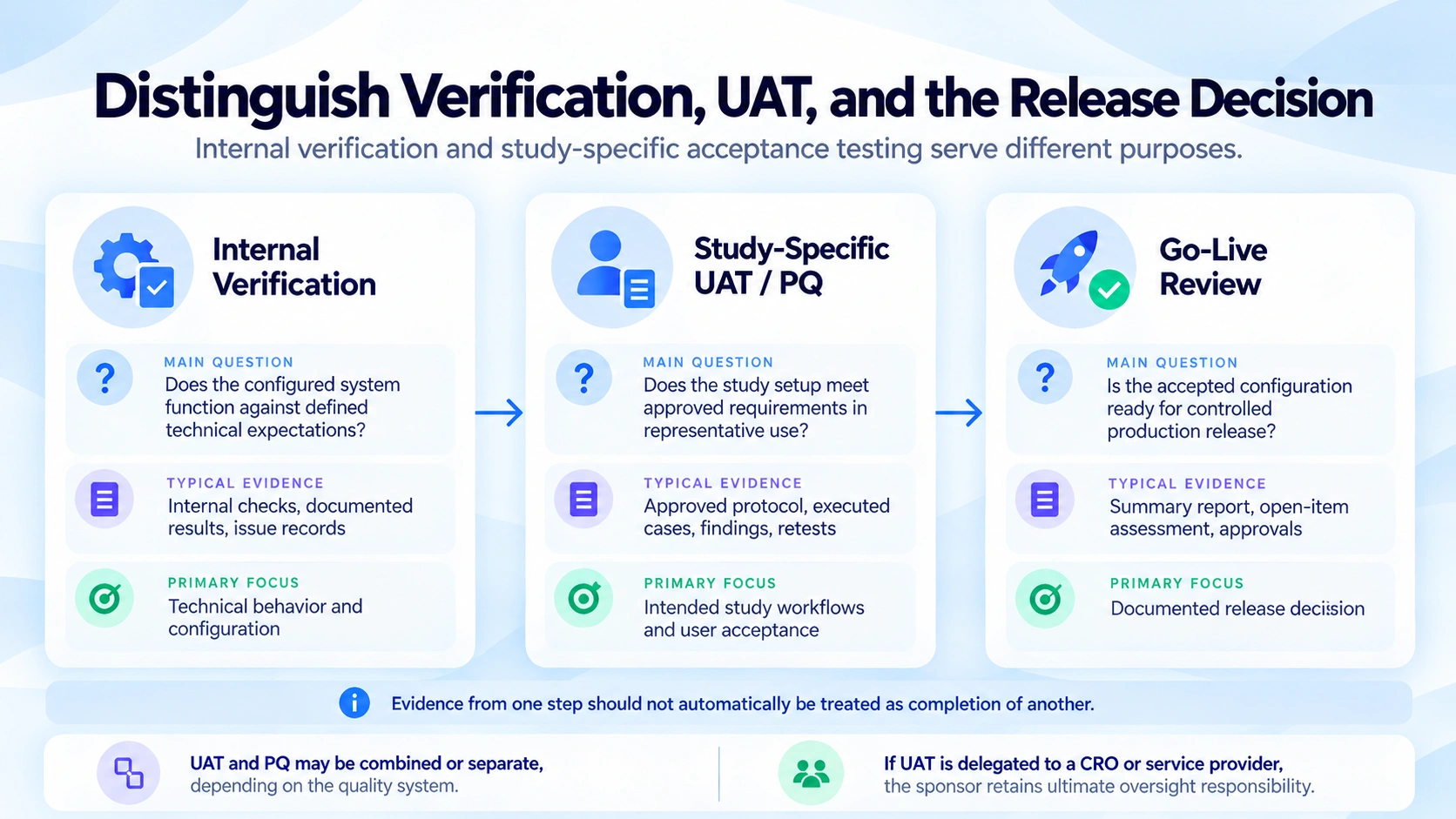
Internal verification and study-specific acceptance testing serve different purposes. The steps are related, but evidence from one should not automatically be treated as completion of another.
| Activity | Main question | Typical evidence | Primary focus |
| Internal verification or operational qualification | Does the configured system function against defined technical expectations? | Internal checks, documented results, issue records | Technical behavior and configuration |
| Study-specific UAT or performance qualification | Does the study setup meet approved requirements in representative use? | Approved protocol, executed cases, findings, retests | Intended study workflows and user acceptance |
| Go-live review | Is the accepted configuration ready for controlled production release? | Summary report, open-item assessment, approvals | Documented release decision |
Some quality systems combine UAT and performance qualification (PQ); others use separate protocols.
Sponsor involvement is valuable because protocol owners and operational users can recognize mismatches that technical reviewers may not.
Where UAT execution is delegated to a CRO or service provider, the sponsor retains ultimate responsibility for its trial-related activities and appropriate oversight [2]. The applicable agreement and test plan should specify who executes tests, reviews evidence, addresses findings, and approves results.
Document Clinical Trial UAT Findings, Corrections, and Retests
A useful UAT report records both the result and the basis for accepting it. Each applicable step should receive a documented outcome such as PASS, FAIL, or N/A, together with attributable execution details. A non-applicable result needs a defensible rationale when its relevance might otherwise be unclear.
Evidence may include screenshots, reports, exported files, or references to controlled records. Traceability should connect the evidence to the relevant test case, step, executor, date, and configuration, so a reviewer can reconstruct what was checked.
Findings are part of normal controlled testing, not inherently a sign of poor study preparation. A structured log can record the requirement, affected form or field, observed result, proposed correction, responsible person, resolution date, and retest status.
A corrected field should be retested, and the team should consider whether related workflows require regression testing. A change to eligibility logic, for example, may warrant repeating the screening-to-enrollment pathway rather than only checking the edited field.
Not every open issue necessarily blocks release. Where the governing procedures allow it, residual findings require an explicit assessment of their impact, documented rationale, appropriate mitigation, and formal acceptance. An unresolved critical function should not be treated as passed merely because the planned launch date is approaching.
How Medigen Suite and Catchtrial EDC+ Support Clinical Trial UAT
The value of an EDC implementation process depends on how clearly the configured study can be checked against its intended use. Catchtrial EDC+ is designed for electronic management of clinical study data through configurable eCRFs and associated study workflows. The precise features available for a given project depend on its approved configuration and scope.
For a study using Catchtrial EDC+, acceptance testing can be organized around practical checkpoints: study identity and access, sites and contacts, roles and privileges, subject creation, eCRF content, query handling, and configured alerts. Eligibility, enrollment, randomization, and additional applications belong in the test plan only when applicable to the study.
Catchtrial EDC+ supports separate Preview and Production environments, so UAT with synthetic test data is designed to stay separate from live study records.
Within a Medigen Suite deployment, an agreed study build, a controlled Preview environment, documented test cases, and a findings-and-retest process can help clinical operations and data management teams review the same acceptance criteria. This approach may make the handoff to production more predictable, particularly when several roles contribute to testing.
The acceptance process still requires qualified reviewers, study-specific evidence, and formal approval. For an overview of the platform’s EDC scope, see the Catchtrial EDC+ product page.
Make the Final Go-Live Decision Risk Based and Traceable
The objective of UAT is documented readiness for intended use, not a claim that every conceivable scenario has been tested. Before release, teams should confirm that the applicable cases were executed, required evidence is available, significant findings have been addressed, and any accepted open items are justified.
Regulatory guidance reinforces this approach. ICH E6(R3) Annex 1 calls for risk-based validation of computerized systems (Section 4.3.4), including protocol-specific configurations, automated data-entry checks, and interfaces (Section 4.3.4(e)). Section 4.3.5 covers system release, including updates following protocol amendments [2].
For medical device investigations, ISO 14155:2026 establishes good clinical practice (GCP) requirements for the design, conduct, recording, and reporting of clinical investigations [5].
In the United States, FDA’s October 2024 guidance discusses expectations for trustworthy electronic systems, records, and signatures in clinical investigations [3]. Where 21 CFR Part 11 applies, Section 11.10 addresses validation, authorized access, audit trails, and other controls [4]. UAT contributes evidence within the broader control framework; it is not, by itself, a Part 11 compliance certificate.
The release record should identify the accepted configuration, approval authority, outstanding risks, and controlled path into production. Any material difference between the tested and deployed environments deserves assessment.
A well-planned UAT helps teams move from a functioning build to one evaluated for its intended workflows, and planning it early is one of the practical ways to reduce clinical trial start-up delays. To discuss how Medigen Suite and Catchtrial EDC+ could support your next study setup, request a demo.
Frequently Asked Questions
What is the difference between UAT and software validation in clinical trials?
User acceptance testing verifies that a study-specific system configuration meets approved requirements from the perspective of its intended use. Computerized system validation is broader and encompasses documented activities throughout the system lifecycle. UAT may contribute to validation evidence, but it does not replace technical verification, supplier assessment, change control, or other applicable validation activities.
Who should participate in clinical trial UAT?
UAT should involve appropriately qualified personnel who understand the study requirements and the workflows being tested. Depending on the project, participants may include sponsor representatives, clinical operations professionals, clinical data managers, and designated CRO personnel. Responsibilities should be established in the approved plan or quality procedures, including who executes tests, reviews findings, and approves the results.
How long does UAT take in clinical data management?
The duration of UAT depends on study complexity, the number of applicable workflows, configuration maturity, testing resources, and the findings requiring correction and retesting. A relatively straightforward EDC configuration may require less testing than a multicenter study with extensive edit checks, randomization, or external integrations. Scheduling should account for both execution and the formal acceptance process.
What happens if a clinical trial UAT test fails?
A failed UAT test should be documented, evaluated, and managed through the applicable issue or deviation process. The team should identify the affected requirement, assess the potential impact, and determine the necessary correction or mitigation. After implementation, the relevant functionality should be retested. Any unresolved findings require an appropriate documented disposition before the final acceptance decision.
Does UAT need to be repeated after a protocol amendment?
Not always. A protocol amendment requires an assessment of its impact on the configured system, followed by appropriate retesting where changes affect relevant functionality. Updates to eCRFs, visit schedules, edit checks, or eligibility logic may require targeted tests and regression testing. The scope should be documented through change control and risk assessment, considering both existing and newly collected data.
Does successful UAT demonstrate compliance with 21 CFR Part 11?
Successful UAT does not, by itself, demonstrate compliance with 21 CFR Part 11. Where the regulation applies, the organization must address the relevant requirements for electronic records and electronic signatures, including appropriate technical and procedural controls. UAT may contribute evidence that configured functionality performs as intended, but broader compliance obligations and regulatory applicability require separate assessment.
Regulatory and Guidance Sources
- European Medicines Agency (2023). Guideline on computerised systems and electronic data in clinical trials. EMA/INS/GCP/112288/2023. Annex 2, Sections A2.2 (User requirements), A2.3 (Trial specific configuration and customisation), A2.4 (Traceability of requirements), and A2.5 (Validation and test plans).
- International Council for Harmonisation (2025). ICH E6(R3) Guideline for Good Clinical Practice. Annex 1, Sections 3.3 (Allocation of Activities), 3.6 (Agreements, especially 3.6.6 and 3.6.9), 4.3.4 (Validation, including 4.3.4(e)), and 4.3.5 (System Release).
- U.S. Food and Drug Administration (October 2024). Electronic Systems, Electronic Records, and Electronic Signatures in Clinical Investigations: Questions and Answers.
- U.S. Code of Federal Regulations. 21 CFR § 11.10, Controls for closed systems.
- International Organization for Standardization (2026). ISO 14155:2026, Clinical investigation of medical devices for human subjects – Good clinical practice. Fourth edition, published March 23, 2026.
Table of Contents
Latest Articles

Unblinding in Clinical Trials Done Right, One Patient at a Time
A treatment assignment must remain concealed until disclosure is [...]

Where the Benefits of Electronic Data Capture Really Come to Life
Replacing paper case report forms does not automatically improve [...]
Practical Clinical Trial UAT Before Study Go-Live
A study database can pass technical checks and still [...]
This article provides general information and does not constitute regulatory, legal, clinical, or compliance advice. Requirements and appropriate processes may vary by study, product, jurisdiction, and organization. Medigen Suite functionality should be used in accordance with applicable regulations, study documentation, and internal procedures.