When pharmaceutical R&D costs are measured in billions, technology efficiency becomes a strategic issue rather than an IT detail. Deloitte’s 2025 analysis of the world’s 20 largest biopharma companies reported an average R&D cost of $2.23 billion per asset in 2024, while forecast returns on innovation reached 5.9%.[1]
For sponsors and CROs, this puts ROI from an eClinical platform into perspective. The opportunity is not simply to replace several software licenses with one. It is to create a more connected operating model that can reduce duplicated administration, unnecessary integrations, repeated data handling, and fragmented reporting across clinical development.
The Economics Make Efficiency Matter
Clinical development represents a substantial part of the investment required to bring a new therapy to market.
The U.S. Congressional Budget Office (CBO) reported that, in the development data it reviewed, a drug completing Phase I, II, and III trials incurred approximately $375 million in clinical trial costs. When spending on unsuccessful programs was included, average clinical trial expenditure rose to approximately $1.065 billion per approved new drug.[2]
These figures are not estimates of the savings available from clinical trial software. They illustrate the financial scale within which clinical technology operates.
At that scale, even relatively small improvements in operational efficiency can be commercially meaningful. Reducing repeated system configuration, manual reconciliation, reporting preparation, or technology maintenance does not need to transform the entire development budget to create value.
The business question is therefore straightforward: how much operational effort is required to run the technology supporting each trial, and how much of that effort can be simplified?
Clinical Trials Are Increasingly Global and Technology-Dependent
Scale adds another dimension to the ROI equation.
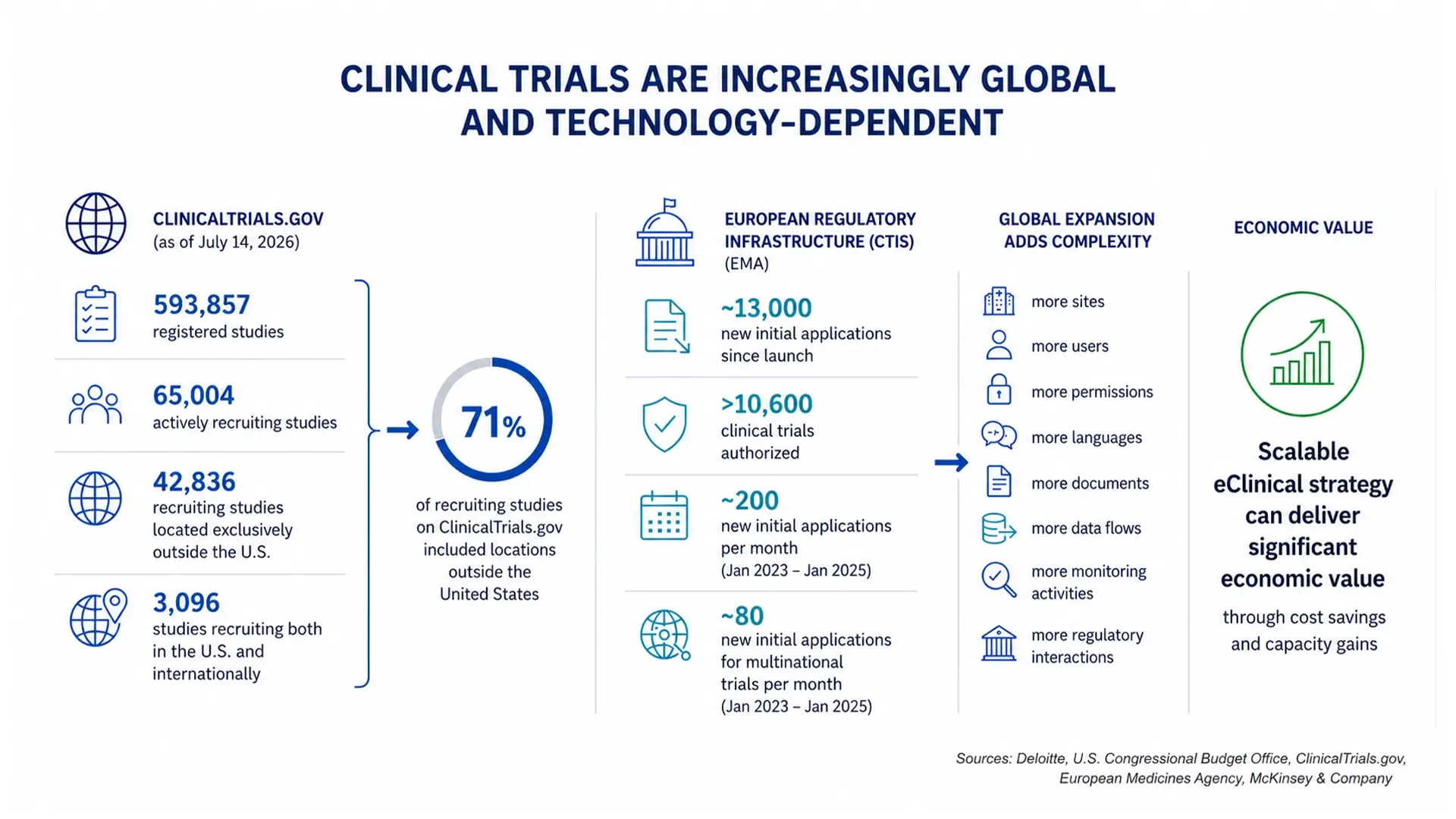
As of July 14, 2026, ClinicalTrials.gov listed 593,857 registered studies, including 65,004 actively recruiting studies. Of those recruiting studies, 42,836 were located exclusively outside the United States and another 3,096 included both U.S. and international locations. In other words, about 71% of recruiting studies listed on ClinicalTrials.gov included locations outside the United States.[3]
European regulatory infrastructure provides another indication of this scale. EMA reported that the Clinical Trials Information System (CTIS) had received nearly 13,000 initial applications since its launch, with more than 10,600 clinical trials authorized by EU Member States. Between January 2023 and January 2025, CTIS received around 200 new initial applications per month, approximately 80 of them for multinational trials.[4]
For a sponsor or CRO, global expansion can multiply sites, users, permissions, languages, documents, data flows, monitoring activities, and regulatory interactions.
A scalable eClinical strategy therefore has economic value not only because of what each application does, but because of how efficiently those applications work together.
Where the ROI of a Unified eClinical Platform Can Come From
A fragmented technology model may still contain excellent individual applications. The additional cost often appears at the boundaries between them.
The same study may require site information in an EDC and a CTMS. Users may require separate accounts and role assignments across applications. Operational reports may depend on exports from different systems. Data transferred between platforms may require interfaces, testing, monitoring, and reconciliation.
A unified approach can reduce some of those boundaries where workflows and data are designed to work together.
| ROI lever | Potential economic impact |
| Fewer system interfaces | Can reduce integration development, testing, maintenance, and troubleshooting effort |
| Coordinated user administration | Can simplify provisioning, role management, access reviews, and deprovisioning |
| Reusable study information | Can reduce repeated configuration and manual transfer of common study, site, and user data |
| Connected reporting | Can reduce the effort required to extract, combine, reconcile, and format information from multiple applications |
| More consistent workflows | Can simplify training and day-to-day navigation across related clinical processes |
| Consolidated vendor landscape | May reduce contracting, governance, support, and vendor-management activities |
| Coordinated change management | Can simplify the assessment and implementation of technology changes across connected functions |
| Portfolio scalability | Can help teams extend established processes across additional studies, sites, and users without equivalent growth in administrative effort |
These are ROI mechanisms, not guaranteed savings. Their financial value depends on the organization’s existing environment and how extensively workflows can actually be consolidated.
There Is Already Evidence That Clinical IT Modernization Can Reduce Cost
Independent commercial analysis provides useful evidence that modernizing clinical technology can translate into measurable IT savings.
McKinsey’s 2025 analysis of clinical-development IT reported that companies investing in upgrades to core clinical applications had achieved 20% to 30% reductions in IT costs, attributed to factors including lower maintenance requirements and more efficient use of cloud and software-as-a-service technologies.[5]
The same analysis is also useful because it cautions against treating modernization itself as the business case. McKinsey estimated that 40% to 50% of the top 20 pharmaceutical companies had invested heavily in modernizing clinical IT applications, while many had not yet established a clear ROI. Another 30% had modernized only one or two applications.[5]
That distinction matters.
Technology consolidation creates the opportunity for ROI. Process design determines whether the opportunity becomes measurable value.
A sponsor that replaces several applications but retains duplicate processes, manual reconciliation, and fragmented data ownership may capture relatively little benefit. A sponsor that uses a connected environment to simplify those processes has a stronger basis for measurable returns.
How Medigen Suite Brings These ROI Levers Together
Medigen Suite is structured as an integrated eClinical product family spanning complementary clinical trial workflows. The portfolio includes Catchtrial EDC+, Maptrial CTMS+, Fastrial AI+, Mastertrial LMS+, and Catchtrial Apps+, including ePRO, eCOA, and eConsent.
Rather than operating as isolated point solutions, these products are designed to work within the same broader environment. Clinical data captured in Catchtrial EDC+ can connect with operational and monitoring workflows in Maptrial CTMS+, while ePRO and eCOA extend the environment to patient-facing data collection.
This integration spans areas such as site management, user roles and privileges, access controls, queries, configurable edit checks, review activities, locking, and freezing. By connecting these functions across products, Medigen Suite can help reduce the need to manage related clinical and operational processes separately.
Reporting provides another integration point. Catchtrial’s Report Designer can use patient-level data, site-level information, user details, visits, and eCRF forms and fields within configurable reports, with reporting functionality also available across Maptrial Monitoring workflows.
The platform also includes structured exports for clinical data, queries, and audit trail information, making information generated within clinical workflows available for related review and analysis activities.
For prospective buyers, the ROI question is therefore whether bringing these complementary capabilities together can help reduce duplicate processes, manual handoffs, separate integrations, and administrative effort within the existing technology model.
This can be assessed during platform evaluation by mapping current applications, integrations, administrative processes, and reporting workflows against the operating model available through Medigen Suite.
Compliance Is Part of Total Cost of Ownership
Clinical technology also carries a governance requirement, which makes compliance relevant to ROI.
ICH E6(R3) Good Clinical Practice emphasizes quality by design, proportionate risk-based approaches, and systems and processes that are fit for their intended purpose. The Principles and Annex 1 have been effective in the EU since July 23, 2025.[6]
For electronic records subject to 21 CFR Part 11, controls for closed systems include validation, accurate and complete copies, record protection and retrieval, restriction of access to authorized individuals, secure time-stamped audit trails, and authority checks.[7]
FDA’s October 2024 guidance further addresses the use of electronic systems, records, and electronic signatures in clinical investigations and the controls needed for records to remain trustworthy and reliable.[8]
These requirements do not prescribe a single-platform model. They do demonstrate that regulated systems cannot be evaluated solely by license cost.
Every relevant system has to be governed according to its intended use. Interfaces, access, changes, records, and data flows also need appropriate control.
When a unified platform genuinely reduces the number of separate systems, interfaces, or administrative processes that an organization must govern, that reduction can form part of the total cost of ownership calculation.
Making ROI Measurable
The strongest commercial case for a unified platform starts with numbers from the buyer’s own environment.
Before implementation, an organization can establish a baseline covering technology spend, number of applications, interfaces, user accounts, administration hours, reporting effort, reconciliation activities, training requirements, support tickets, validation activities, and vendor-management effort.
The proposed future environment can then be measured against the same indicators.
This also separates cost savings from capacity gains. If a unified workflow reduces the hours required to prepare recurring study reports, the organization may save external costs, reduce overtime, or simply free experienced staff to focus on higher-value activities. Each represents economic value, but they should not be presented as the same type of return.
The result is a more credible ROI model because the value comes from measurable changes rather than generic platform claims.
From Technology Consolidation to Business Value
The broader industry figures make the commercial context clear: $2.23 billion average R&D cost per asset among the top 20 biopharma companies analyzed by Deloitte, hundreds of millions of dollars associated with clinical trial execution in the CBO analysis, more than 65,000 recruiting studies currently registered on ClinicalTrials.gov, and reported 20% to 30% IT cost reductions among companies modernizing core clinical-development applications.[1,2,3,5]
Against that background, the ROI case for unified eClinical platforms is not based on the promise that one system will transform the economics of a clinical trial.
It is based on something more practical: reducing the amount of technology-related work required to run clinical trials effectively at scale.
For sponsors and CROs, that means identifying where integrations, duplicated configuration, fragmented reporting, repeated administration, and separate governance activities consume resources today, then assessing which of those activities a unified platform can realistically simplify.
To explore how Medigen Suite can bring clinical trial workflows together within a unified eClinical environment, request a demo and evaluate the potential ROI against your current technology landscape.
Frequently Asked Questions
What is the ROI of a unified eClinical platform?
The ROI depends on the organization’s current technology and operating model. Potential value can come from lower IT and integration costs, reduced administrative effort, more reusable data, streamlined reporting, simplified vendor governance, and greater capacity to scale clinical operations. A credible calculation should compare measurable current-state costs and activities with the proposed future environment.
Is there evidence that modernizing clinical trial technology can reduce IT costs?
Yes, although results are organization-specific. McKinsey reported that companies in its analysis that modernized core clinical-development applications achieved IT cost reductions of approximately 20% to 30%, including through decreased maintenance and more efficient cloud and SaaS use.[5]
Why is technology consolidation relevant when clinical trials are so expensive?
Because technology costs sit inside a much larger development investment. CBO reported approximately $375 million in Phase I through III trial expenditure for a drug completing all three phases in the sample it reviewed, while Deloitte reported average R&D cost of $2.23 billion per asset among the top 20 biopharma companies in 2024.[1,2]
How should a sponsor build an ROI calculation?
Start with the current operating model and quantify the work surrounding the technology. Compare license and vendor costs together with integrations, administration, reporting, reconciliation, validation, training, support, and governance. The same measures can then be applied to the proposed platform architecture to calculate credible savings and capacity gains.
Evidence and Primary Sources
- Deloitte, Measuring the Return from Pharmaceutical Innovation 2025
- U.S. Congressional Budget Office, Research and Development in the Pharmaceutical Industry
- ClinicalTrials.gov, Trends and Charts on Registered Studies
- European Medicines Agency, Annual Report 2025, Human Medicines
- McKinsey & Company, Faster, Smarter Trials: Modernizing Biopharma’s R&D IT Applications
- European Medicines Agency, ICH E6(R3) Good Clinical Practice
- Electronic Code of Federal Regulations, 21 CFR Part 11
- U.S. Food and Drug Administration, Electronic Systems, Electronic Records, and Electronic Signatures in Clinical Investigations, October 2024
Table of Contents
Latest Articles
Unblinding in Clinical Trials Done Right, One Patient at a Time
A treatment assignment must remain concealed until disclosure is [...]
Where the Benefits of Electronic Data Capture Really Come to Life
Replacing paper case report forms does not automatically improve [...]
Practical Clinical Trial UAT Before Study Go-Live
A study database can pass technical checks and still [...]
This article provides general information and does not constitute regulatory, legal, clinical, or compliance advice. Requirements and appropriate processes may vary by study, product, jurisdiction, and organization. Medigen Suite functionality should be used in accordance with applicable regulations, study documentation, and internal procedures.