
Smarter Single Sign-On for Global Clinical Trial Systems
As clinical trials expand across countries, sites, systems, and external partners, managing digital access becomes harder to control. Single sign-on for clinical trial software promises a more coordinated authentication model, but its value depends on how well it works alongside role-based permissions, user lifecycle management, and security controls.
For sponsors and CROs evaluating global eClinical technology, the objective is therefore broader than reducing the number of passwords. The real consideration is how authentication fits into a controlled access strategy across the clinical trial environment.
Why Access Management Matters in Global Clinical Trial Software
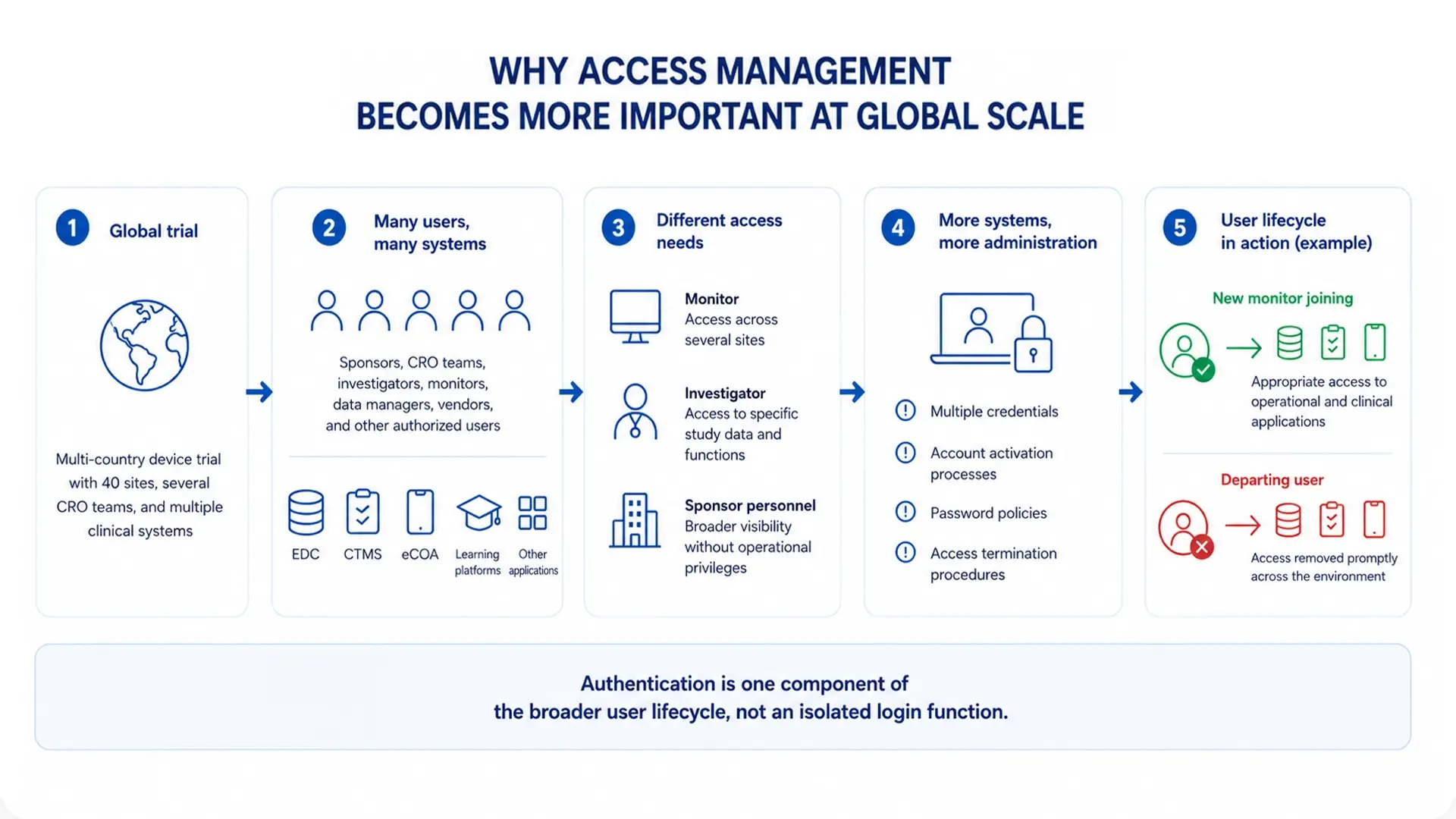
A global trial can involve sponsors, CRO teams, investigators, monitors, data managers, vendors, and other authorized users who need different levels of system access. Those users may work across electronic data capture (EDC), clinical trial management systems (CTMS), electronic clinical outcome assessment (eCOA), learning platforms, and other applications.
The underlying complexity is legitimate. A monitor may require access across several sites, while an investigator may need access only to specific study data and functions. Sponsor personnel may require broader visibility without the same operational privileges as site teams.
As the number of systems grows, separate authentication processes can add another administrative layer. Teams may need to manage multiple credentials, account activation processes, password policies, and access termination procedures.
Consider a hypothetical multi-country device trial involving 40 sites, several CRO teams, and multiple clinical systems. A new monitor joining the study may need appropriate access to operational and clinical applications, while a departing user may need access removed promptly across the environment.
The practical takeaway is that authentication should be considered as one component of the broader user lifecycle, not as an isolated login function.
What Single Sign-On Changes and What It Does Not
Single sign-on can centralize authentication, but it does not replace application-level authorization.
In a federated identity model, an identity provider authenticates a user and communicates authentication information to separately administered applications. Current NIST digital identity guidance describes federation as an approach through which identity information can be used across multiple relying parties.
That distinction between authentication and authorization is particularly important in clinical research.
Authentication answers: Who is this user?
Authorization answers: What is this user permitted to see or do?
A user may successfully authenticate through a centralized identity service while still requiring carefully configured study, site, role, and functional permissions inside the clinical application.
A well-designed single sign-on approach can therefore complement:
- Role-based access control
- Study and site assignments
- User activation and deactivation
- Multi-factor authentication where applicable
- Privilege management
- Access and activity reporting
- Audit trail controls
These elements work together. Centralized authentication alone does not determine whether an investigator can sign an eCRF, whether a monitor can review a particular site, or whether a sponsor user should have read-only access.
SSO vs Separate Credentials in Clinical Trial Systems
The right authentication model depends on the organization’s architecture, security policies, study ecosystem, and user population. SSO can be particularly relevant where the same workforce regularly accesses several connected applications, while separate authentication may remain appropriate for certain external or specialized user groups.
| Access consideration | Separate application credentials | Federated SSO approach |
| Authentication | Managed individually by each application | Authentication can be coordinated through an identity provider |
| User experience | Users may manage several credentials | Users may authenticate once for participating applications |
| Password administration | Distributed across systems | Can become more centralized depending on configuration |
| Application permissions | Defined within each system | Still requires appropriate authorization and role mapping |
| User deactivation | May require actions across individual systems | Central identity controls may simplify part of the process, depending on integration |
| External users | Can be handled directly by individual applications | Requires an appropriate federation strategy for external identities |
| Implementation | Less dependency on identity federation | Requires technical integration and identity governance |
| Security model | Depends on each application’s controls | Depends on both the identity provider and participating applications |
Neither model should be judged only by the number of clicks required to log in. For regulated clinical environments, traceability, authorization, account governance, security, and operational fit remain central considerations.
This is particularly relevant when selecting commercial clinical trial software. Buyers should evaluate not only whether SSO is available, but also how authentication interacts with study roles, site assignments, account provisioning, deprovisioning, and application-specific privileges.
Single Sign-On in Medigen Suite: Controlled Clinical Trial Access
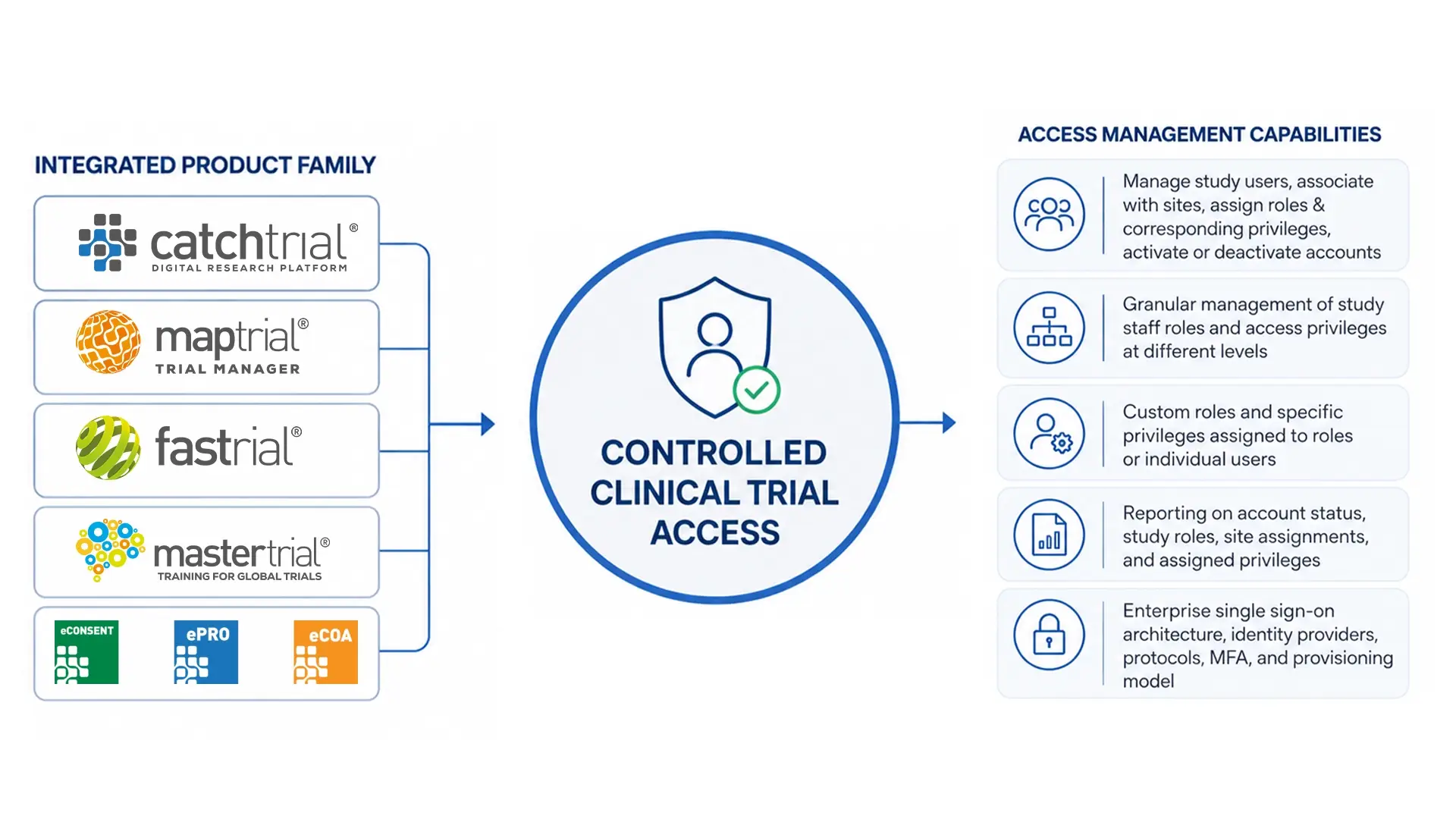
Medigen Suite brings key eClinical functions into an integrated product family spanning Catchtrial EDC+, Maptrial CTMS+, Fastrial AI+, Mastertrial LMS+, and Catchtrial Apps+.
Catchtrial and Maptrial include documented access-management capabilities that are relevant to a broader identity strategy. Administrators can manage study users, associate users with one or more sites, assign roles and corresponding privileges, and activate or deactivate accounts across preview and production environments.
The platform also supports granular management of study staff roles and access privileges at different levels of the study structure. Custom roles and specific privileges can be assigned to roles or individual users, supporting controlled access according to study responsibilities.
Additional reporting capabilities can document user account status, study roles, site assignments, and assigned privileges, which can contribute to access review and governance processes when configured accordingly.
For organizations where enterprise single sign-on is a procurement requirement, the supported SSO architecture, identity providers, authentication protocols, MFA interaction, and provisioning model should be confirmed for the intended Medigen Suite deployment.
SSO, Access Control and Regulatory Expectations
Regulated clinical systems require controlled access, but regulations generally focus on the integrity and control of electronic records rather than prescribing SSO as the required authentication architecture.
In the United States, 21 CFR Part 11 establishes requirements for electronic records and electronic signatures. For closed systems, §11.10 includes controls designed to limit system access to authorized individuals and authority checks intended to determine that only authorized individuals can use the system, electronically sign records, access operations or devices, alter records, or perform specific operations.
FDA’s October 2024 final guidance, Electronic Systems, Electronic Records, and Electronic Signatures in Clinical Investigations: Questions and Answers, provides current recommendations for electronic systems used in clinical investigations and addresses the trustworthiness and reliability of electronic records and signatures.
ICH E6(R3) Good Clinical Practice also reinforces the importance of proportionate controls for computerized systems and user access. In the European Union, the ICH E6(R3) Principles and Annex 1 have been effective since July 23, 2025.
For personal data subject to the General Data Protection Regulation (GDPR), Article 32 requires controllers and processors to implement appropriate technical and organizational measures according to risk. These measures address areas including the confidentiality, integrity, availability, and resilience of processing systems and services.
The distinction matters. SSO can form part of a controlled access architecture, but SSO by itself does not demonstrate appropriate authorization, auditability, electronic signature control, or data integrity.
Consider a hypothetical CRO employee who moves from one study team to another. Central authentication may remain unchanged, but the user’s application privileges should still reflect the new study assignment. The authorization change is therefore as important as the authentication event.
For sponsors and CROs, the stronger approach is to evaluate the complete access model: identity, authentication, authorization, traceability, and user lifecycle controls.
Choosing an Authentication Approach for Clinical Trial Software
SSO is most valuable when it fits naturally into a broader access governance strategy. The evaluation should begin with how users actually interact with the clinical technology environment rather than treating SSO as a standalone checkbox.
Key questions include whether the same users access multiple applications, how external site personnel are managed, how roles are assigned, how quickly access must change when responsibilities change, and how authentication events interact with electronic signatures and other controlled actions.
For multinational studies, scalability also matters. A model that works for a small internal team may need additional identity governance when hundreds of sponsor, CRO, site, and vendor users participate across different organizations.
The goal is a proportionate architecture that combines convenient authentication with precise authorization. When evaluating single sign-on in clinical trial software, a unified eClinical platform can help teams approach user access as part of the wider clinical workflow rather than as a disconnected IT task.
Medigen Suite is designed around a coordinated eClinical environment with configurable user, role, site, and privilege management across key clinical workflows. To discuss your access-control requirements, integration architecture, and options for global studies, request a Medigen Suite demo.
Frequently Asked Questions
What is single sign-on in clinical trial software?
Single sign-on is an authentication approach in which a user authenticates through a central identity service and can then access participating applications without completing a separate full authentication process for each one. In clinical trials, SSO should operate alongside application-specific roles, permissions, site assignments, and other authorization controls rather than replacing them.
Is single sign-on required by 21 CFR Part 11?
No. 21 CFR Part 11 does not prescribe single sign-on as a required authentication method. It establishes controls for electronic records and signatures, including limiting system access to authorized individuals and applying appropriate authority checks. An SSO architecture can form part of that control environment, but compliance depends on the complete system and procedural configuration.
Does SSO replace role-based access control?
No. SSO primarily addresses authentication, while role-based access control determines what an authenticated user is authorized to access or perform. Clinical trial systems still need appropriately configured roles and privileges. Within Medigen Suite, Catchtrial and Maptrial provide configurable role, user, site, and privilege management for this purpose.
What should sponsors evaluate when comparing SSO options?
Sponsors should evaluate identity-provider compatibility, authentication protocols, MFA requirements, user provisioning and deprovisioning, external-user handling, role mapping, electronic-signature interactions, auditability, and business-continuity procedures. The appropriate configuration depends on the organization’s security architecture, study model, and mix of internal and external clinical trial users.
Why does SSO matter when evaluating commercial clinical trial software?
SSO can become important when clinical teams regularly move between several systems and organizations want a more coordinated authentication model. Its value should be assessed together with role-based permissions, account lifecycle management, audit capabilities, and system integration. A convenient login process is useful, but controlled authorization remains essential in regulated clinical environments.
Primary Regulatory Sources
- 21 CFR Part 11, Electronic Records; Electronic Signatures, particularly 21 CFR §11.10, Controls for Closed Systems
- U.S. Food and Drug Administration, Electronic Systems, Electronic Records, and Electronic Signatures in Clinical Investigations: Questions and Answers, Final Guidance, October 2024
- ICH E6(R3), Guideline for Good Clinical Practice, Principles and Annex 1
- Regulation (EU) 2016/679, General Data Protection Regulation (GDPR), Article 32, Security of Processing
Table of Contents
Latest Articles
Unblinding in Clinical Trials Done Right, One Patient at a Time
A treatment assignment must remain concealed until disclosure is [...]
Where the Benefits of Electronic Data Capture Really Come to Life
Replacing paper case report forms does not automatically improve [...]
Practical Clinical Trial UAT Before Study Go-Live
A study database can pass technical checks and still [...]
This article provides general information and does not constitute regulatory, legal, clinical, or compliance advice. Requirements and appropriate processes may vary by study, product, jurisdiction, and organization. Medigen Suite functionality should be used in accordance with applicable regulations, study documentation, and internal procedures.