
Too Busy to Read the Full Article? Here’s What You Need to Know
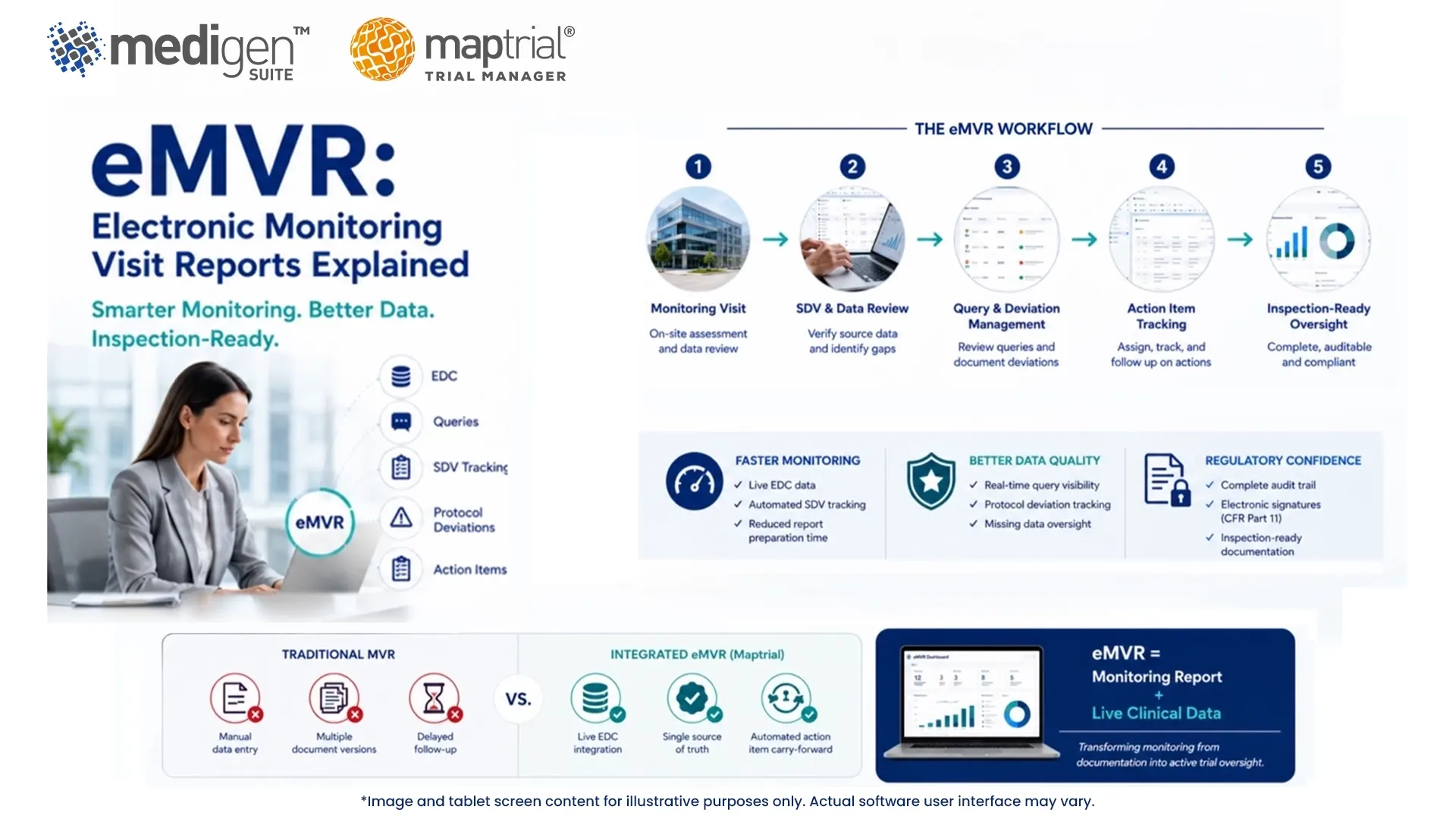
- An eMVR is an electronic record of monitoring visit findings, action items, SDV progress, query status, and protocol deviations.
- It replaces paper and standalone document-based reports with a traceable, integrated workflow.
- When embedded in an eClinical platform, the eMVR draws on live EDC data, eliminating manual data entry and version-control risk.
- Maptrial, the monitoring module in the Medigen Suite, supports CRA workflows through action item management, SDV/DMR tracking, configurable query privileges, and freeze/lock oversight.
- Compliant eMVRs must be supported by a complete audit trail and, where required, FDA CFR Part 11-compliant electronic signatures.
- Best-practice eMVR completion reduces post-visit preparation time, improves data quality, and strengthens regulatory defensibility.
What Is an eMVR (Electronic Monitoring Visit Report)?
An eMVR, or Electronic Monitoring Visit Report, is a structured digital document completed by a Clinical Research Associate (CRA) before, during, and after an on-site monitoring visit. It records findings, action items, protocol deviations, data discrepancies, and follow-up obligations identified at an investigational site — replacing the paper-based monitoring visit report with a traceable, real-time electronic workflow.
In clinical trial operations, the eMVR is the primary accountability tool between a sponsor or CRO and each investigative site. When implemented within an integrated eClinical platform, it connects directly to live EDC data, query status, and SDV (Source Data Verification) progress — turning a static report into a dynamic management instrument.
Why eMVRs Matter in Clinical Trial Site Monitoring
CRA monitoring is one of the most resource-intensive activities in a clinical trial. CRAs spend significant time preparing visit reports, cross-referencing EDC data, chasing outstanding queries, and documenting protocol deviations – often using disconnected tools that create delays and version-control problems.
An eMVR addresses these inefficiencies by embedding the monitoring report directly within the same environment where clinical data lives. This means a CRA can:
- Reference current query status and SDV progress at the time of writing
- Link action items to specific patients, forms, or visits
- Track outstanding issues from visit to visit with automated carry-forward logic
- Share findings with the sponsor and site in a fully auditable, timestamped format
The shift from paper or standalone Word documents to a true eMVR is not just a formatting upgrade — it is a structural change in how monitoring oversight is documented, escalated, and resolved.
What Does an eMVR Typically Cover?
A comprehensive eMVR contains all findings and obligations generated during a monitoring visit. The sections below represent the standard scope of a well-structured electronic monitoring report.
- Visit Summary and Administrative Details
The opening section captures the who, what, and when of the visit: the site identifier, the CRA name, the visit date, the type of visit (e.g., initiation, interim, close-out), and the personnel present. This section establishes the formal record of the monitoring activity.
- Action Items and Outstanding Issues
Action items are the operational core of the eMVR. Each item is registered with a description, responsible party, due date, and current status. In an integrated platform like Maptrial, action items are tracked across visits so that unresolved items from prior reports automatically carry forward, preventing issues from falling through the cracks.
- Query Status Overview
A meaningful eMVR includes a snapshot of the query landscape at the site: total open queries, manual queries awaiting investigator response, auto-generated queries from edit check failures, and high-priority queries. This data, when drawn directly from the EDC, eliminates the manual effort of copying query counts into a separate document and guarantees accuracy.
- Source Data Verification (SDV) Tracking
SDV is a central CRA activity. The eMVR records which forms and fields have been verified, which are outstanding, and the overall SDV completion percentage per patient and visit. When the eMVR is connected to a live SDV tracking module, these figures are populated automatically from the monitoring system rather than manually entered.
- Protocol Deviation Documentation
Any deviation from the approved study protocol identified during the visit must be documented. The eMVR should capture the deviation type, the date it occurred, the affected patient and visit, and the corrective action taken or planned. This feeds directly into regulatory deliverables such as the PD Listing Report and PD Classification Report.
- Data Lock and Freeze Status
The eMVR documents the current lock and freeze status of patient data at the site. CRAs use this to verify that data finalization is progressing according to the trial timeline and to identify forms still open for modification.
- Follow-Up Obligations
Every monitoring visit generates obligations. The eMVR formalizes these: what the site must address before the next visit, what the CRA will resolve through remote site monitoring between visits, and what requires escalation to the sponsor or data management team.
eMVR vs. Traditional Monitoring Visit Reports: A Direct Comparison
| Feature | Paper/Word Report | eMVR in Integrated Platform |
| Query data accuracy | Manually copied | Pulled live from EDC |
| SDV progress tracking | Manual entry | Auto-populated from SDV module |
| Action item carry-forward | Manual review of prior report | Automated, session-to-session |
| Protocol deviation logging | Separate document | Linked to PD report |
| Audit trail | None or file metadata | Full timestamp and user log |
| Sponsor visibility | Email attachment | Real-time access in platform |
| Version control | Risk of multiple versions | Single source of truth |
The difference is significant. A CRA preparing a paper-based monitoring report after an on-site visit may spend two to four hours cross-referencing data from multiple systems. An eMVR embedded in the EDC environment can reduce that preparation time substantially because the data is already there.
How Maptrial Supports the eMVR Workflow
Maptrial, the monitoring module within the Medigen Suite, is designed specifically to support the CRA’s on-site monitoring workflow. Rather than treating the monitoring report as a separate deliverable, Maptrial integrates monitoring activities directly into the same platform used by site staff, data managers, and sponsors.
Action Item Management
Maptrial provides full lifecycle management of action items — registration, assignment, tracking, and resolution — within the application environment. CRAs can log findings during the visit and assign them to the relevant party with a due date. Sponsors and data managers can view action item status in real time without waiting for a report to be filed.
SDV and DMR Tracking
Maptrial supports complete Source Data Verification and Data Manager Review (DMR) workflows. CRAs can mark fields and forms as SDV-verified directly within the system. The resulting SDV Tracking Report gives an up-to-date view of verification progress per site and per patient, which can be incorporated directly into the eMVR narrative.
Query Management with Monitoring Privileges
Query management privileges in Maptrial are configurable by role. Monitors can be granted specific rights to create, respond to, close, or escalate queries — including the ability to flag high-priority queries that trigger automatic email notifications. Query auto-response functionality means that when a site corrects a flagged field, the associated query is resolved automatically, keeping the query log clean.
Freeze and Lock Oversight
Maptrial gives monitors clear visibility into freeze and lock status at the form and patient level. Freeze and lock actions can be performed in bulk, and all activity is tracked in dedicated online logs (Freeze Log, Lock Log) that are exportable to Excel. CRAs can document data finalization progress in the eMVR with confidence that the figures reflect the current system state.
Protocol Deviation and Missing Data Reports
Maptrial connects to the Data Validator module, which generates the Missing Data Report, Missing Fields Report, PD Listing Report, and PD Classification Report in real time. CRAs preparing an eMVR can reference these reports to ensure that every deviation and data gap identified during the visit is accurately captured.
The Role of eMVRs in Data Quality and Trial Integrity
The eMVR is not merely an administrative document. It is a direct instrument of data quality. Every action item, deviation, and query discrepancy captured in the monitoring report represents an opportunity to correct the clinical data record before database lock.
Sponsors and data managers who can access real-time eMVR data — integrated with live EDC metrics — are in a fundamentally stronger position to:
- Identify sites with systemic compliance problems early
- Prioritize data management resources toward high-risk sites
- Demonstrate to regulators that monitoring oversight was rigorous and documented
- Reduce the risk of findings during audits or inspections
When monitoring reports are siloed from the EDC, this oversight loop breaks down. The CRA writes a report; the data manager reads it days later; corrective actions are initiated weeks after the visit. In a connected eMVR environment, the loop closes in real time.
Key Questions About eMVRs — Answered
What is the difference between an eMVR and a monitoring plan? A monitoring plan defines the strategy, frequency, and scope of monitoring activities for the entire trial. An eMVR is the visit-level record of what was actually found and addressed during a specific on-site visit. The plan sets the framework; the eMVR documents execution.
Who is responsible for completing an eMVR? The CRA assigned to the site is typically responsible for completing the eMVR. In some CRO structures, the CRA’s line manager or a sponsor representative may co-sign or review the report before it is finalized.
How long after a monitoring visit should an eMVR be submitted? ICH GCP guidelines recommend that monitoring reports be submitted promptly. Most sponsors specify a window of five to ten business days following the visit. An integrated eMVR platform can accelerate this timeline significantly since data does not need to be manually gathered.
Can an eMVR satisfy GCP and regulatory requirements? Yes — provided the platform generating the eMVR maintains a compliant audit trail, supports electronic signatures where required, and meets 21 CFR Part 11 or equivalent international standards. The E-Signature feature in the Medigen Suite is compliant with FDA CFR Part 11 requirements, ensuring that signed monitoring documents carry regulatory validity.
What happens to action items that are not resolved before the next visit? In an integrated platform, unresolved action items carry forward automatically into the next visit report. The CRA can update the status, add new notes, and escalate if necessary — without manually recreating the item from the previous report.
For more information about the Medigen Suite and how Maptrial supports on-site monitoring workflows, contact the Medigen Suite team or request a demo today.
Table of Contents
- Too Busy to Read the Full Article? Here’s What You Need to Know
- What Is an eMVR (Electronic Monitoring Visit Report)?
- Why eMVRs Matter in Clinical Trial Site Monitoring
- What Does an eMVR Typically Cover?
- eMVR vs. Traditional Monitoring Visit Reports: A Direct Comparison
- How Maptrial Supports the eMVR Workflow
- The Role of eMVRs in Data Quality and Trial Integrity
- Key Questions About eMVRs — Answered
Latest Articles
21 CFR Part 11 password requirements: what the regulation actually says
A 90-day password change is not a 21 CFR [...]

Clinical trial software for the connected study stack
Clinical trials are generating more data from more sources, [...]

A practical guide to the main types of clinical trials
The type of clinical trial you run shapes almost [...]
This article provides general information and does not constitute regulatory, legal, clinical, or compliance advice. Requirements and appropriate processes may vary by study, product, jurisdiction, and organization. Medigen Suite functionality should be used in accordance with applicable regulations, study documentation, and internal procedures.