What Are CDISC Standards?
CDISC standards are a globally recognized set of data standards developed by the Clinical Data Interchange Standards Consortium (CDISC) to ensure that clinical trial data is collected, structured, and submitted in a consistent, interoperable format. Regulatory agencies like the FDA and PMDA require CDISC-compliant submissions, making these standards essential for any sponsor conducting clinical research.
CDISC standards define how clinical trial data should look — from the first data entry at the site to the final submission package sent to regulators.
Why CDISC Standards Matter in Clinical Research?
Clinical trials generate enormous volumes of data across hundreds of sites, time zones, and systems. Without standardization, this data becomes nearly impossible to compare, analyze, or submit for regulatory review.
CDISC standards solve this by:
- Enabling data reuse and pooling across studies and sponsors
- Accelerating regulatory submissions to FDA, EMA, and PMDA
- Reducing costly data transformation and programming time
- Supporting automated data validation and quality checks
- Improving transparency and reproducibility of clinical findings
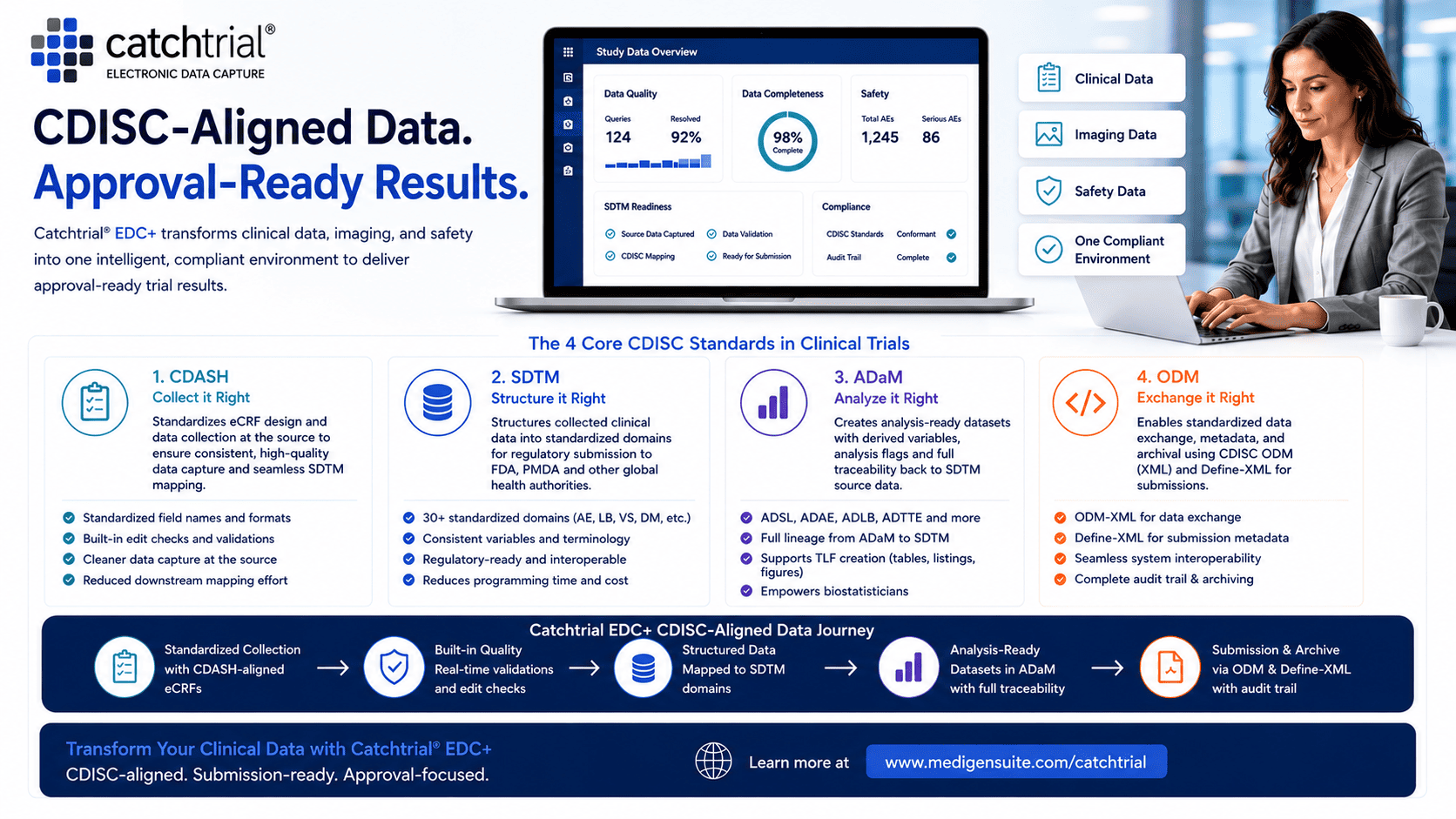
The four core CDISC standards every clinical data professional needs to understand are SDTM, ADaM, ODM, and CDASH.
SDTM: Study Data Tabulation Model
What is SDTM?
What is SDTM?
SDTM (Study Data Tabulation Model) is the CDISC standard that defines how collected clinical trial data should be organized for regulatory submission. It structures raw clinical data into a standardized, tabular format that regulators can review and evaluate consistently.
Key facts about SDTM:
| Attribute | Detail |
| Full name | Study Data Tabulation Model |
| Purpose | Organizing clinical data for regulatory submission |
| Required by | FDA (since 2016 for NDA/BLA), PMDA |
| Data domains | Demographics (DM), Adverse Events (AE), Lab results (LB), Vital Signs (VS), and 30+ others |
| Implementation guide | SDTMIG (Implementation Guide) |
CDISC ADaM: Analysis Data Model
What is CDISC ADaM?
What is CDISC ADaM?
CDISC ADaM (Analysis Data Model) is the standard that defines how analysis-ready datasets should be structured for statistical analysis and reporting. Where SDTM organizes raw observations, ADaM creates the derived datasets that biostatisticians actually use to generate tables, listings, and figures (TLFs) for clinical study reports.
Key facts about ADaM:
| Attribute | Detail |
| Full name | Analysis Data Model |
| Purpose | Creating analysis-ready datasets linked to statistical outputs |
| Core datasets | ADSL (subject-level), ADAE (adverse events), ADLB (labs), ADTTE (time-to-event), and others |
| Key principle | Full traceability from analysis result back to raw SDTM source data |
| Required by | FDA for electronic submissions alongside SDTM |
How ADaM differs from SDTM:
• SDTM = “What was collected” (organized observations)
• ADaM = “What was analyzed” (derived variables, flags, analysis populations)
ADaM datasets include derived variables like AVAL (analysis value), BASE (baseline value), CHG (change from baseline), and population flags like SAFFL (safety analysis flag) and ITTFL (intent-to-treat flag). Every derived variable must be traceable back to its SDTM source, ensuring full data lineage and auditability.
CDISC ODM: Operational Data Model
CDISC ODM (Operational Data Model) is the standard for exchanging and archiving clinical data and metadata in XML format. It is the universal language for transferring study data between clinical systems — including EDC systems, CDMS, and data warehouses — without losing context or structure.
| Attribute | Detail |
| Full name | Operational Data Model |
| Format | XML-based |
| Purpose | Data exchange, archiving, and system interoperability |
| Scope | CRF definitions, study metadata, clinical data, and audit trails |
| Extensions | ODM-XML, Dataset-XML (for SDTM/ADaM), Define-XML (submission metadata) |
What CDISC ODM enables:
- Migration of study data between EDC systems without data loss
- Archival of complete study data including audit trails at study close-out
- Regulatory submission metadata via Define-XML (the “data dictionary” of a submission package)
- Interoperability between sponsor, CRO, and technology vendor systems
ODM is the backbone that makes SDTM and ADaM submissions machine-readable. The Define-XML file — an ODM extension — accompanies every CDISC submission and tells reviewers what every variable means, where it came from, and how it was derived.
CDISC CDASH: Clinical Data Acquisition Standards Harmonization
What is CDISC CDASH?
CDISC CDASH (Clinical Data Acquisition Standards Harmonization) is the standard that defines how data should be collected at the source — in the eCRF (electronic Case Report Form). It works upstream of SDTM, ensuring that the data collected at the clinical site is already structured in a way that maps cleanly to SDTM domains.
| Attribute | Detail |
| Full name | Clinical Data Acquisition Standards Harmonization |
| Purpose | Standardizing eCRF field names and data collection |
| Benefit | Easier SDTM mapping, reduced programming burden |
| Alignment | Directly maps to SDTM domains |
| Coverage | 27 clinical domains including AEs, medications, labs, vital signs |
Why CDASH matters for EDC design:
Without CDASH, every sponsor designs eCRFs differently — different field names, different coding conventions, different question formats. This forces significant programming effort to transform site-collected data into SDTM format.
With CDASH-aligned eCRFs, field names and structures already mirror SDTM variables, which:
- Reduces SDTM mapping complexity by up to 60%
- Minimizes data transformation errors
- Speeds up database lock and submission timelines
- Enables consistent cross-study data pooling
How the Four CDISC Standards Work Together
The four CDISC standards form a continuous data pipeline from study design to regulatory submission:
Study Design
↓
CDASH → eCRF data collection (standardized fields)
↓
SDTM → Submission-ready tabulation datasets
↓
ADaM → Analysis datasets & statistical outputs
↓
ODM → XML exchange, archiving & Define-XML metadata
↓
Regulatory Submission (FDA / EMA / PMDA)
Frequently Asked Questions About CDISC Standards
Q: Are CDISC standards mandatory for FDA submissions? Yes. The FDA requires SDTM and ADaM datasets for New Drug Applications (NDAs) and Biologics License Applications (BLAs) submitted after December 2016, and for certain device submissions. PMDA (Japan) has similar requirements.
Q: What is the difference between SDTM and ADaM? SDTM organizes raw observations as collected during the trial. ADaM contains derived analysis datasets created for statistical analysis, including derived variables, baseline flags, and population indicators. Both are required for a complete regulatory submission.
Q: Is CDASH the same as SDTM? No. CDASH defines how data should be collected in eCRFs; SDTM defines how it should be organized for submission. CDASH is designed to map cleanly to SDTM, minimizing the transformation work required.
Q: What is Define-XML? Define-XML is an ODM-based file that accompanies SDTM and ADaM submission packages. It acts as a data dictionary, describing every dataset, variable, code list, and derivation in the submission so regulators and reviewers can interpret the data accurately.
Q: Which CDISC standards does Medigen Suite support? The Medigen Suite platform — including Catchtrial EDC — is designed to support CDISC-aligned data collection and export, including CDASH-compliant eCRF design and SDTM-ready data exports in formats compatible with SAS and standard statistical packages.
How Medigen Suite Supports CDISC-Compliant Clinical Trials
Implementing CDISC standards requires more than knowledge — it requires a clinical technology platform built with compliance in mind from the ground up.
Medigen Suite’s Catchtrial EDC is engineered to support the full CDISC data pipeline:
CDASH-Aligned eCRF Design
Catchtrial’s Manage Visits, Forms and Fields module provides flexible, CDASH-compatible eCRF design. Study designers can configure field names, data types, and value lists that align directly with CDASH recommendations, significantly reducing downstream SDTM mapping effort.
The Annotated CRF feature automatically generates aCRFs that document the mapping between every eCRF field and its corresponding SDTM variable — an essential regulatory deliverable.
SDTM-Ready Data Exports
Catchtrial‘s Export SAS function produces datasets in the SAS Transport File format (sas7bdat), preserving variable labels, value formats, and data types required for SDTM programming. The system also supports Export CSV and custom export configurations to support any downstream SDTM transformation workflow.
Audit Trail and Data Integrity
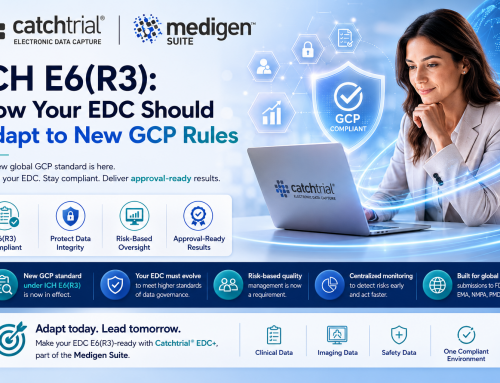
CDISC submissions require complete, unalterable audit trails. Catchtrial‘s Export Audit Trail and Export Audit Log functions provide a comprehensive sequential record of every data change — who made it, when, the before/after values — fully compliant with FDA 21 CFR Part 11 requirements.
Medical Coding with MedDRA
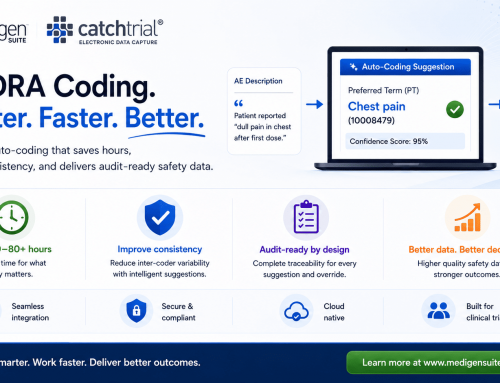
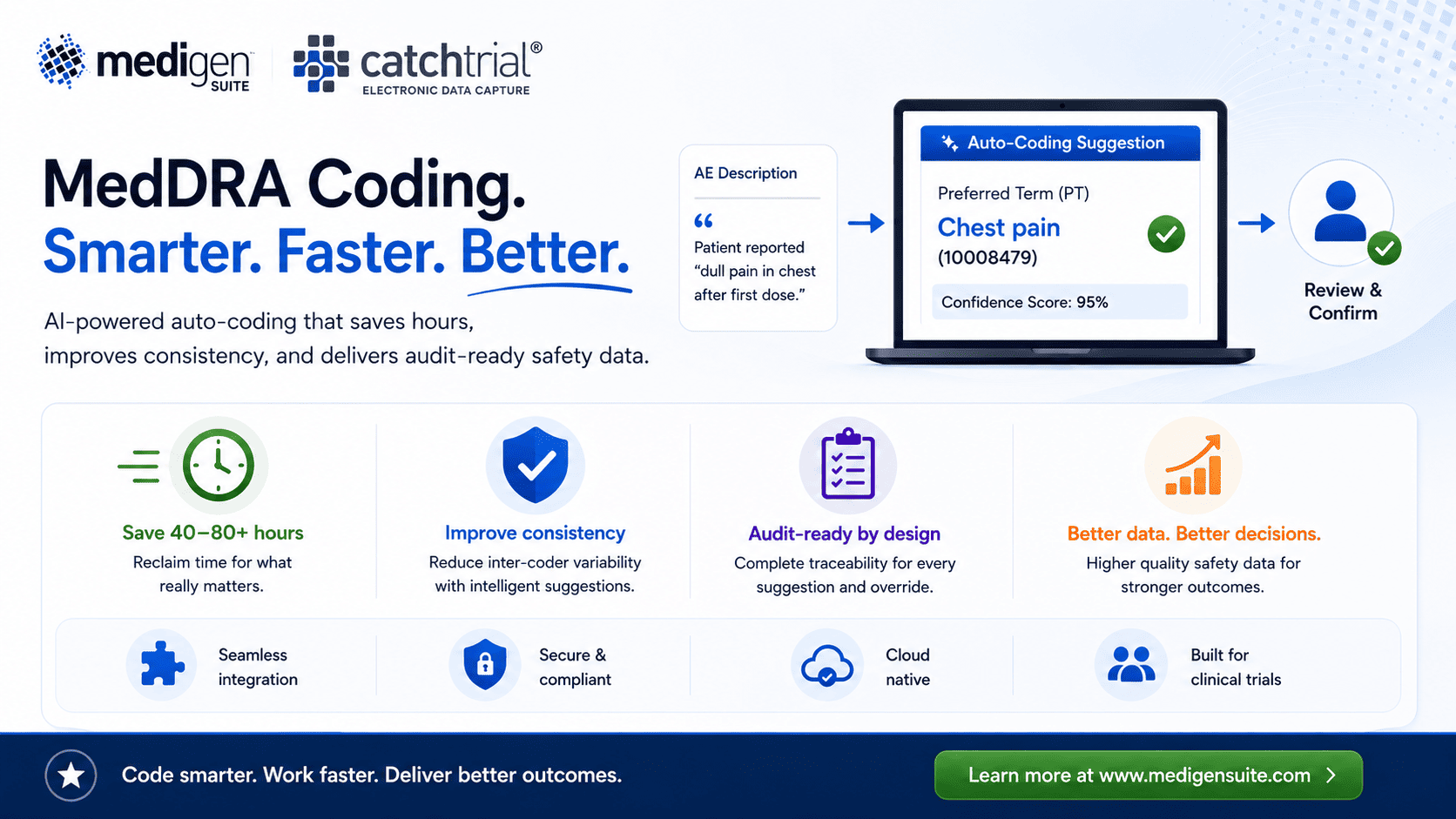
Accurate adverse event coding is essential for SDTM’s AE domain. Catchtrial‘s Medical Coding module supports AI-assisted MedDRA coding, suggesting appropriate System Organ Class (SOC) and Preferred Term (PT) values directly within the eCRF — the same terminology structure used in SDTM AE datasets.
Data Validation and Query Management
The Catchtrial Data Validator module provides automated integrity checks — both field-level and cross-field — that mirror the validation rules applied during SDTM and ADaM conformance checking. This catches CDISC-relevant data issues during the study, not at submission time.
Getting Started with CDISC-Compliant Data Management
Adopting CDISC standards is a strategic investment that pays dividends at every stage of your clinical program — faster submissions, lower programming costs, and greater confidence in data quality.
The right EDC platform makes the difference between CDISC compliance being a burden and being built-in.
Medigen Suite is purpose-built for sponsors and CROs who take data quality seriously.
Explore how Catchtrial and the full Medigen Suite platform can support your CDISC implementation at medigensuite.com.