Many data managers encounter CDISC issues later than ideal in the study timeline. A field gets mapped inconsistently across sites. An AE term is coded outside the agreed MedDRA version. A custom export format does not align with what the biostatistics team needs for SDTM. When these issues surface near database lock, resolving them means reopening data that was intended to be final, adding time and effort that earlier planning could have avoided.
CDISC, the Clinical Data Interchange Standards Consortium, sets the data standards that the FDA and other regulators expect for clinical trial submissions, primarily through SDTM (Study Data Tabulation Model) for raw data and ADaM (Analysis Data Model) for analysis-ready datasets. Sponsors and CROs increasingly treat CDISC alignment as a day-one consideration rather than a downstream conversion task, since designing for the standard from the start is typically more efficient than retrofitting non-standard data later.
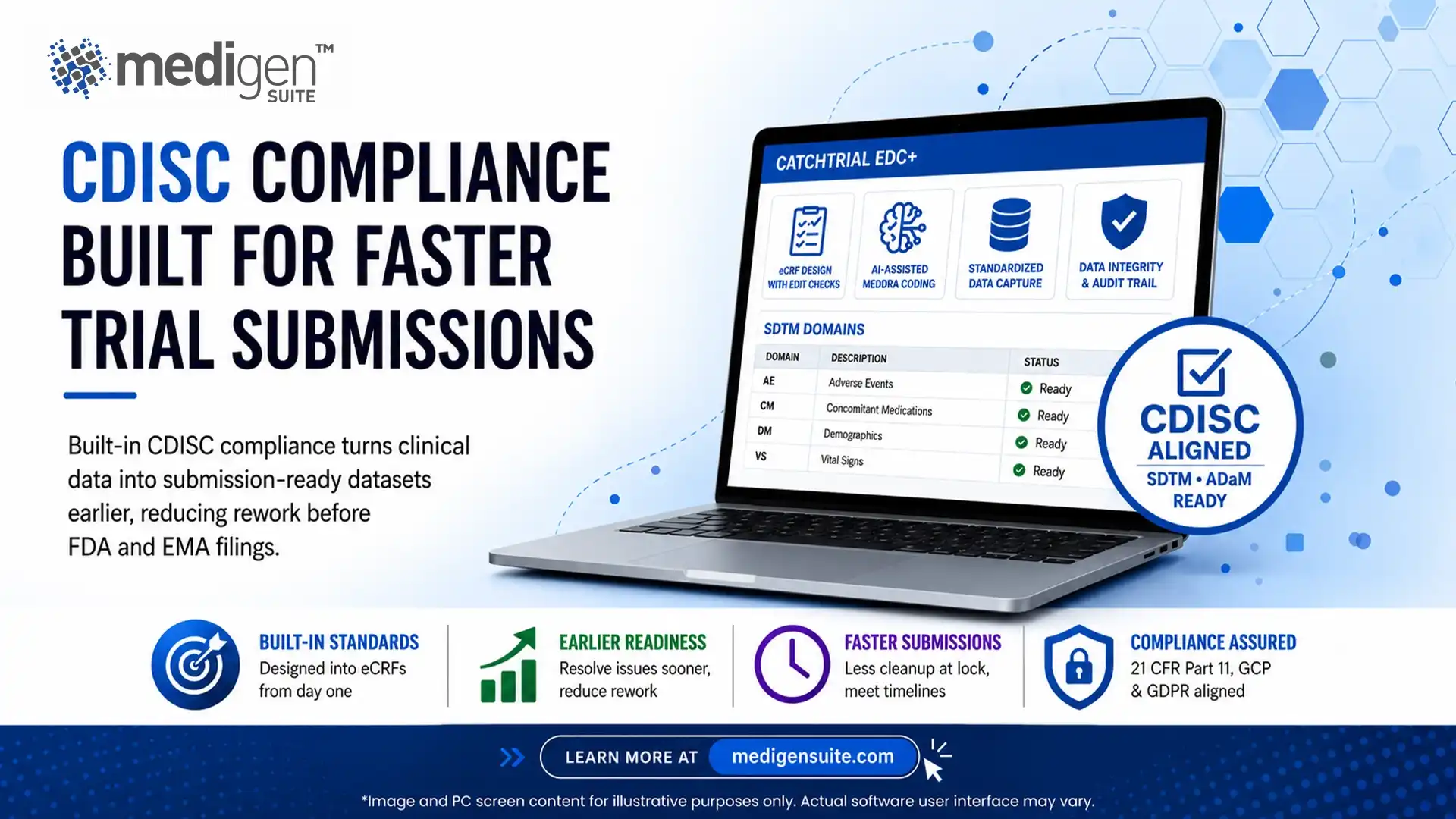
This is where the relationship between EDC capability and submission readiness becomes relevant. A system that captures data well is not automatically the same as a system that captures data in a way that maps cleanly to CDISC. Medigen Suite is built with that distinction in mind.
Why CDISC Alignment Belongs Earlier in the Study Timeline
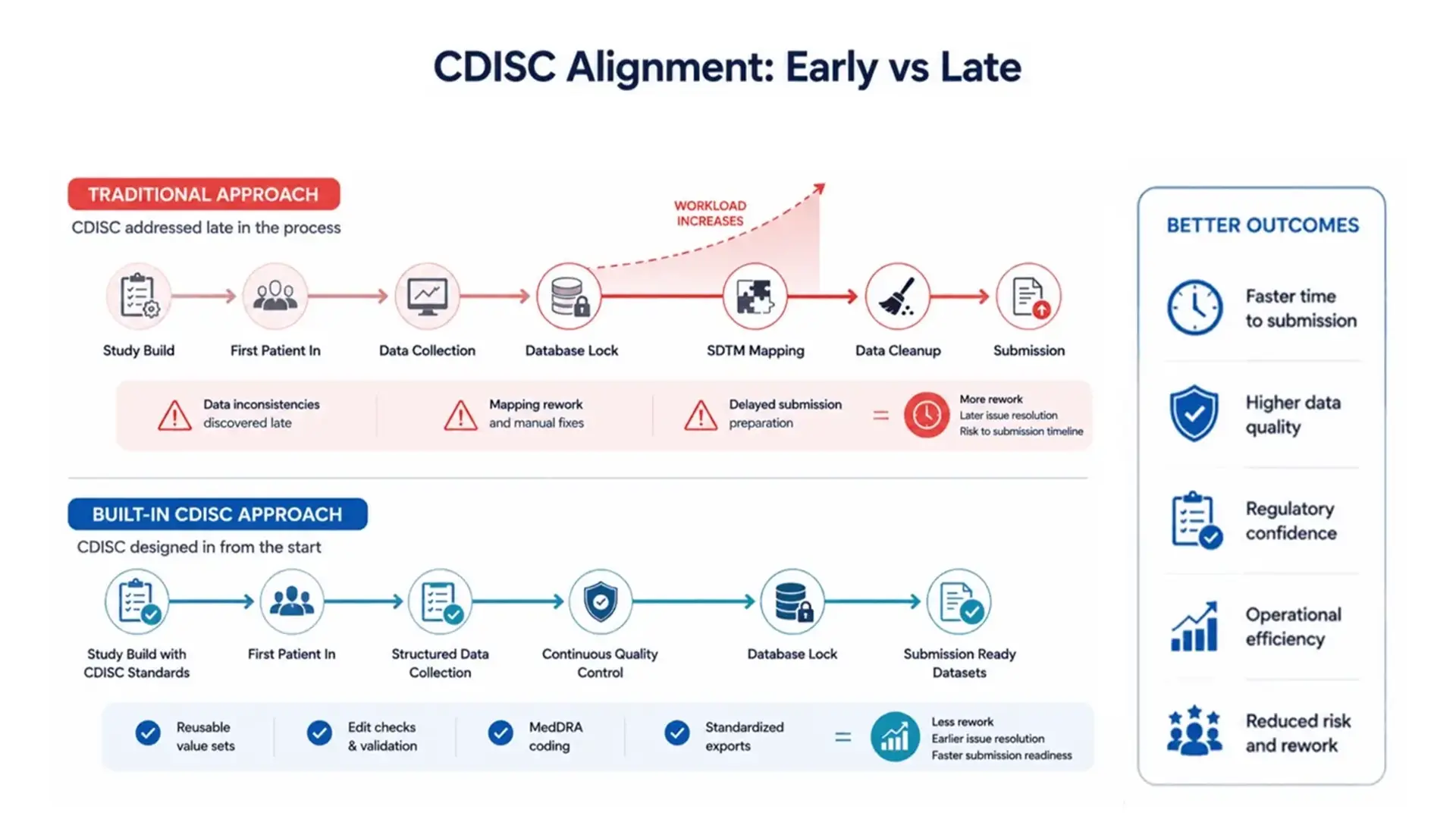
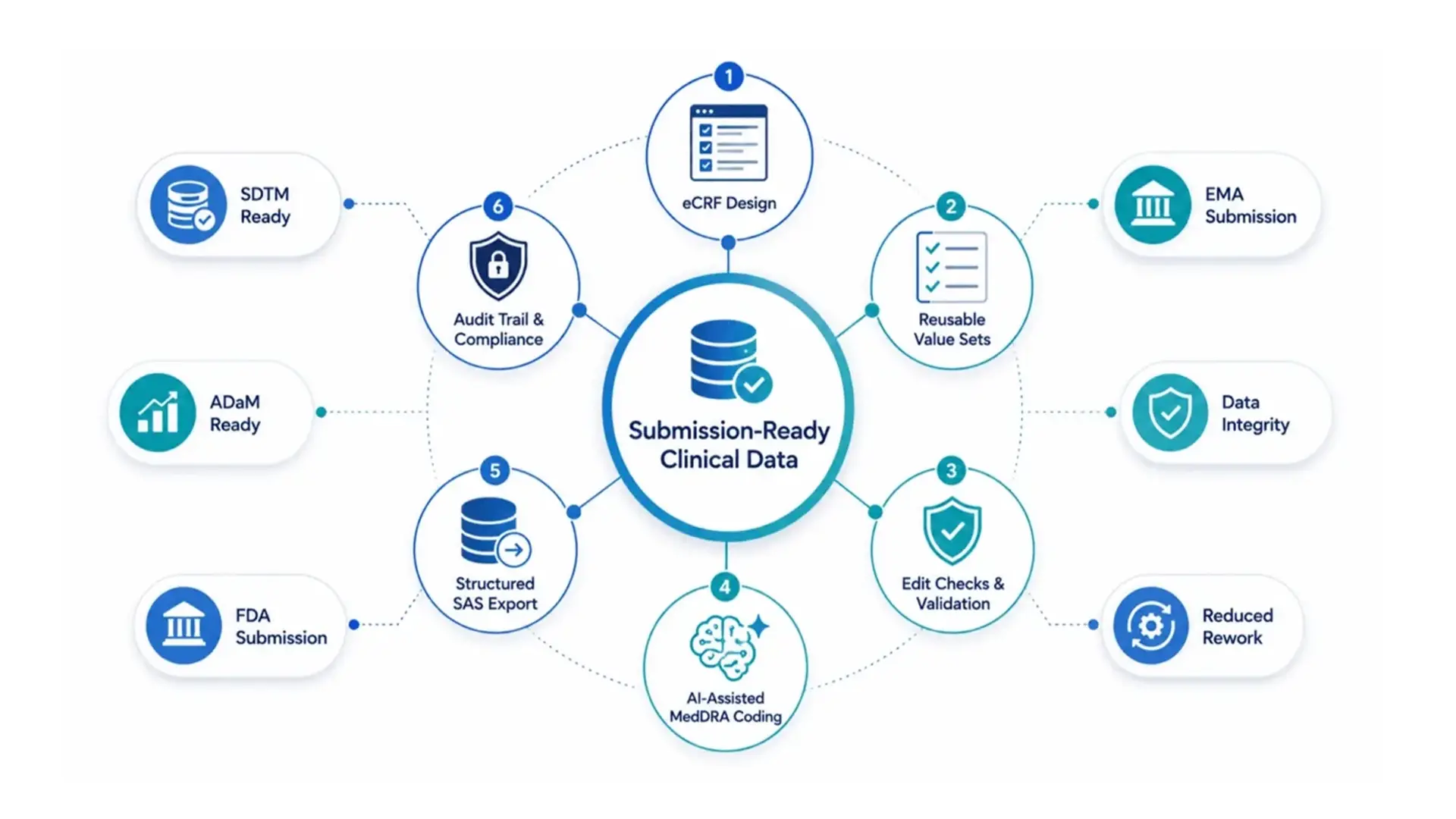
CDISC works best as part of the study design, not a final-mile formatting exercise. SDTM defines how observations should be structured, domain by domain, and ADaM defines how those domains feed into the analyses that support a regulatory filing. When eCRF design accounts for these structures from the start, biostatistics and data management teams spend less time transforming raw data into compliant datasets, which reduces transcription risk and the kind of query regulators may raise during review.
The need is more pronounced in multi-site, multi-country trials, where CRF Multi-Version configurations, randomization groups, and site-specific terminology can diverge over time unless the underlying data structure is controlled centrally. A platform that maintains consistency at the point of entry helps keep this risk well managed before data reaches the database.
Data Quality as the CDISC Foundation
CDISC compliance depends on data quality as much as formatting. Clean, consistent SDTM domains start with clean, consistent source data. Edit checks, defined value ranges, and field-level validation at data entry help reduce inconsistent or out-of-range values, which lowers the amount of reconciliation needed during SDTM mapping. Standardized value sets for select and radio fields, reused consistently across forms, give downstream programmers a stable foundation to work from rather than a range of free-text variants that need to be normalized later.
Medical coding is a good example of where this matters. Adverse event coding to MedDRA terms, a core input to the AE and related SDTM domains, can benefit from AI-assisted coding suggestions at the point of entry, which helps standardize terminology before it reaches the statistical programming stage.
Comparing Approaches to CDISC Readiness
| Approach | When CDISC structure is addressed | Typical effort required | Timeline impact |
| Retrofit conversion | After database lock, during export | Higher rework, more mapping checks | Adds time before submission |
| Vendor-led SDTM mapping service | Post-database-lock, outsourced | Dependent on external timeline and cost | Adds external lead time |
| Built-in standards at eCRF design | At study build, before first patient in | Lower rework, earlier issue resolution | Minimal added time at lock |
The built-in approach does not remove the need for SDTM and ADaM programming. It reduces the volume of cleanup that programming has to absorb, which is typically where submission timelines come under the most pressure.
How Medigen Suite Supports CDISC Aligned Data Capture
Medigen Suite‘s eClinical platform is designed so that data standards are addressed during study build, ahead of database lock. A few capabilities are directly relevant to clinical data standards work:
Catchtrial EDC+ supports the design of eCRFs with reusable, study-wide value templates (Multivalues), edit checks at the field level, and structured form versioning tied to protocol or randomization group, all of which help reduce the variability that can complicate SDTM mapping later. AI-assisted MedDRA coding at the point of AE entry helps standardize terminology earlier in the data lifecycle.
For export and downstream statistical use, Catchtrial Report Builder supports direct export to SAS transport format (sas7bdat), giving statistical programming teams a defined, repeatable starting point for SDTM and ADaM transformation work. Maptrial CTMS+ and the broader Medigen Suite architecture help keep operational and clinical data aligned across modules, which is useful when SDTM domains need consistent identifiers and metadata across the trial.
Because these capabilities sit inside a single connected suite rather than a collection of separate tools, the data structure decisions made at study build carry through consistently to monitoring, reporting, and export, rather than being re-negotiated at each handoff.
The Regulatory and Compliance Layer
CDISC compliance sits alongside other regulatory expectations: 21 CFR Part 11 requirements for electronic records and signatures, ICH GCP expectations for data integrity, and, for trials with European sites, GDPR obligations around personal data handling. Catchtrial EDC+ maintains a detailed audit trail of data modifications and login activity, supports role-based access and query management privileges, and applies e-signature workflows compliant with 21 CFR Part 11 requirements. These controls do not generate CDISC domains directly, but they support the broader data integrity expectations that accompany a CDISC-compliant submission package.
Choosing the Right Approach for Your Next Submission
Teams evaluating their CDISC readiness may find it useful to ask a slightly different question than “are we CDISC compliant.” A more practical framing is when in the data lifecycle standards alignment gets addressed. If the answer is “after database lock,” there is an opportunity to move that work earlier, often starting with how the EDC is configured at study build. Reusable value sets, consistent coding support, and export formats aligned to statistical programming needs are practical, achievable steps rather than a late-stage mapping exercise.
Frequently Asked Questions
Is CDISC compliance mandatory for every submission?
The FDA requires SDTM and ADaM compliant datasets for most NDA, BLA, and certain device submissions, and the PMDA in Japan has similar expectations. Requirements vary by region and submission type, so sponsors should confirm the applicable standards version and scope with their regulatory affairs team early in study planning.
Which CDISC standard applies to my data, SDTM or ADaM?
SDTM organizes raw collected data into standardized domains (such as AE, CM, VS). ADaM takes those SDTM domains and structures them into analysis-ready datasets that directly support statistical tables and figures in the clinical study report. Most submissions require both.
Does CDISC alignment change how sites use the EDC day to day?
No. When standards are built into the eCRF design rather than applied retroactively, sites continue entering data through the same forms and workflows. The structural decisions that support SDTM mapping operate behind the scenes.
Who is responsible for the actual SDTM and ADaM programming?
Typically a biostatistics or statistical programming team, often using SAS, builds the final SDTM and ADaM datasets. An EDC that exports clean, consistently structured data and supports SAS transport format reduces the rework that team has to do, but it does not replace that programming function.
When should CDISC mapping requirements be reviewed in the study timeline?
Ideally during eCRF design and study build, before first patient in. Reviewing SDTM domain requirements at this stage, rather than after database lock, gives the study team time to adjust form structure, value sets, or coding conventions while changes are still low-risk.
If your team is assessing how clinical data standards work fits into your next study build, it is worth looking at how Medigen Suite structures eCRF design, coding, and export around CDISC requirements from the outset. Visit the Medigen Suite product page or request a demo to see how Catchtrial EDC+ and the connected Medigen Suite platform support cleaner, earlier CDISC alignment for your upcoming submissions.
Table of Contents
Latest Articles
21 CFR Part 11 password requirements: what the regulation actually says
A 90-day password change is not a 21 CFR [...]

Clinical trial software for the connected study stack
Clinical trials are generating more data from more sources, [...]

A practical guide to the main types of clinical trials
The type of clinical trial you run shapes almost [...]
This article provides general information and does not constitute regulatory, legal, clinical, or compliance advice. Requirements and appropriate processes may vary by study, product, jurisdiction, and organization. Medigen Suite functionality should be used in accordance with applicable regulations, study documentation, and internal procedures.