
Most eClinical tools perform well individually; however, the effort required grows in the gaps between them. System fragmentation rarely breaks a single validated platform. It does, however, turn every hand-off between systems into work that someone must perform, verify and later explain.
For sponsors, the practical question is: where does this work fall within the current system setup, how much oversight is required, and how can it be reduced without replacing one risk with another?
The three hidden costs of system fragmentation
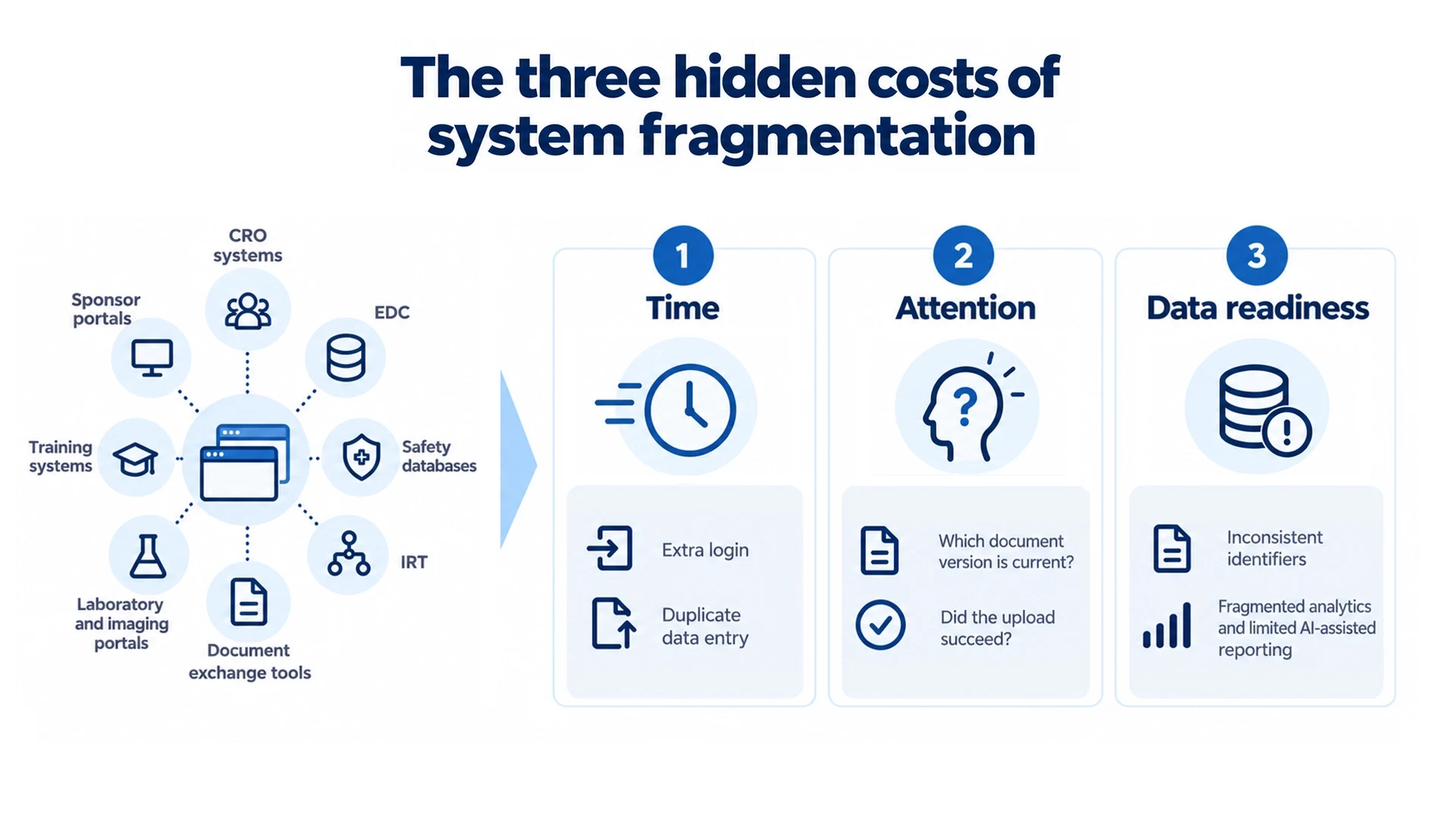
The burden is real, but it is spread thinly enough to escape most budgets An August 2026 article in ACRP’s Clinical Researcher highlights how trial sites work across numerous tools for a single trial: sponsor portals, CRO systems, EDC, safety databases, training systems, IRT, laboratory and imaging portals, and document exchange tools.
A 2026 analysis of 65 interventional oncology trials at a cancer center in Milan, Italy, found that the center used an average of 5.3 electronic portals per study, with 66.1% of the trials requiring five to seven portals. The authors identified vendor streamlining and interoperability as potential ways to improve efficiency and data quality. They also found that industry-sponsored trials employed significantly more e-portals than academic ones, with a mean of 5.8 per study.
For sponsors, this is a commercial issue as well as a compliance one: technology burden competes directly with activation speed and with sites’ willingness to accept the next study.
The burden appears in three forms:
- Time. An extra login, a document uploaded to a second portal, a status confirmed by email. Each takes minutes, but across sites, staff and study months, those minutes become a workstream of their own.
- Attention. Every disconnected system raises small questions. Which version is current? Did the upload succeed? Do two screens agree? That uncertainty draws on the focus of coordinators and monitors, whose attention belongs on participants and data.
- Data readiness. Records reconciled manually can carry inconsistent identifiers or timing. This matters more as sponsors rely on centralized monitoring, which ICH E6(R3) describes as an evaluation of accumulated data (section 3.11.4.2). Analytics and AI-assisted review can only be as consistent as the records beneath them.
Key takeaway: none of these costs is a compliance failure in itself. Together, however, they turn system fragmentation into a growing set of control points that the sponsor must govern.
What regulations and GCP guidance expect
No regulation or GCP guideline requires sponsors to minimize the number of systems they use. What they establish are expectations for data integrity, traceability and oversight, regardless of architecture.
Where E6(R3) stands in 2026. ICH adopted E6(R3) Principles and Annex 1 on 6 January 2025. They came into effect in the EU on 23 July 2025, and FDA published them as final guidance in September 2025. Annex 2, which covers decentralized and pragmatic trial designs, reached ICH Step 4 in June 2026 and takes effect in the EU on 15 January 2027.
Sponsor responsibility and oversight
- Principle 10.2: when activities are transferred to service providers, responsibility for trial conduct, including the quality and integrity of trial data, remains with the sponsor.
- Section 3.6.9: the sponsor should ensure appropriate oversight of important transferred activities, including those further subcontracted.
- Section 3.6.8: the sponsor should have access to relevant information, such as SOPs and performance metrics, to select and oversee service providers.
- Section 3.10.1.1: sponsors should consider risks across processes and systems, explicitly including computerized systems and service provider activities.
- Principle 7.4 and section 3.1.4: the sponsor should not place unnecessary burden on participants and investigators.
Data governance across systems (E6(R3) section 4)
- 4.2.2: relevant metadata, including audit trails.
- 4.2.5: data transfer, exchange and migration, which, in practice, is where reconciliation risk concentrates.
- 4.3.7 and 4.3.8: technical support and user management for computerized systems.
- For investigators, Section 2.12.2 adds that unnecessary transcription steps between source records and data acquisition tools should be avoided.
Binding US requirement. 21 CFR Part 11 (11.10(e)) requires secure, computer-generated, time-stamped audit trails that independently record the date and time of operator entries and actions that create, modify or delete electronic records. Part 11 applies to electronic records and signatures used to meet FDA record requirements.
For further context, see FDA’s Electronic Systems, Electronic Records, and Electronic Signatures in Clinical Investigations: Questions and Answers, which addresses electronic systems in clinical investigations directly.
EU trials. The EMA Guideline on computerised systems and electronic data in clinical trials sets parallel expectations for audit trails, user access management and service providers.
Key takeaway: a fragmented stack is not a Part 11 violation or a GCP deviation in itself. It can, however, increase the effort required to demonstrate data integrity, traceability and oversight across every provider involved.
Why connected systems can reduce oversight work
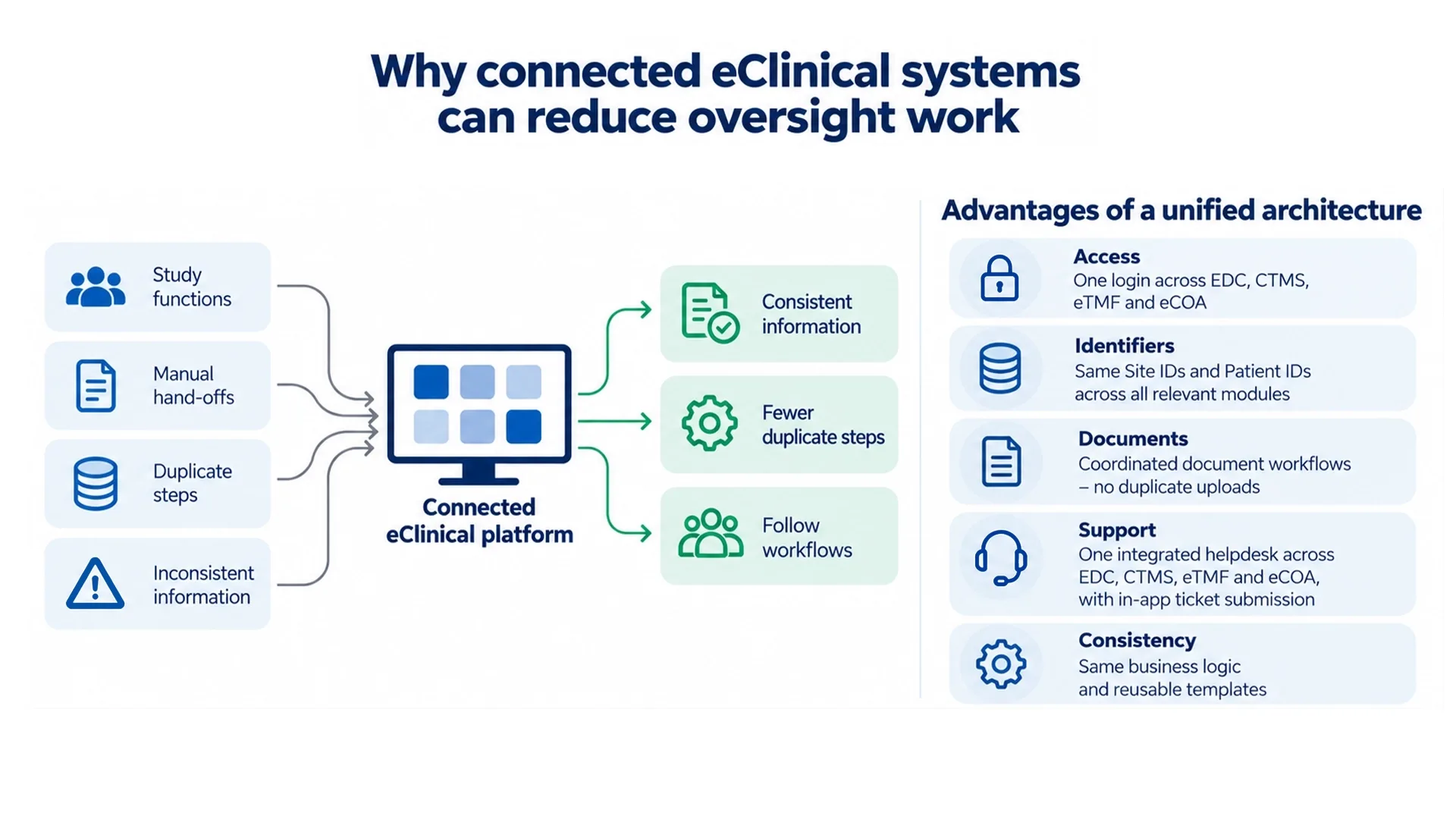
A connected eClinical platform can reduce the number of manual hand-offs among study functions, helping sponsors and sites maintain consistent information and follow workflows with fewer duplicate steps. As with any technology architecture, sponsors should still consider provider oversight, business continuity and change management. These considerations are part of sound vendor governance and do not negate the operational advantages that a unified approach can offer. When evaluating an eClinical architecture, sponsors may wish to assess:
- Systems, interfaces and manual reconciliation points
- Audit trail accessibility and how events correlate across functions
- Identity and access management across systems
- Change control interfaces between vendors and releases
- Business continuity and exit arrangements
- Supplier oversight proportionate to the functions outsourced, including further subcontracting
How Medigen Suite supports fewer uncontrolled hand-offs
Medigen Suite brings EDC (Catchtrial), CTMS (Maptrial), ePRO and eCOA into one platform, designed to reduce the hand-offs described above. For an overview of how the modules fit together, see the article: Clinical trial software for the connected study stack. Here, the focus is on the control points outlined above:
- Access: study staff use one login across Catchtrial EDC, Maptrial CTMS, ePRO and eCOA. Roles and privileges are configurable at every level of the study structure, with custom roles available for individual users.
- Identifiers: Site IDs are configured at study setup across the relevant Medigen Suite modules. Patient ID format, sequencing and composition can be defined for each study.
- Timestamps: site configuration handles local time zones, helping keep event timing consistent across countries.
- Amendments: eCRF versions can be assigned to specific sites, and forms display only the questions that apply to each site’s protocol version.
- Documents: Document workflows support traceability, including tracking of replaced files.
- Support: one integrated helpdesk across EDC, CTMS, ePRO and eCOA, with in-app ticket submission, tracking and traceability.
- Consistency: configurable edit checks for each eCRF field, reusable option templates across forms, and coded-list fields that accept only valid codes.
By bringing EDC, CTMS, ePRO and eCOA capabilities together, Medigen Suite can help reduce the operational burden of moving between separate vendor systems. Study teams can manage eCRF version assignments, questionnaire data, site records, user access and support requests within the connected platform, reducing the number of cross-system hand-offs that require coordination.
See how the modules connect on the Medigen Suite product page or request a demo.
Frequently Asked Questions
What is system fragmentation in clinical trials?
System fragmentation is the use of many disconnected platforms to run a single trial, each with its own logins, identifiers, audit trail and support process. EDC, CTMS, ePRO, eTMF, IRT and training systems may each work well independently. The burden tends to sit in the hand-offs, where data and documents must be reconciled manually across tools.
What are the hidden costs of fragmented eClinical systems?
The main hidden costs are time, attention and data readiness. Staff lose minutes to extra logins, duplicate uploads and status checks. Coordinators and monitors spend attention confirming versions and uploads. Records reconciled manually are more likely to carry inconsistencies, which can weaken centralized monitoring and analytics that depend on accumulated trial data.
Is system fragmentation a 21 CFR Part 11 violation?
No, fragmentation is not a Part 11 violation in itself. Part 11 requirements apply to electronic records and signatures used to meet FDA record requirements. The challenge is operational: when identifiers, versions and documents reside in separate systems, demonstrating data integrity, traceability and oversight across them tends to require more effort.
What does ICH E6(R3) say about sponsor oversight of eClinical vendors?
ICH E6(R3) keeps responsibility for trial conduct with the sponsor when activities are transferred to service providers, including data quality and integrity (Principle 10.2). The sponsor should ensure appropriate oversight of important transferred activities (section 3.6.9) and consider risks across processes and systems, including computerized systems and service provider activities (section 3.10.1.1). Section 4 sets expectations for audit trails, data transfer and user management. E6(R3) has applied in the EU since 23 July 2025, and FDA published it as final guidance in September 2025.
References
- Kulkarni T. Death by a Thousand Portals: Addressing Technology Fragmentation and Site Burden in Clinical Research. ACRP Clinical Researcher, August 2026.
- Stabile S, et al. Digital workload in oncology trials: A comparative analysis of e-portal usage and operational insights from a single-center experience. Tumori Journal. 2026;112(2):157-163.
- ICH. E6(R3) Guideline for Good Clinical Practice, final version, 6 January 2025.
- EMA. ICH E6 Good clinical practice, scientific guideline page (effective dates, Annex 2).
- FDA. E6(R3) Good Clinical Practice, final guidance, September 2025.
- FDA. Electronic Systems, Electronic Records, and Electronic Signatures in Clinical Investigations: Questions and Answers.
- eCFR. 21 CFR 11.10, Controls for closed systems.
- EMA. Guideline on computerised systems and electronic data in clinical trials.
Table of Contents
Latest Articles

Unblinding in Clinical Trials Done Right, One Patient at a Time
A treatment assignment must remain concealed until disclosure is [...]

Where the Benefits of Electronic Data Capture Really Come to Life
Replacing paper case report forms does not automatically improve [...]
Practical Clinical Trial UAT Before Study Go-Live
A study database can pass technical checks and still [...]
This article provides general information and does not constitute regulatory, legal, clinical, or compliance advice. Requirements and appropriate processes may vary by study, product, jurisdiction, and organization. Medigen Suite functionality should be used in accordance with applicable regulations, study documentation, and internal procedures.