
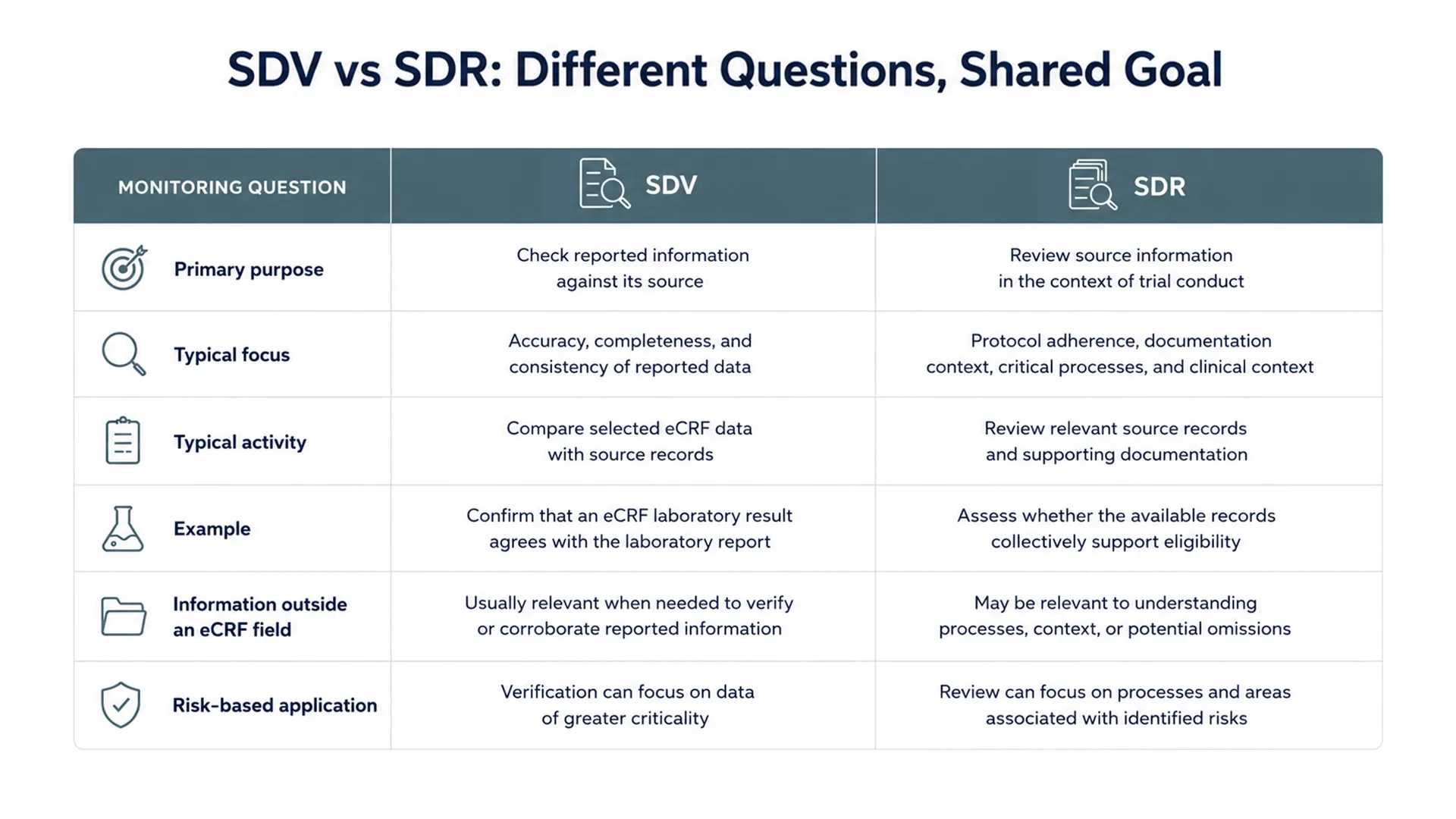
The real challenge with SDV vs SDR is not deciding which activity is better. It is knowing which monitoring question each activity is intended to answer. Source Data Verification (SDV) focuses on the relationship between reported trial data and the underlying source, while Source Data Review (SDR) examines source information more broadly in the context of trial conduct.
ICH E6(R3) makes the distinction operationally important. Section 3.11.4 describes monitoring as a broad set of activities and explicitly lists source data review and source data verification as separate approaches, alongside data analytics and review of trial documents and information.
Why SDV vs SDR matters for monitoring
Clinical trial monitoring is broader than checking whether data were transcribed correctly. Under ICH E6(R3), its aim is to protect participants’ rights, safety, and well-being and support the reliability of trial results. The sponsor determines the extent and nature of monitoring based on identified risks, with the approach documented in the monitoring plan. [ICH E6(R3), Section 3.11.4]
That creates different monitoring questions. A monitor may need to establish whether a laboratory result reported in an electronic case report form (eCRF) accurately represents the source. In another situation, the more relevant question may be whether the records support eligibility, whether a protocol-required process occurred at the appropriate time, or whether information in the source requires further safety follow-up. [ICH E6(R3), Section 3.11.4.3]
The regulatory framework also depends on what is being investigated. ICH E6(R3) applies to interventional trials of investigational products within the pharmaceutical framework. Medical device clinical investigations have their own GCP standard, ISO 14155, together with applicable regional requirements.
The practical takeaway is that verification and broader review are related quality-control activities, but they are not interchangeable.
SDV vs SDR asks different questions
Terminology deserves care because even established sources use SDV in more than one way.
The current CDISC Glossary v20.0, published September 26, 2025, contains two distinct entries. “Source data verification” refers to checking that data derived from source data accurately represent the source. “Source document verification (SDV)” refers to comparing investigator-reported information with source or original records to establish completeness, accuracy, and validity.
ICH E6(R3), by contrast, uses the terms “source data review” and “source data verification” in Section 3.11.4 without providing separate glossary definitions for them. In established monitoring practice and the clinical monitoring literature, SDR is generally used for the broader review of source documentation for protocol adherence, documentation quality, and site processes, rather than solely for transcription checking.
The distinction is useful, but it should not be made artificially rigid. A 2024 scoping review noted substantial overlap in practice and found that published studies did not always distinguish clearly between activities attributable to SDV and those attributable to source document review.
Whatever terminology a team uses, the important step is to define the intended activities in the monitoring plan rather than assume that the labels alone communicate the scope.
Where source data review adds context
Consider a hypothetical multi-site medicinal-product trial in which eligibility depends on medical history, laboratory values, previous treatments, and a protocol-defined clinical assessment.
SDV may confirm that selected eligibility data reported in the eCRF correspond with the underlying source records. Source data review can address the broader question of whether the available documentation collectively supports the eligibility decision and whether the required assessment process was followed.
EMA’s GCP Q&A illustrates why this matters. It notes that an overall eligibility statement in the CRF may not be sufficient when the underlying source data do not demonstrate that all criteria were fulfilled, and emphasizes that the locations of relevant source data should be adequately identified.
Similar distinctions can arise around:
- informed consent and timing of trial procedures
- inclusion and exclusion criteria
- adverse events and safety reporting
- primary and important secondary endpoints
- protocol deviations
- participant withdrawals and follow-up
- investigator oversight
- documentation supporting critical trial processes
ICH E6(R3) reflects that broader scope. Section 3.11.4.5.2 covers site monitoring activities such as informed consent, adverse event reporting, source-record locations, recruitment, and essential records, while Section 3.11.4.5.4 addresses checking reported trial data against source and other trial-related records.
What medical device investigations add to the monitoring picture
For device-focused sponsors, ISO 14155 needs to sit alongside the broader risk-based monitoring discussion rather than appear merely as a scope disclaimer.
ISO published ISO 14155:2026, Edition 4, on March 23, 2026, replacing ISO 14155:2020 as the current international edition. The current standard places the monitoring plan in Clause 6.7 and defines monitoring in Clause 3.36 as oversight of investigation progress to confirm that the investigation is conducted, recorded, and reported in accordance with the Clinical Investigation Plan (CIP), written procedures, the standard, and applicable regulatory requirements. ISO also notes that centralized monitoring can complement or reduce the extent and frequency of on-site monitoring.
In the EU, MDCG 2024-3 makes the device-specific monitoring expectations particularly concrete. Section 3.6.6 states that the sponsor must ensure adequate monitoring and that the CIP should include a general outline of the monitoring plan, appointment of a monitor independent from the investigational site, the monitor’s access to source data, and the planned extent of source data verification. It also states that the extent and nature of monitoring should reflect the characteristics, objectives, methodology, and degree of deviation from normal clinical practice of the investigation.
There is an important 2026 regulatory nuance. ISO 14155:2026 is now the current international edition, but the EU MDR harmonisation reference currently remains EN ISO 14155:2020 together with A11:2024, which the Commission added through Implementing Decision (EU) 2026/193 in January 2026. The MDR harmonised-standards decision is currently consolidated to June 17, 2026.
FDA recognition also currently lags the ISO revision. The FDA Recognized Consensus Standards database, last updated May 25, 2026, continues to list ISO 14155, Third edition 2020-07, under recognition number 2-282.
For device sponsors, the practical implication is to distinguish the latest technical edition from the edition currently referenced for a particular regulatory or conformity-assessment purpose.
How Maptrial CTMS+ supports structured monitoring workflows
Technology can support this monitoring model, while the monitoring plan still determines what should be reviewed, verified, documented, and escalated.
Maptrial CTMS+ supports configurable study structures across visits, eCRFs, and individual fields, together with customizable edit checks at individual eCRF-field level. These controls can complement monitoring by identifying data conditions requiring attention, while the monitoring methodology determines whether the appropriate follow-up is verification, broader review, a query, or another action.
For source-related documentation, governance comes first. EMA’s current GCP Q&A states that transfers of medical-record copies to sponsors or service providers must respect applicable national rules and data-protection requirements, use appropriate redaction and security measures, and be limited to information that is ethically and scientifically justified. Extensive centralized collection of medical-record copies should not substitute for source verification at the investigator site. [EMA GCP Q&A, D.2]
Where a study’s regulatory and procedural arrangements permit document-upload workflows, Maptrial CTMS+ supports configurable upload points for de-identified source documents and DICOM files, including accepted file formats and standardized nomenclature based on study, site, and participant identifiers.
The platform also supports patient-level study-document uploads through dedicated forms, configurable management of subsequent uploads, tracking of prior versions where configured, and download access for authorized users.
Granular role management supports configurable access privileges across the study structure, including custom roles and privileges assigned to roles or individual users.
Teams evaluating how to operationalize an SDV, SDR, or TSDV model can assess Maptrial CTMS+ against their monitoring-plan, source-access, document-management, and role-based access requirements.
Build the monitoring plan around criticality
The most useful question is not simply, “What percentage of SDV should we perform?” It is which risks require exact source verification, which require broader contextual review, and which can be addressed through centralized review, data analytics, or another monitoring activity.
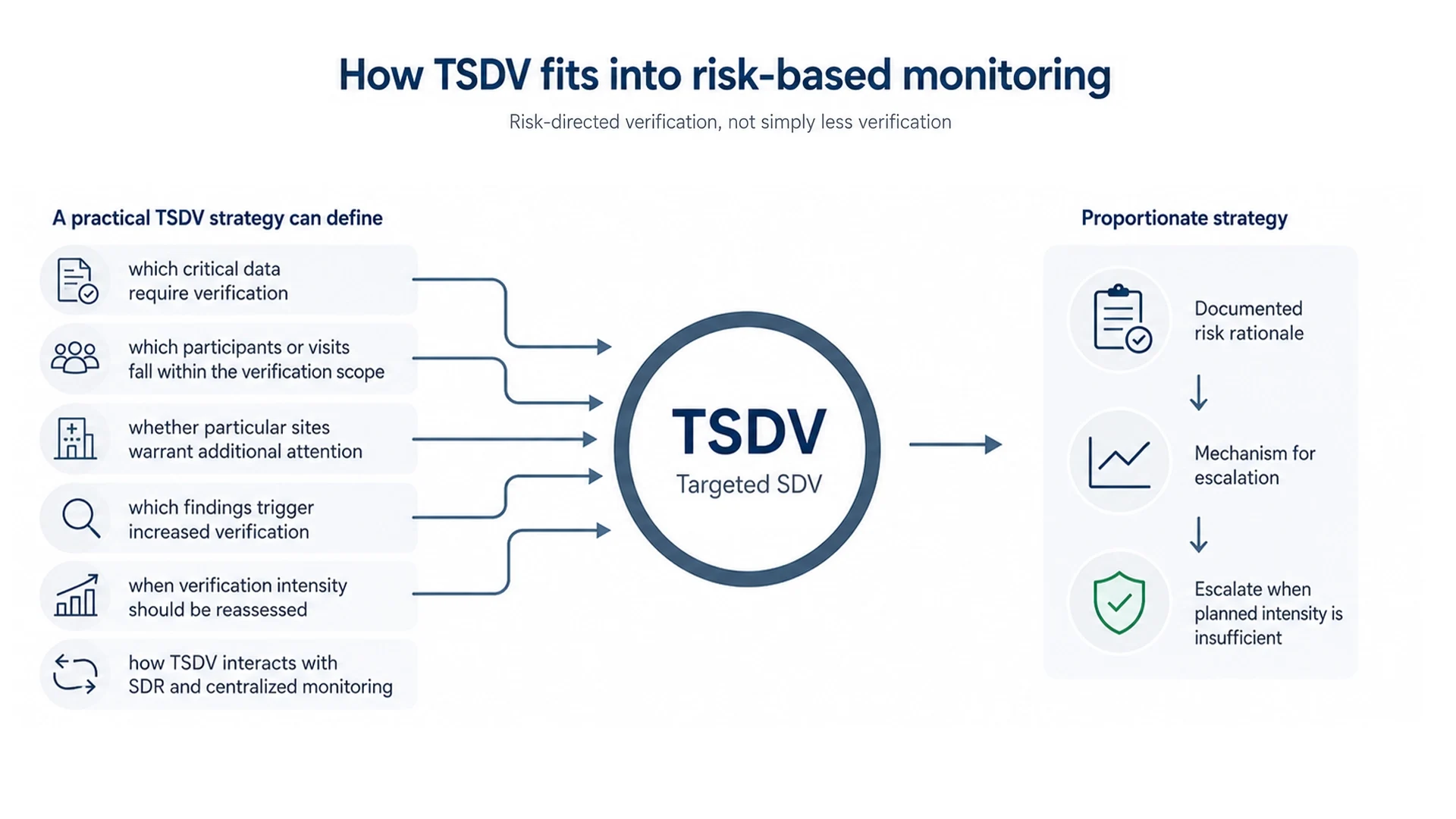
This is where targeted source data verification (TSDV) fits. Rather than applying the same verification level everywhere, TSDV concentrates verification on the data, participants, visits, or sites that matter most for participant protection and the reliability of results. The selection should be justified in the monitoring plan and reassessed when findings or data-quality indicators suggest that more verification is needed.
Across ICH GCP, FDA risk-based monitoring guidance, and the device-specific ISO and EU frameworks, the direction is toward monitoring that is proportionate to the investigation and focused on information and processes that matter to participant protection and the reliability of results. The exact mix remains study-specific.
SDV and SDR therefore work best as complementary components of a monitoring strategy rather than competing alternatives.
For sponsors and CROs looking to put that strategy into practice across sites, visit the Maptrial CTMS+ product page or request a demo to see how Maptrial CTMS+ can support structured, risk-based clinical trial monitoring.
Frequently Asked Questions
What is the difference between SDV and SDR in clinical trials?
SDV focuses on checking reported trial information against the underlying source, while SDR reviews source information more broadly in its clinical and operational context. ICH E6(R3) identifies source data review and source data verification as separate monitoring approaches but does not provide standalone definitions for the two terms. Published monitoring literature also notes some practical overlap between them.
Is source data review required in addition to SDV?
No universal rule requires every clinical investigation to conduct a separately labelled SDR activity in addition to SDV. The monitoring activities selected should address the applicable regulatory requirements, critical data and processes, and study-specific risks. However, SDV alone may not address monitoring questions concerning protocol conduct, eligibility context, safety processes, or documentation quality, so broader review activities may still be necessary.
What does TSDV mean in clinical trials?
TSDV means Targeted Source Data Verification. It focuses verification on data, participants, visits, or sites selected according to criticality and risk rather than automatically applying the same verification level everywhere. A targeted strategy should be justified in the monitoring plan and reassessed when monitoring findings or data-quality indicators suggest that additional verification is appropriate.
Is 100 percent SDV required in clinical trials?
No universal FDA expectation requires 100 percent SDV for every participant, visit, and data point. FDA’s August 2013 risk-based monitoring guidance states that complete source-to-CRF comparison may provide minimal additional benefit in some studies and supports tailoring verification to critical data and trial-specific risks. This does not mean that reduced SDV is appropriate without a documented rationale.
How can Maptrial CTMS+ support SDV and SDR workflows?
Maptrial CTMS+ includes functionality that can support the operational environment around source data monitoring, including configurable study structures, field-level edit checks, controlled document-upload workflows, patient-level study-document handling, and granular role-based permissions. How those capabilities are used should follow the study’s monitoring plan, source-access arrangements, privacy requirements, and applicable regulatory framework.
Sources
- ICH E6(R3), Guideline for Good Clinical Practice, Principles and Annex 1
- ISO 14155:2026, Clinical investigation of medical devices for human subjects, Good clinical practice
- Commission Implementing Decision (EU) 2026/193
- MDCG 2024-3, Guidance on content of the Clinical Investigation Plan for clinical investigations of medical devices
- FDA, Oversight of Clinical Investigations: A Risk-Based Approach to Monitoring
- FDA, A Risk-Based Approach to Monitoring of Clinical Investigations: Questions and Answers
- FDA Recognized Consensus Standards database
- EMA, Good Clinical Practice Questions and Answers
- CDISC Glossary v20.0
- Hamidi M, et al., Source Data Verification (SDV) quality in clinical research: A scoping review
Table of Contents
Latest Articles
21 CFR Part 11 password requirements: what the regulation actually says
A 90-day password change is not a 21 CFR [...]

Clinical trial software for the connected study stack
Clinical trials are generating more data from more sources, [...]

A practical guide to the main types of clinical trials
The type of clinical trial you run shapes almost [...]
This article provides general information and does not constitute regulatory, legal, clinical, or compliance advice. Requirements and appropriate processes may vary by study, product, jurisdiction, and organization. Medigen Suite functionality should be used in accordance with applicable regulations, study documentation, and internal procedures.