
Replacing paper case report forms does not automatically improve how a clinical trial uses its information. The benefits of electronic data capture (EDC) become more meaningful when the system is configured around protocol requirements, review responsibilities, and the decisions that depend on the data.
For sponsors, contract research organizations (CROs), and sites, the opportunity extends beyond digital entry. A thoughtful EDC approach can support earlier review and better study visibility when processes fit the trial.
Why the Benefits of Electronic Data Capture Go Beyond Paper
Digitizing a form changes its format; designing an EDC workflow changes how information is managed. Paper-based processes often involve separate steps for recording observations, transferring them into a database, checking inconsistencies, and communicating corrections. An electronic case report form (eCRF) brings structured entry into a computerized environment, but its value depends on what happens before and after submission.
A study team might need to know which critical assessments are outstanding, whether a value falls outside an expected range, or which sites have unresolved data queries. Merely replacing paper with a digital replica does not address those questions.
The distinction is between electronic storage and structured data management. A well-planned EDC implementation can connect collection, clarification, and oversight, particularly as protocols introduce more assessments and sites.
Design Data Quality at the Point of Entry
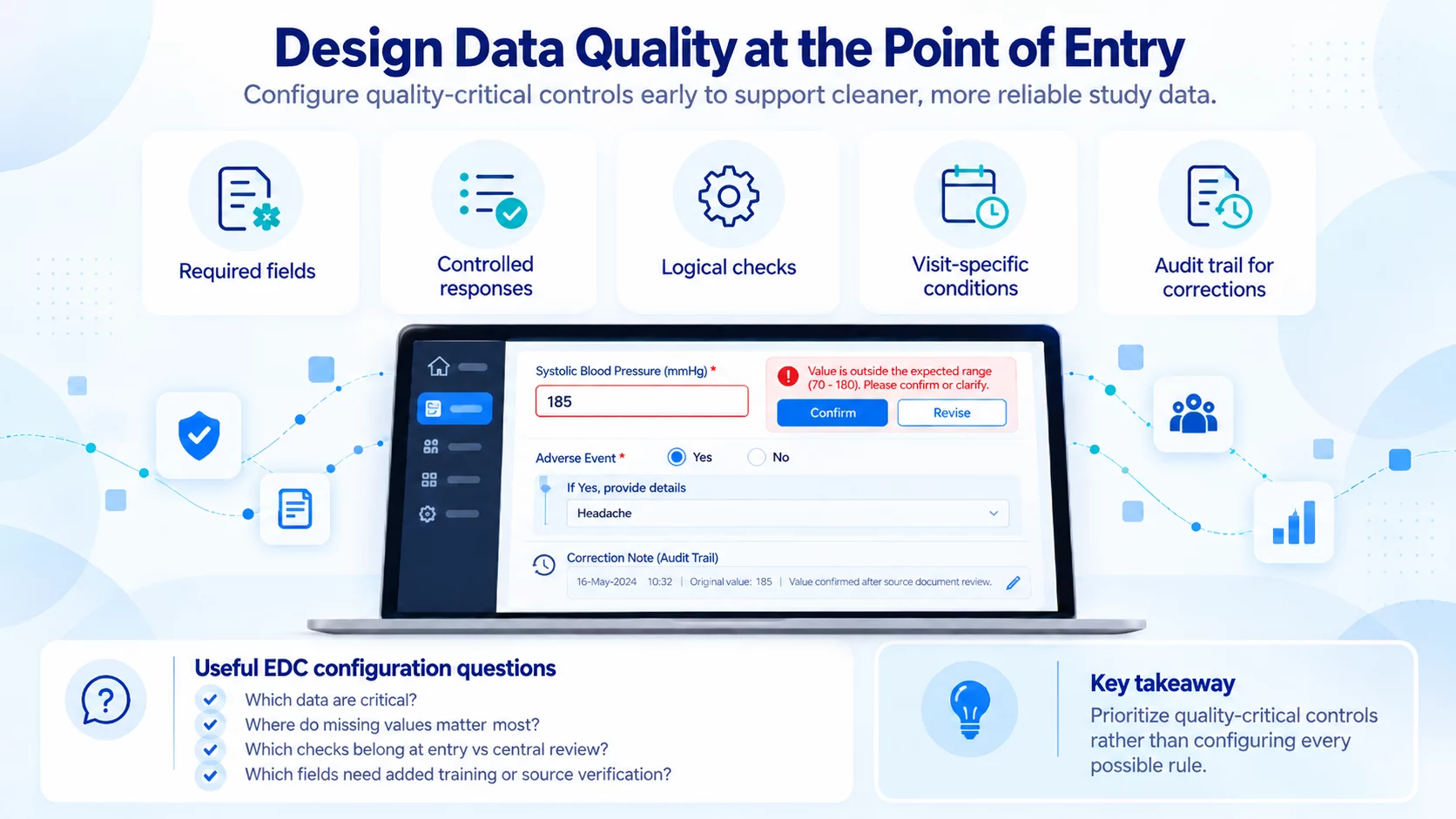
Data quality is easier to address when review requirements inform form design from the outset. Electronic forms can be configured with required fields, controlled response options, logical checks, and visit-specific conditions. These mechanisms may flag missing or inconsistent entries earlier in the study, in line with clinical data management guided by ALCOA++.
For example, an electronic form for a clinical assessment could be designed to flag a value outside a predefined range. The alert does not establish an error; it prompts confirmation or clarification.
Useful configuration questions include:
- Which data are critical to participant protection or the study’s primary objectives?
- Where do missing values or inconsistent units create meaningful review work?
- Which checks should appear during entry, and which should be reviewed centrally?
- How should users document corrections while preserving the original record?
- Which data fields require additional training or source verification?
Electronic data capture examples such as range checks and conditional form logic illustrate the potential, but these features are not substitutes for protocol clarity, site training, or sound data management procedures. Excessive checks may also create unnecessary alerts.
The practical takeaway is to prioritize quality-critical controls rather than configuring every possible rule. Those controls should then be checked during clinical trial UAT before study go-live.
Two EDC Clinical Trial Examples Across Study Workflows
The operational value of EDC becomes clearer when viewed through actual tasks rather than feature lists. The following EDC clinical trials examples illustrate how technology can support different study requirements.
Hypothetical example 1: Multi-site medical device study. Sites collect device performance measurements at scheduled follow-up visits. A configured EDC workflow could guide users to the relevant forms, identify outstanding assessments, and support query follow-up when entered values require clarification. The likely benefit is earlier visibility into what still needs review.
Hypothetical example 2: International interventional study. Teams work with different visit schedules, languages, and monitoring assignments. A role-based EDC setup may help organize data access and review responsibilities by site, while centralized indicators can support prioritization of outstanding work. Results tend to be strongest where configuration, training, and processes are aligned.
These scenarios highlight the need to know what still requires attention. In an EDC trial, clear ownership of queries matters as much as electronic entry.
For sponsors and CROs, earlier access to emerging data patterns may also support risk-based monitoring discussions. Such visibility still requires protocol context and clinical judgment.
Compare the Benefits of Electronic Data Capture Before Selecting a System
The right comparison is not simply paper versus software, but the depth of workflow support required. Different approaches can be reasonable for different studies, particularly when the volume and criticality of data vary.
| Decision factor | Paper-based collection | Basic electronic forms | Configured EDC workflow |
| Data entry | Handwritten or locally recorded | Entered in digital fields | Structured eCRFs with study-specific logic where configured |
| Consistency checks | Primarily manual | May include simple field validation | Can include protocol-specific checks and conditional logic |
| Review coordination | Separate logs and correspondence | Often managed outside the form | Can support query tracking and review status within the workflow |
| Study visibility | Requires consolidation | Depends on reporting setup | May support centralized dashboards and issue prioritization |
| Change history | Corrections documented through paper procedures | Depends on system controls | Should be assessed for attributable changes and appropriate audit trails |
| Implementation effort | Printing, handling, and manual processes | Form setup and user onboarding | Configuration, validation, training, and ongoing change control |
A basic electronic form may be sufficient for a limited administrative use case. A multi-site trial with complex assessments or repeated review cycles is more likely to benefit from an EDC approach designed for clinical research.
Not all EDC platforms include these capabilities. Buyers should verify configuration and supporting documentation, as outlined in our guide on how to choose an EDC system with confidence.
How Catchtrial EDC+ Supports Clinical Data Workflows
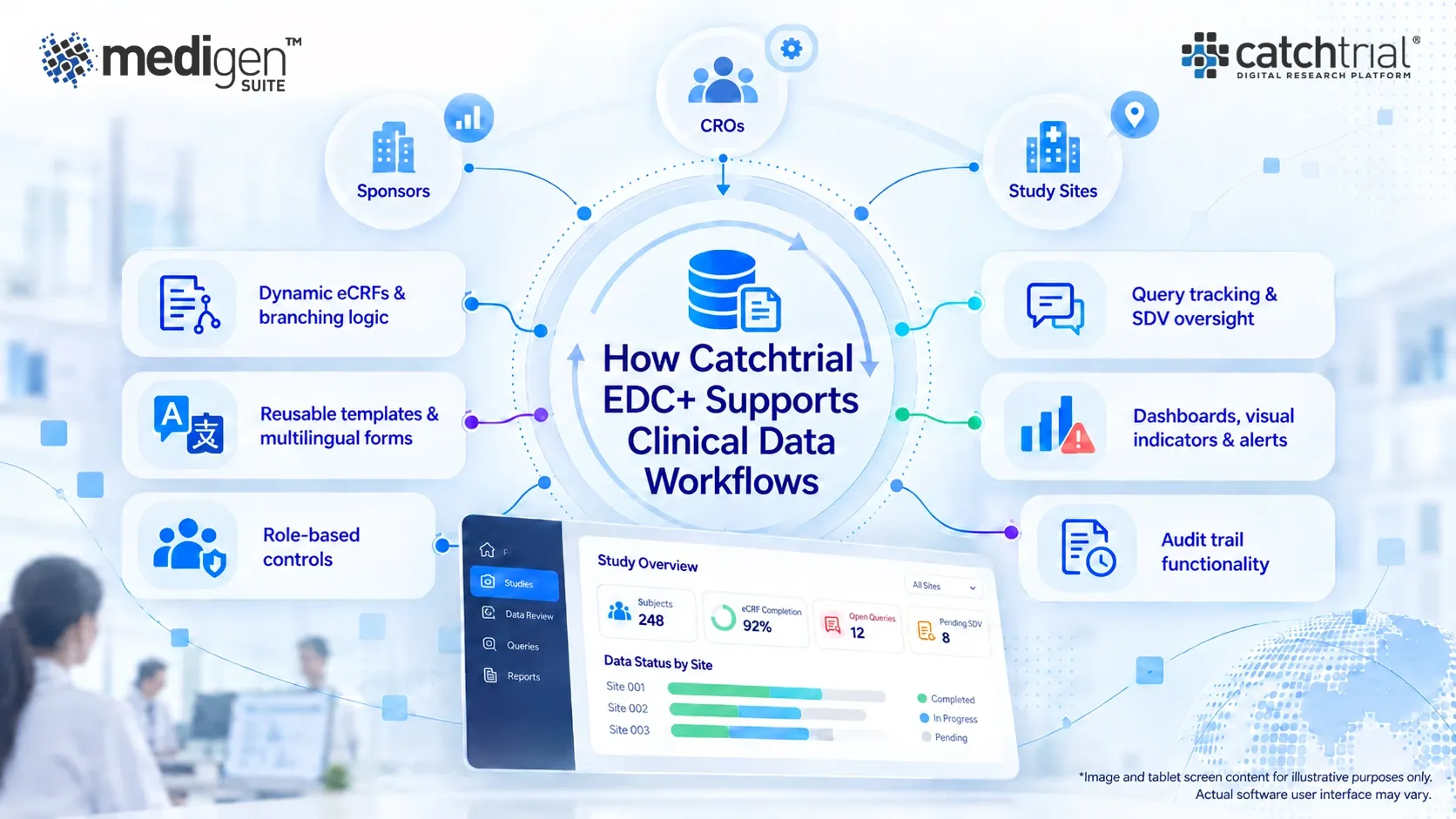
Catchtrial EDC+ is built around clinical data collection and the review work connected to it. The platform is designed to support protocol-specific electronic data collection and coordinated data review activities, and to help sponsors, CROs, and study sites manage the operational requirements of clinical research. [4]
Its capabilities address several of the practical considerations discussed throughout this article:
- Dynamic eCRFs and branching logic: Designed to support protocol-specific data entry, including conditional fields and forms that adapt to predefined responses.
- Reusable templates and multilingual forms: Intended to support efficient form configuration and data collection across studies with different language requirements.
- Role-based controls: Designed to support the assignment of access rights and responsibilities according to study roles.
- Query tracking and source data verification (SDV) oversight: Designed to support the management of data clarification and review activities across sites, including visibility into query and SDV status.
- Dashboards, visual indicators, and alerts: Intended to support centralized review of study progress, data quality, and operational indicators. These tools can help teams identify emerging issues and prioritize follow-up activities.
- Audit trail functionality: Designed to support traceability of clinical data changes by recording relevant user actions and modifications.
Together, these capabilities can support a more structured approach to clinical data management, extending beyond data entry to include clarification, review, and oversight. Their practical value depends on how the platform is configured for the protocol, user responsibilities, and study-specific procedures.
For sponsors looking to move beyond basic electronic forms, Catchtrial EDC+ offers an approach centered on structured data capture and the associated review workflows. Compare its capabilities with your study needs on the Catchtrial EDC+ product page.
Regulatory Confidence Requires More Than Digital Records
Electronic records require appropriate controls; digital format alone does not establish regulatory compliance. The FDA’s October 2024 guidance on electronic systems, records, and signatures addresses the circumstances in which electronic clinical investigation records can be considered trustworthy and reliable. It also discusses risk-based validation and controls relevant to record integrity. [1]
When 21 CFR Part 11 applies, it requires controls for system access, record integrity, audit trails and, where used, electronic signatures. These requirements apply alongside the underlying recordkeeping regulations for the study. [1]
ICH E6(R3) Good Clinical Practice emphasizes quality by design and proportionate management of trial processes and data. Its Principles and Annex 1 took effect in the European Union on July 23, 2025, reinforcing the importance of data governance and fit-for-purpose computerized systems. [2]
For studies subject to the EU General Data Protection Regulation (GDPR), personal data processing must also meet applicable requirements, including principles of data minimization, accuracy, integrity, and confidentiality. EDC selection should therefore address data access, supplier responsibilities, retention, and international transfers where relevant. [3]
Ask for study-relevant evidence covering validation, access controls, audit trails, recovery, and change management. Compliance requires documented processes, not marketing assumptions.
Match the Benefits of Electronic Data Capture to Your Study
The strongest EDC business case starts with study requirements, not a promise of instant efficiency. Map the full journey of critical data, from initial entry through clarification, review, export, and retention. Identify which steps involve manual duplication, delayed visibility, or avoidable coordination work.
Engage sites on usability, data managers on queries, monitors on review workflows, and quality teams on traceability.
Also consider migration, integrations, training, support, and study-specific validation. Measure progress against defined needs.
The benefits of electronic data capture are most relevant when records become part of a coherent, risk-proportionate workflow. Visit the Catchtrial EDC+ product page or request a demo to assess its fit for your next study.
Frequently Asked Questions
What are the main benefits of electronic data capture for smaller clinical studies?
For smaller clinical studies, electronic data capture can help organize data entry, identify inconsistencies earlier, and simplify query follow-up when the relevant functions are configured for the protocol. Simple studies may need only limited controls, while repeated visits, critical safety data, or frequent clarification can make structured review workflows valuable even at modest scale. The decision should balance implementation effort with expected operational benefits.
How does an EDC system differ from a general-purpose electronic form?
An EDC system is designed for structured clinical study data collection and management, while a general-purpose electronic form focuses primarily on collecting responses. Depending on the platform and configuration, EDC may also support study-specific logic, data queries, role-based access, audit trails, and centralized review. The relevant differences should be assessed against the protocol and applicable regulatory requirements.
Does using EDC automatically satisfy FDA 21 CFR Part 11?
No. Using EDC does not automatically establish compliance with 21 CFR Part 11. Compliance depends on whether the regulation applies, the system’s intended use and controls, and the organization’s procedures and documentation. Sponsors should evaluate validation, access restrictions, record integrity, applicable audit trail requirements, and electronic signatures where relevant, rather than relying solely on vendor compliance statements. [1]
Can electronic data capture records serve as original source data?
Yes, electronic records can serve as original source data when observations are first entered directly into an appropriately controlled computerized system. However, transcribing information from another original record into an eCRF does not make that eCRF the original source. Sponsors and investigators should define data origin, attribution, access, and retention arrangements as part of their study procedures. [5]
What determines the cost of implementing EDC in a clinical trial?
EDC implementation costs depend on factors such as study complexity, configuration requirements, the number of users and sites, integrations, licensing arrangements, validation activities, and ongoing support. Sponsors should also consider internal effort associated with training, testing, data migration, and change control. A meaningful cost assessment compares the full implementation effort with the operational needs that the system is expected to support.
What should sponsors test before an EDC system goes live?
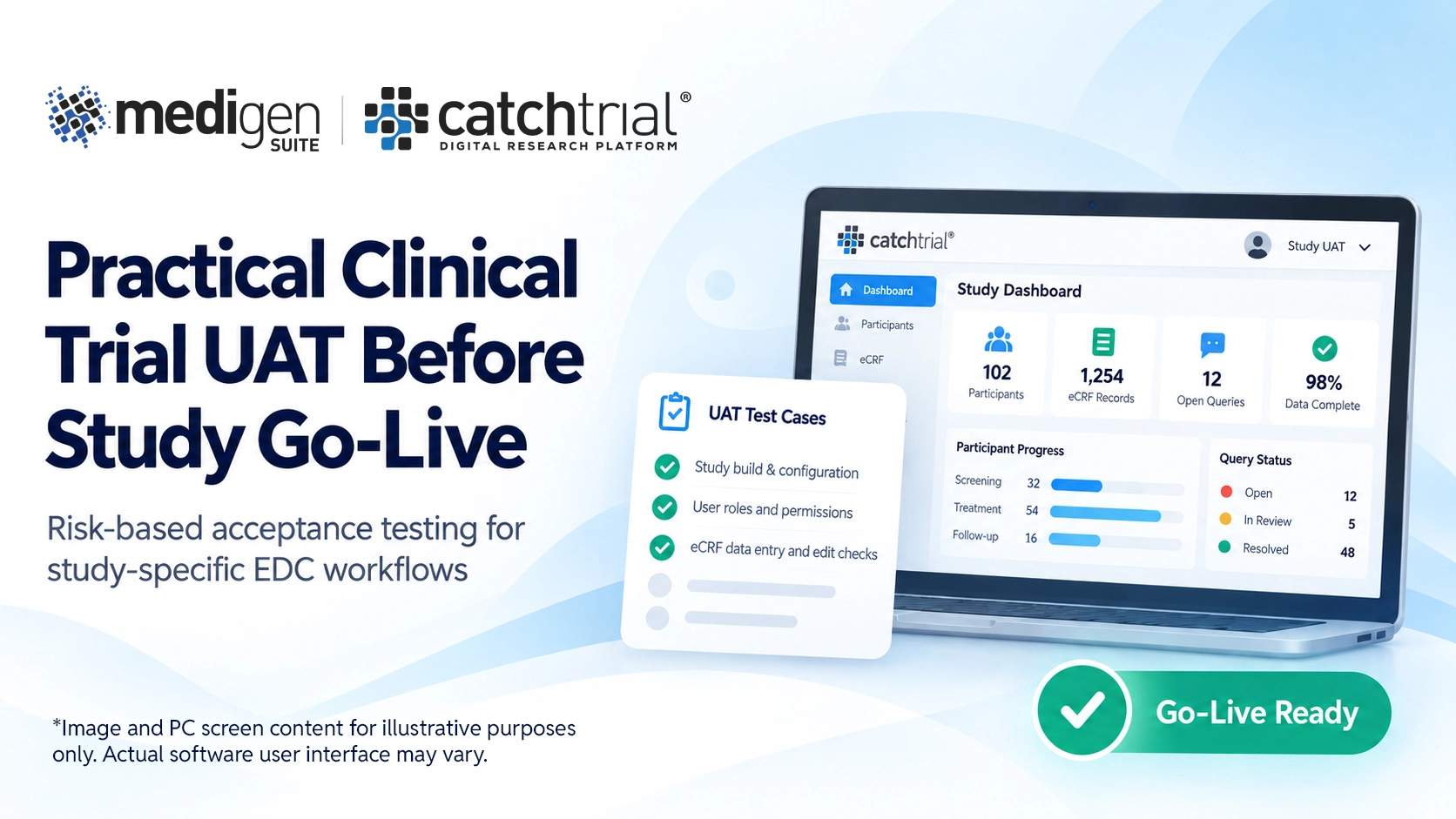
Sponsors should perform documented study-specific acceptance testing appropriate to the system’s intended use and associated risks. Testing typically addresses eCRF behavior, visit logic, user permissions, data entry checks, queries, audit trails, and relevant integrations. The objective is to confirm that the configured workflows meet approved requirements and that identified issues have been addressed appropriately before operational use.
Sources and Regulatory References
- U.S. Food and Drug Administration (FDA), October 2024.
Electronic Systems, Electronic Records, and Electronic Signatures in Clinical Investigations: Questions and Answers - European Medicines Agency (EMA), ICH E6(R3). ICH E6 Good Clinical Practice: Principles and Annex 1
- European Union, Regulation (EU) 2016/679. General Data Protection Regulation (GDPR)
- Medigen Suite. Catchtrial EDC+ Product Information
- U.S. Food and Drug Administration (FDA), September 2013.
Electronic Source Data in Clinical Investigations
Table of Contents
Latest Articles

Unblinding in Clinical Trials Done Right, One Patient at a Time
A treatment assignment must remain concealed until disclosure is [...]
Where the Benefits of Electronic Data Capture Really Come to Life
Replacing paper case report forms does not automatically improve [...]
Practical Clinical Trial UAT Before Study Go-Live
A study database can pass technical checks and still [...]
This article provides general information and does not constitute regulatory, legal, clinical, or compliance advice. Requirements and appropriate processes may vary by study, product, jurisdiction, and organization. Medigen Suite functionality should be used in accordance with applicable regulations, study documentation, and internal procedures.