

Comparing the best EDC systems for clinical trials starts with a simple point: choosing an electronic data capture platform affects far more than where study data are stored. An EDC system must fit the protocol, support reliable data handling, work for sites and study teams, and stand up to regulatory expectations.
The scale of modern clinical data makes that decision increasingly important. A 2026 peer-reviewed analysis by the Tufts Center for the Study of Drug Development (Tufts CSDD) examined 105 Phase II and III protocols and found that Phase III protocols now collect an average of approximately 5.9 million data points. That represents a 67% increase from 3.56 million in 2020, with data volume growing by about 11% annually.
Why EDC selection is an operational decision
EDC selection is really a study design and operating model decision. An electronic data capture system sits at the point where protocol requirements become day-to-day data entry, review, queries, corrections, and database finalization.
The same Tufts CSDD analysis found that, when non-core procedures and non-essential procedures supporting core or standard endpoints are considered together, nearly one-third of procedures and data points collected per protocol fall into these categories.
The practical implication is important. More functionality and more data collection are not automatically better. An EDC needs to support purposeful data collection aligned with study objectives, critical-to-quality factors, and the operational reality of the protocol.
ICH E6(R3) reflects the same direction. Its Principles and Annex 1 emphasize quality by design, fit-for-purpose systems, and proportionate, risk-based approaches to trial processes and technology. In the European Union, the Principles and Annex 1 became effective on July 23, 2025. FDA issued its final E6(R3) guidance in September 2025.
ICH E6(R3) Annex 2 has since progressed further. It reached ICH Step 4 on June 3, 2026, was adopted by the Committee for Medicinal Products for Human Use on June 25, 2026, and takes effect in the EU on January 15, 2027. Annex 2 addresses additional trial designs and data sources, including pragmatic and decentralized trials and trials incorporating real-world data.
The practical takeaway: the strongest EDC choice is not necessarily the platform with the longest feature list. It is the system whose configuration, controls, workflows, and support model fit the study’s critical data and operational complexity.
What an EDC system should support
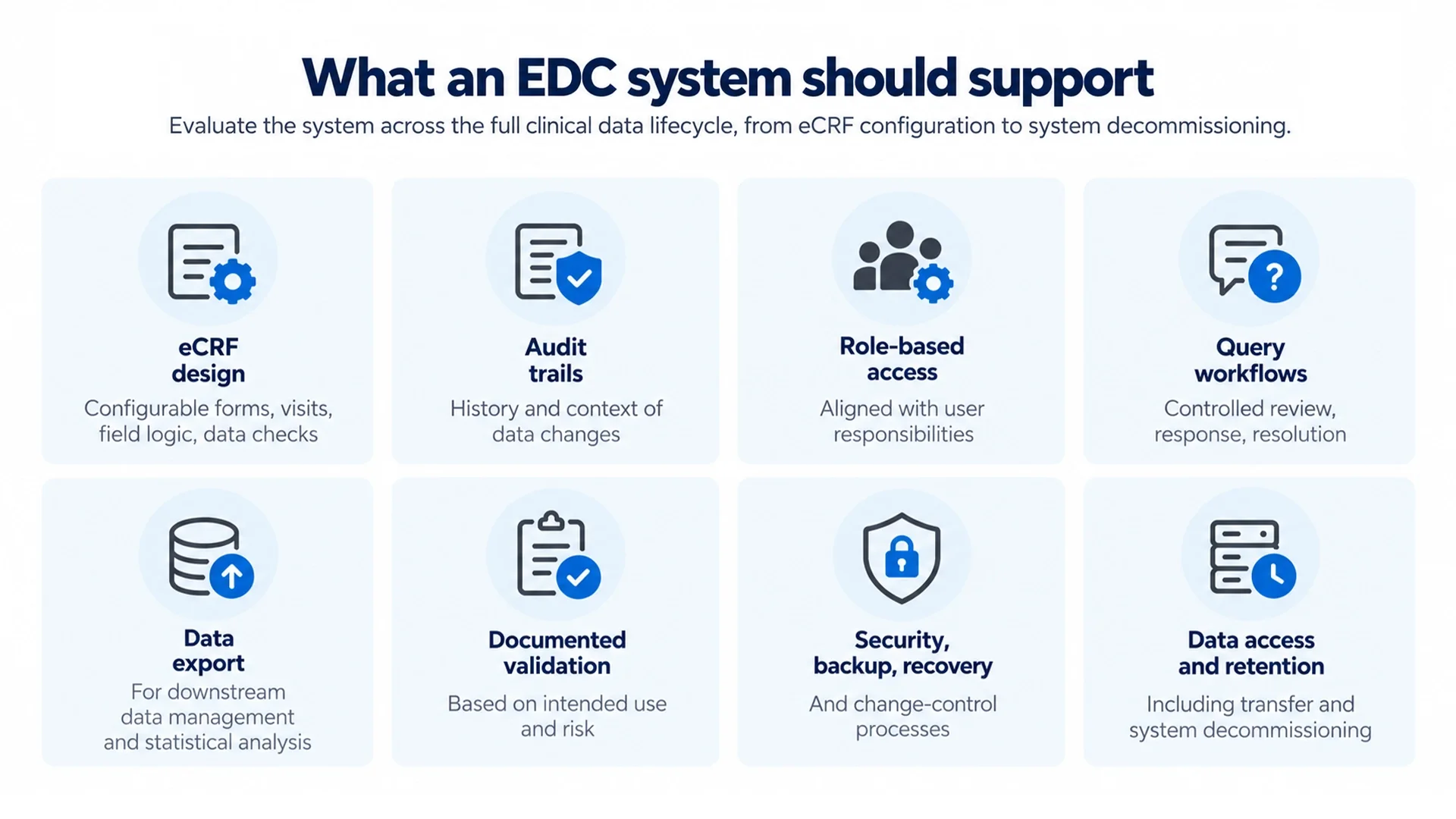
An EDC system should be assessed against the full clinical data lifecycle, not only data entry. That means examining what happens from eCRF configuration through data entry, review, correction, export, database lock, retention, and eventual system decommissioning.
FDA’s October 2024 final guidance on electronic systems, electronic records, and electronic signatures applies to sponsors, clinical investigators, institutional review boards, contract research organizations, and other parties involved in regulated clinical investigations. It addresses electronic records and systems that need to be trustworthy, reliable, and appropriately controlled.
For buyers comparing electronic data capture vendors, that translates into practical areas to evaluate:
- Protocol-aligned eCRF design, including configurable forms, visits, field logic, and data checks
- Secure audit trails that preserve the history and context of data changes
- Role-based access aligned with user responsibilities
- Query workflows supporting controlled review, response, and resolution
- Data export options appropriate for downstream data management and statistical analysis
- Documented validation based on intended use and risk
- Security, backup, recovery, and change-control processes
- Clear arrangements for data access, transfer, retention, and system decommissioning
These criteria are more useful than asking whether an electronic data capture vendor is simply “compliant.” Software capabilities matter, but compliance also depends on how a regulated organization validates, configures, governs, and uses the system.
Evaluate data quality and site workflow together
Data quality controls need to work within the site’s actual data-entry process. Required fields, range checks, format controls, conditional logic, cross-form checks, and queries can support more structured data collection when configured appropriately.
The European Medicines Agency guideline on computerized systems and electronic data in clinical trials provides detailed expectations for auditability. It states that audit trails should capture data changes at the individual field level rather than only at the eCRF page level. Changes resulting from data queries should remain traceable, and the audit trail should preserve the original electronic entry.
The EMA guideline also expects accurate and unambiguous electronic timestamps, with Coordinated Universal Time or the applicable time zone captured where relevant. For electronic data transfers during a trial, it expects transfers to be pre-specified and the transfer process to be validated to preserve data and file integrity.
These expectations are useful to translate directly into an EDC demonstration.
Consider a hypothetical multi-site study in which an investigator corrects an out-of-range laboratory value after a query. Rather than asking only whether the platform “has an audit trail,” the study team can ask to see the original value, corrected value, user identity, timestamp, reason for change, associated query history, and resulting data export.
The practical takeaway: when comparing electronic data capture vendors, test real workflows rather than generic screens.
Compare EDC vendors with a study-fit scorecard
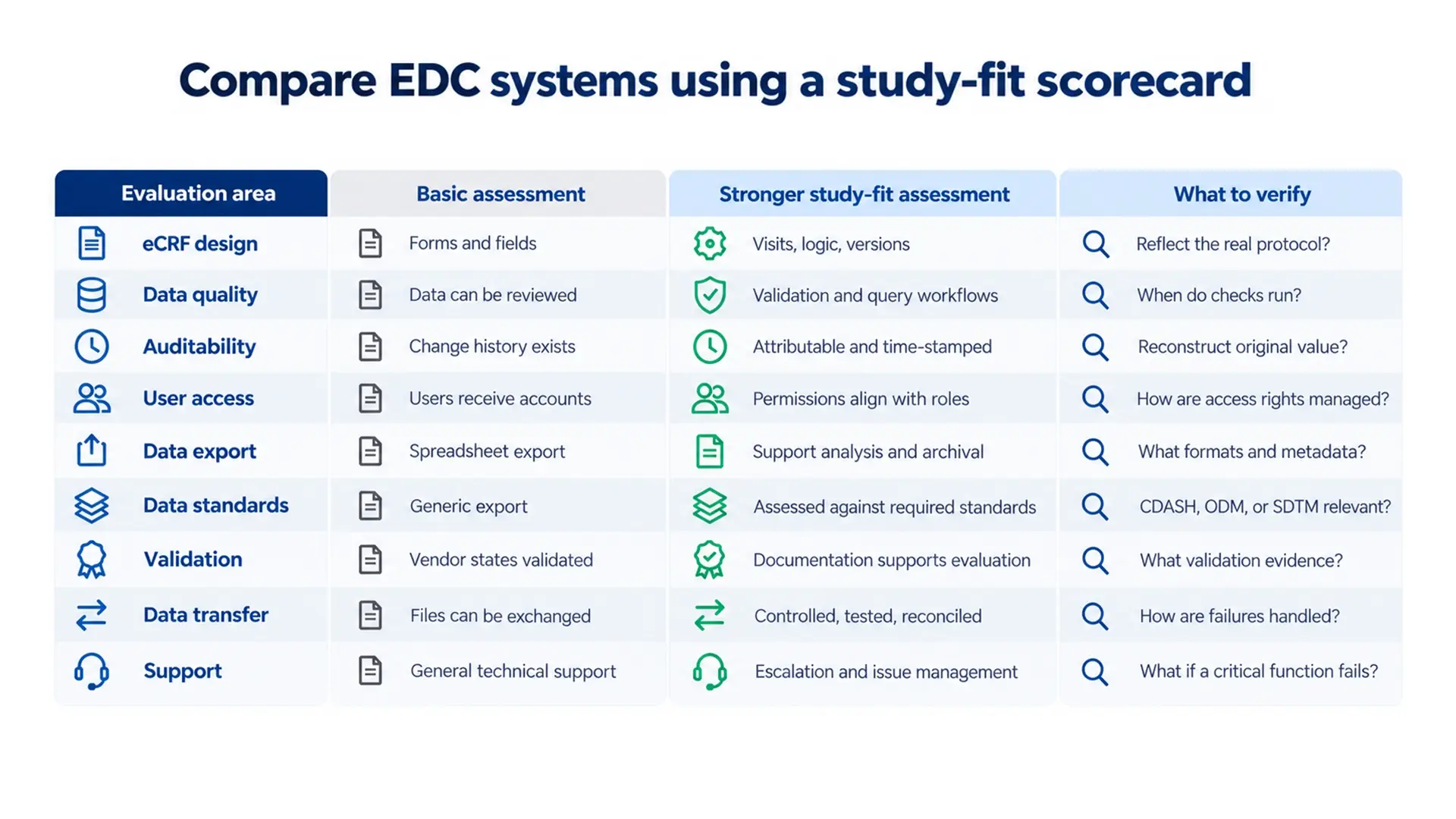
A structured scorecard turns vendor comparison into a documented study-fit decision instead of a feature-count exercise.
It can also give Clinical Operations, Data Management, Quality, IT, Biostatistics, and site-facing teams a common evaluation framework.
| Evaluation area | Basic assessment | Stronger study-fit assessment | What to verify |
|---|---|---|---|
| eCRF design | Forms and fields are available | Visits, logic, versions, and protocol-specific controls are configurable | Can the design reflect the real protocol without excessive workarounds? |
| Data quality | Data can be reviewed | Configurable validation and query workflows support structured review | When do checks run, who manages them, and how are exceptions handled? |
| Auditability | Change history exists | Changes remain attributable and time-stamped with historical context | Can reviewers reconstruct the original value, change, user, timing, and reason? |
| User access | Users receive accounts | Permissions can be aligned with study roles and responsibilities | How are access rights granted, changed, reviewed, and revoked? |
| Data export | Spreadsheet export is available | Outputs can support defined downstream analysis and archival workflows | What formats, metadata, filters, and status information are available? |
| Data standards | Generic export is available | Data workflows are assessed against required standards and mappings | Are CDASH, ODM, or SDTM-related requirements relevant to this program? |
| Validation | Vendor states the platform is validated | Documentation supports evaluation against intended use and risk | What validation evidence can be reviewed during vendor qualification? |
| Data transfer | Files can be exchanged | Transfer processes can be controlled, tested, and reconciled | How are completeness, integrity, failures, and reconciliation handled? |
| Support | General technical support exists | Escalation and issue-management processes are defined | What happens if a critical study function becomes unavailable? |
The evaluation should also account for scale. A platform supporting a relatively simple observational study may require a very different configuration from one supporting millions of data points, multiple protocol versions, complex follow-up schedules, and numerous investigational sites.
How Catchtrial EDC+ supports configurable study data workflows
Catchtrial EDC+ is designed to support configurable electronic data capture across protocol-driven study workflows. Its eCRF environment supports electronic management of clinical data, configurable system messages and warnings, data-integrity controls such as permitted ranges, and detailed audit logging.
The audit trail records who made a data change, when it occurred, the reason for the change, and the before-and-after values of the affected data point. These records can be exported through the Export Audit Trail function.
Query traceability can also be reviewed separately through the Export Query by Form function, which can include the query text, creation date, resolution details, and the associated form and field. Together, these capabilities can help study teams evaluate audit-trail and query workflows against their protocol and regulatory requirements.
Depending on the selected study configuration, Catchtrial EDC+ can also support customizable edit checks, automated or manual query workflows, eCRF versioning, conditional fields, role-specific query privileges, locking and freezing workflows, and controlled user permissions.
These capabilities become particularly relevant as study complexity grows. In the 2026 Tufts analysis, the average Phase III protocol generated almost 6 million individual data points. At that scale, structured validation, traceability, and efficient review become central elements of the data-management model.
Catchtrial EDC+ also supports data outputs for downstream use. Available configurations include data export and reporting options, including CSV and SAS outputs. The exact formats, metadata, filters, and configuration required for a study should be confirmed during study setup.
For programs using Clinical Data Interchange Standards Consortium (CDISC) standards, requirements should be defined more precisely. Clinical Data Acquisition Standards Harmonization (CDASH), the Operational Data Model (ODM), and the Study Data Tabulation Model (SDTM) address different parts of the clinical data lifecycle. Teams should confirm any required collection conventions, exchange formats, or downstream mappings during study setup rather than assuming that a generic export function covers them.
Visit the Catchtrial EDC+ product page for an overview of the platform and available study configuration options.
Regulatory expectations should shape vendor due diligence
Regulatory guidance makes vendor due diligence part of the EDC decision, not an afterthought. Buyers need to evaluate both the technology and the controls surrounding its intended use.
FDA’s 2024 electronic systems guidance recommends a risk-based approach to validation of electronic systems used in clinical investigations. It also addresses user access, security, electronic signatures, audit trails, data retention, and responsibilities when sponsors or other regulated parties use external service providers.
The EMA guideline similarly expects service providers to be appropriately qualified. It also states that electronic source data and associated audit trails should remain accessible to authorized investigators, monitors, auditors, and inspectors while participant confidentiality is protected.
Data portability deserves particular attention. The EMA guideline expects trial data transfers to preserve data and file integrity. FDA’s Part 11 Scope and Application guidance also makes clear that applicable predicate-rule record-retention requirements continue to apply and that retained records and copies should preserve their content and meaning.
The practical takeaway: ask electronic data capture vendors for evidence rather than broad compliance claims. Review validation documentation, user management, security controls, backup and recovery, change management, hosting arrangements, exports, audit trails, support processes, and end-of-study data availability.
Choose the EDC that fits the study you are actually running
The right EDC decision starts with the protocol and critical data, then works outward to workflow, governance, and technology. Phase III data volume has risen by roughly two-thirds since 2020, reaching approximately 5.9 million data points per protocol on average.
Build requirements around critical data, site processes, review responsibilities, protocol amendments, integrations, data standards, exports, retention, and regulatory scope before comparing demonstrations.
Then test each shortlisted system with realistic scenarios. Include corrections, queries, access changes, protocol revisions, data exports, locking, and end-of-study retrieval. This approach can make it easier to determine whether an EDC is suited to the operational reality of the study rather than simply checking whether a feature exists.
Catchtrial EDC+ is designed for configurable clinical data workflows and can be evaluated against these criteria using your own study requirements. Visit the Catchtrial EDC+ product page or request a demo to assess how the platform could support your next study.
Frequently Asked Questions
What are the best EDC systems for clinical trials?
The best EDC systems for clinical trials are not the ones with the longest feature list, but the ones that fit the protocol, critical data and regulatory scope of a specific study. When comparing electronic data capture companies, look for configurable eCRF design, field-level audit trails, controlled query workflows, documented validation and export options that match downstream requirements. The best electronic data capture software for one study may be oversized, or insufficient, for another, so a study-fit scorecard and scenario-based demonstrations are more reliable than generic rankings.
What should I look for when comparing EDC vendors?
Start with protocol fit, data-integrity controls, audit trails, user access, validation evidence, query workflows, exports, security, and support. Modern Phase III protocols can generate close to 6 million data points on average, so scalability and structured data review deserve particular attention. Vendor evaluation should also cover implementation, change control, hosting, data ownership, retention, and end-of-study retrieval.
How do electronic data capture systems support data quality?
Electronic data capture systems typically support data quality through configurable forms, validation rules, edit checks, queries, audit trails, and review workflows. Regulatory guidance also expects traceability when electronic data are changed. EMA guidance, for example, states that audit trails should capture changes at the individual field level. The effectiveness of these controls still depends on appropriate study design and configuration.
Does an EDC system need to comply with 21 CFR Part 11?
21 CFR Part 11 applies to electronic records and signatures within its regulatory scope when they are used to satisfy applicable FDA record requirements. Selecting appropriate software is only one component. Regulated organizations also need suitable validation, procedures, access controls, security, training, record retention, and oversight for the way the system is configured and used.
What makes an EDC system a strong fit for a complex study?
A strong fit depends on the protocol, critical data, user roles, review model, integrations, and regulatory scope. Complex studies may require additional configurability for conditional logic, protocol versions, specialized data reviews, exports, or long-term follow-up. A study-specific demonstration is therefore more informative than comparing feature counts alone.
Should an EDC system support CDISC standards?
That depends on the study’s data strategy and downstream requirements. CDASH addresses data-collection conventions, ODM supports structured data and metadata exchange, and SDTM is used to organize clinical study data for regulatory submission workflows. For studies supporting applicable FDA or PMDA submissions, standardized submission data such as SDTM may be required, so the practical question is how the EDC and its exports fit into the sponsor’s standards and submission pipeline rather than whether the EDC produces SDTM directly.
How early should an EDC system be selected?
EDC selection should occur early enough to allow requirements definition, vendor qualification, study build, validation activities, testing, training, and site readiness before data collection starts. The exact timeline depends on protocol stability, study complexity, integrations, migrations, and organizational procedures. Earlier selection may give teams more time to test critical workflows before study activation.
Sources and regulatory references
- Getz K, Botto E, Arques AC, et al. Insights Informing Strategies for Optimizing the Collection of Clinical Trial Data. Therapeutic Innovation & Regulatory Science. 2026;60:563-574.
- European Medicines Agency. ICH E6 Good Clinical Practice – Scientific Guideline. ICH E6(R3) Principles and Annex 1 became effective in the EU on July 23, 2025. Annex 2 reached ICH Step 4 on June 3, 2026, was adopted by CHMP on June 25, 2026, and becomes effective in the EU on January 15, 2027.
- U.S. Food and Drug Administration. E6(R3) Good Clinical Practice. Final Guidance, September 2025.
- U.S. Food and Drug Administration. Electronic Systems, Electronic Records, and Electronic Signatures in Clinical Investigations: Questions and Answers. Final Guidance, October 2024.
- U.S. Food and Drug Administration. Part 11, Electronic Records; Electronic Signatures – Scope and Application. Guidance for Industry, September 2003.
- European Medicines Agency. Guideline on computerised systems and electronic data in clinical trials, EMA/INS/GCP/112288/2023.
- Clinical Data Interchange Standards Consortium. CDISC standards, including the foundational standards Clinical Data Acquisition Standards Harmonization (CDASH) and Study Data Tabulation Model (SDTM), and the Operational Data Model (ODM) data exchange standard.
- U.S. Food and Drug Administration. Providing Regulatory Submissions in Electronic Format – Standardized Study Data. Final Guidance, June 2021.
- Pharmaceuticals and Medical Devices Agency. Revision of Technical Conformance Guide on Electronic Study Data Submissions. April 8, 2024. PMDA/CPE Notification No. 1345 and PMDA/CRS Notification No. 21, provisional English translation.
Table of Contents
Latest Articles

Unblinding in Clinical Trials Done Right, One Patient at a Time
A treatment assignment must remain concealed until disclosure is [...]
Where the Benefits of Electronic Data Capture Really Come to Life
Replacing paper case report forms does not automatically improve [...]
Practical Clinical Trial UAT Before Study Go-Live
A study database can pass technical checks and still [...]
This article provides general information and does not constitute regulatory, legal, clinical, or compliance advice. Requirements and appropriate processes may vary by study, product, jurisdiction, and organization. Medigen Suite functionality should be used in accordance with applicable regulations, study documentation, and internal procedures.