
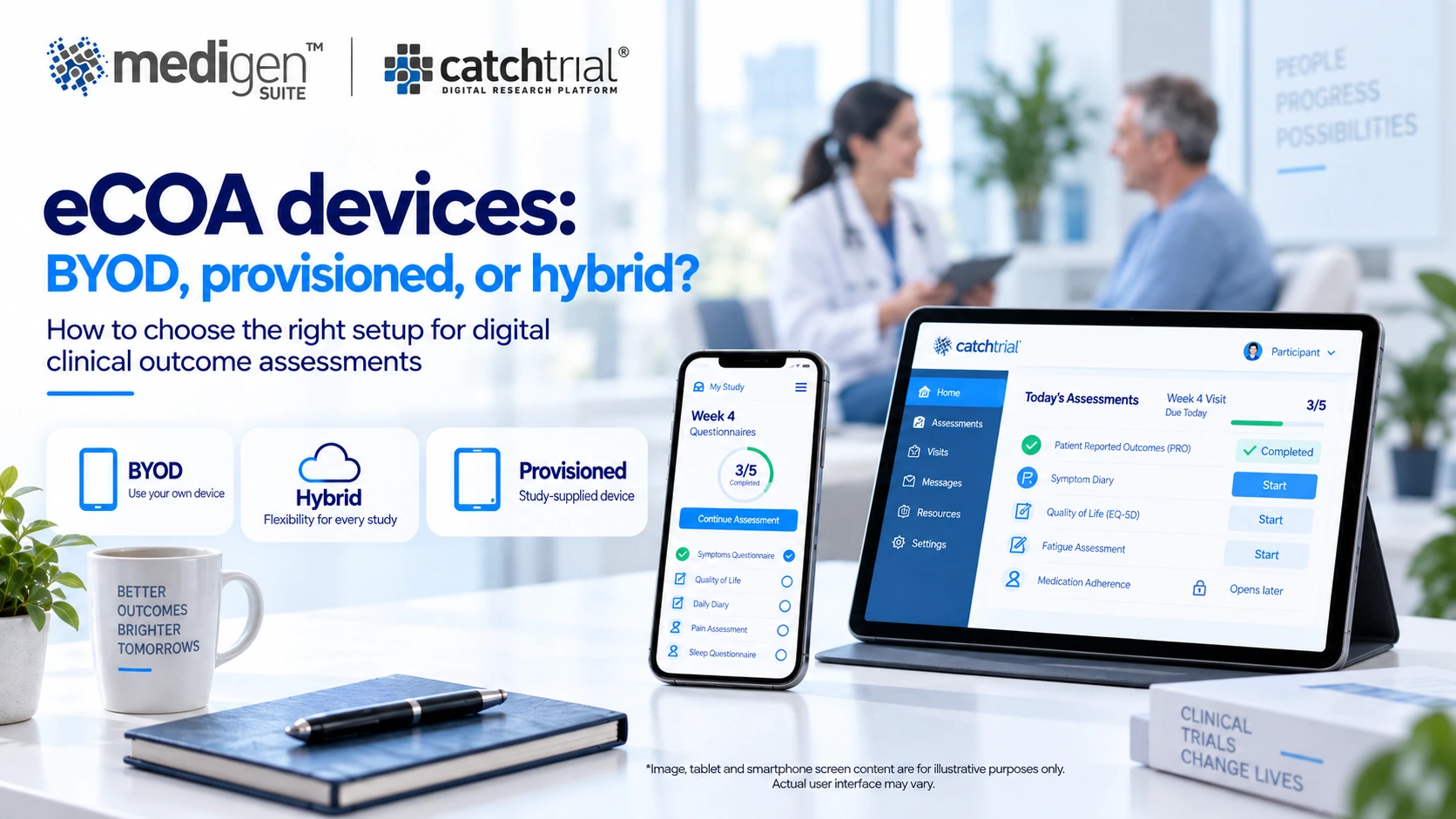
Choosing how participants access electronic clinical outcome assessments can shape far more than device logistics. The right eCOA devices need to fit the assessment, participant population, study design, technical requirements, and regulatory context.
For many eCOA trials, the choice comes down to three models: participants use their own devices, the study supplies provisioned devices, or the protocol supports a combination of both. Each can work well, but each shifts the operational and technical risks in a different direction.
Why your eCOA device strategy matters
An eCOA device is part of the data collection pathway, not simply the screen on which a questionnaire appears.
Electronic clinical outcome assessment, or eCOA, covers patient-reported outcomes (PROs), clinician-reported outcomes (ClinROs), observer-reported outcomes (ObsROs), and performance outcomes (PerfOs). These assessment types provide different perspectives on how a participant feels, functions, or survives. [1]
How an assessment is presented and completed therefore needs to remain appropriate for the instrument and its intended use.
Performance outcomes are a particularly clear example of why device strategy matters beyond ePRO. When a task depends on factors such as screen size, sensors, or timing accuracy, tighter control of the hardware configuration may be important to the assessment.
The European Medicines Agency specifically recognizes that electronic patient-reported outcome and clinician-reported outcome data can be captured on privately owned devices such as mobile phones, tablets, computers, and wearables. Its guidance also addresses web applications, native applications, and hybrid technological approaches. [2]
Importantly, this EMA guideline applies to clinical trials of investigational medicinal products and should not be presented as directly governing clinical investigations under the EU Medical Device Regulation. [2]
The practical takeaway is simple: device strategy should follow the assessment and protocol requirements rather than being treated as an isolated technology decision.
A short symptom diary completed at home, for example, may create very different device requirements from a performance-based assessment where display characteristics, sensors, or response timing are particularly important.
BYOD brings familiarity, with more device variability
Bring your own device, or BYOD, lets participants use a compatible personal smartphone, tablet, or computer to complete electronic assessments.
The attraction is clear. Participants already know their own devices and usually carry them throughout the day. Depending on the study setup, BYOD may also help reduce the amount of dedicated hardware that needs to be distributed, tracked, replaced, and recovered.
Research supports the feasibility of this model for certain patient-reported outcome measures. In a randomized equivalence trial of 155 participants, paper, BYOD, and provisioned-device administration showed equivalence across the response-scale types evaluated. In the same study, 94 percent of participants said they would definitely or probably be willing to download a clinical trial app to their own mobile device. [8]
These findings support BYOD for the PRO measures and response scales studied, but they do not establish interchangeability for every patient-reported outcome measure, instrument, or device configuration.
A 2022 crossover study involving 64 participants with stable chronic obstructive pulmonary disease also found equivalent scores between provisioned-device and BYOD completion for the CAT and E-RS:COPD measures within the study’s predefined equivalence analyses. [9]
These findings support BYOD for the patient-reported outcome measures evaluated rather than establishing equivalence across all ePRO instruments or participant populations.
The tradeoff is a less uniform technical environment. Different participants may have different screen sizes, operating systems, browser versions, device settings, security patches, and connectivity conditions.
EMA guidance for medicinal-product clinical trials states that minimum technical specifications should be established for BYOD and that factors such as operating-system support, security updates, screen size, data quality, and the possible impact of software updates should be considered. [2]
For study teams, BYOD therefore shifts part of the operational focus from hardware distribution toward compatibility, validation, support, and contingency planning.
Provisioned devices offer greater standardization
With a provisioned model, the study supplies participants with preselected hardware for completing assessments.
This approach can make the technical environment easier to standardize. Device type, operating system, software version, and configuration can be controlled more tightly than across a broad population of personal devices.
Provisioned hardware may be particularly relevant when:
- device characteristics are important to the assessment
- the study population may not reliably have compatible technology
- access to a personal device cannot be assumed
- a tightly controlled technical configuration is preferred
- performance-based assessments depend on device-specific characteristics
- study procedures require dedicated equipment
The additional control comes with additional logistics. Devices may need to be configured, distributed, inventoried, replaced if lost or damaged, and recovered at the end of participation.
ICH E6(R3) states that where equipment for data acquisition is provided to trial participants by the investigator, the investigator or institution should ensure that traceability is maintained and that participants receive appropriate training. [6]
The practical question is therefore not whether provisioned devices are inherently better controlled than BYOD. It is whether that additional level of hardware standardization is valuable enough for the particular study and assessment to justify the associated operational model.
BYOD, provisioned, or hybrid: comparing the options
There is no single device strategy that fits every eCOA clinical trial. A defensible decision starts with the endpoint, assessment method, participant population, technical constraints, and study geography.
| Decision factor | BYOD | Provisioned device | Hybrid approach |
| Hardware | Participant-owned compatible device | Study-supplied device | Study-supplied device |
| Technical environment | More variation across supported configurations | More standardized configuration | Both environments need to be considered |
| Device logistics | Less dedicated hardware distribution may be required | Requires distribution, tracking, replacement, and recovery processes | Provisioning remains necessary for selected participants |
| Participant familiarity | Uses technology already familiar to the participant | Requires use of a separate study device | Supports either route where appropriate |
| Compatibility planning | Requires defined minimum specifications and supported configurations | Focuses on the selected study configuration | Requires controls for both pathways |
| Contingency planning | Needed for incompatible devices, updates, connectivity, or device loss | Needed for hardware failure, loss, or replacement | Requires documented movement between routes |
| Typical consideration | Personal-device use fits the assessment and population | Standardized hardware has study value | Flexibility and an alternative access route are priorities |
A hybrid strategy can offer a useful middle ground. Participants who have a compatible device and are comfortable using it can follow the BYOD route, while a provisioned option remains available when needed.
This is particularly relevant for clinical trials of investigational medicinal products within the scope of the EMA guideline. EMA expects an alternative method of data collection, such as a sponsor-provided device, to be available so that participants are not excluded because they cannot or do not wish to use BYOD. [2]
Consider a hypothetical multinational study collecting a short weekly patient-reported symptom assessment. Most participants may be able to use their own smartphones, while a smaller group may need a study-supplied device because of device compatibility, accessibility, or personal preference.
A hybrid design could support both populations while avoiding the need to force the entire study into one hardware model.
How Catchtrial ePRO/eCOA supports BYOD and provisioned workflows
Catchtrial ePRO/eCOA supports completion on participant-owned devices, so a BYOD, provisioned, or hybrid design can be implemented within the same study environment rather than requiring a separate system for each route.
Around that, the platform is built to let study teams configure visits, forms, and fields to match the protocol, including electronic questionnaires whose total score is calculated automatically when the form is saved. Integrity checks can be set on that score, for example to flag a result that falls outside protocol criteria at enrollment.
Where a study issues hardware, the Device Accountability Log add-on is designed to support device tracking, inventory, and status verification within the system. This is directly relevant to the traceability ICH E6(R3) expects when equipment is provided to participants. [6]
For multinational programs, multilanguage functionality is also available, with language settings configurable for individual users.
An integrated Helpdesk is designed to give users a traceable route for reporting and following technical issues. That may be particularly useful in a BYOD design, where support requirements can vary across participant-owned devices.
The eCOA device strategy itself still needs to be defined during study planning. In particular, sponsors should confirm which operating systems are supported, the minimum device specifications, and whether the participant-facing solution runs as a web application, native application, or hybrid model.
Hardware procurement, provisioning processes, connectivity requirements, screen characteristics, and instrument-specific validation should likewise be confirmed for the individual study rather than assumed from the software platform alone.
Teams evaluating their digital assessment workflow can visit the Catchtrial ePRO/COA page to review how Catchtrial ePRO/eCOA could fit within their planned device and outcome-assessment strategy.
Regulation focuses on reliable data, not device ownership alone
Using a participant’s own device does not remove the responsibilities that apply to computerized clinical trial systems and electronic records.
FDA’s December 2023 final guidance on digital health technologies for remote data acquisition recognizes that digital health technologies can rely on general-purpose computing platforms such as smartphones. Sponsors should assess whether the supporting technology is adequate for the intended function of the digital health technology. [3]
FDA also recommends evaluating the advantages and disadvantages of allowing participants to use their own technologies. Its guidance recognizes that familiar personal technology may reduce the burden of using an additional sponsor-provided device, while participant-owned technology will not be appropriate in every situation. [3]
FDA’s October 2024 final guidance on electronic systems, electronic records, and electronic signatures addresses the use of electronic records in clinical investigations and the conditions under which those records and systems are considered trustworthy and reliable. [4]
For FDA-regulated records, 21 CFR Part 11 is also relevant when applicable. Part 11 applies to specified electronic records created, modified, maintained, archived, retrieved, or transmitted under FDA recordkeeping requirements, as well as certain electronic records submitted to FDA. The underlying FDA recordkeeping requirements are commonly referred to as predicate rules. [5]
ICH E6(R3) similarly addresses fit-for-purpose computerized systems, documented procedures, appropriate training, access controls, security, metadata, audit trails, data transfer, and protection against unauthorized alteration or loss. [6]
Where the General Data Protection Regulation applies, device strategy also needs to account for privacy principles including data minimization, data protection by design and by default, and technical and organizational measures appropriate to the risk. [7]
BYOD and provisioned approaches therefore create different control points, but neither removes the need for documented, risk-based oversight.
Choosing the right eCOA devices starts with the protocol
The strongest device strategy begins with what the study needs to measure and who needs to complete the assessment.
Before committing to BYOD, provisioned hardware, or a hybrid model, teams should consider the assessment itself, expected participant population, accessibility needs, geographic footprint, technology requirements, support model, and contingency process.
They should also ask what happens when the preferred route does not work. A participant may lose a device, an operating system may update, connectivity may fail, or a personal device may no longer meet the study’s minimum specifications.
Planning those scenarios before deployment can help make the device model more resilient and easier to manage across the study lifecycle.
The choice is therefore not simply BYOD versus provisioned hardware. It is about developing an outcome-assessment strategy in which the device, assessment, software, participant experience, and data controls work together.
To see how Catchtrial ePRO/eCOA could support digital clinical outcome assessments within your study, visit the Catchtrial ePRO/eCOA page or request a demo to discuss your planned eCOA workflow and device strategy.
Frequently Asked Questions
What is the difference between BYOD and a provisioned eCOA device?
BYOD uses a compatible device already owned by the participant, while a provisioned model uses hardware supplied for the study. BYOD introduces a broader range of hardware and software configurations. Provisioning creates a more standardized technical environment but requires additional device distribution, tracking, replacement, and recovery processes.
Are BYOD eCOA devices acceptable in regulated clinical trials?
Yes. BYOD can be used in regulated clinical trials when the approach is appropriate for the assessment and applicable validation, data integrity, security, privacy, and study-control requirements are addressed. For clinical trials of investigational medicinal products within its scope, EMA specifically recognizes BYOD for electronic PRO and ClinRO data and expects an alternative data-collection route to be available for participants who cannot or do not wish to use their own device. [2]
Is BYOD always cheaper than provisioned devices?
No. BYOD may reduce dedicated hardware procurement and distribution needs, but total cost depends on the study. Compatibility testing, technical support, validation activities, security controls, and provisioned fallback devices can still create costs. The more useful comparison is the full operating model rather than the purchase price of the hardware alone.
When should a clinical trial consider provisioned eCOA devices?
Provisioned devices may be appropriate when standardizing the technical environment is particularly important, compatible personal-device access cannot be assumed, or the characteristics of the assessment favor a defined device configuration. Performance-based assessments may also warrant tighter hardware control when screen characteristics, sensors, or timing accuracy are relevant to the task.
Can BYOD and provisioned devices be used in the same eCOA trial?
Yes. A hybrid model can combine BYOD with provisioned devices when both pathways are appropriately planned and controlled. This approach may be useful when most participants can use compatible personal devices but an alternative is needed for participants who lack suitable hardware, prefer not to use it, or encounter technical issues.
What should sponsors evaluate before selecting an eCOA device strategy?
Sponsors should evaluate the assessment requirements, participant population, supported hardware and software, screen and usability considerations, connectivity, security, privacy, validation needs, technical support, training, and contingency procedures. The device decision should form part of the broader eCOA implementation and risk-management strategy rather than being treated as a standalone procurement choice.
Sources and regulatory references
[1] U.S. Food and Drug Administration. Patient-Focused Drug Development Glossary.
[2] European Medicines Agency. Guideline on computerised systems and electronic data in clinical trials. EMA/INS/GCP/112288/2023, 9 March 2023.
[3] U.S. Food and Drug Administration. Digital Health Technologies for Remote Data Acquisition in Clinical Investigations. Final guidance, December 2023.
[4] U.S. Food and Drug Administration. Electronic Systems, Electronic Records, and Electronic Signatures in Clinical Investigations: Questions and Answers. Final guidance, October 2024.
[5] U.S. Food and Drug Administration. Part 11, Electronic Records; Electronic Signatures – Scope and Application. Guidance for industry, September 2003.
[6] International Council for Harmonisation. ICH E6(R3) Guideline for Good Clinical Practice. Final consolidated version, adopted 16 June 2026.
[7] European Union. Regulation (EU) 2016/679, General Data Protection Regulation.
[8] Byrom B, et al. Measurement Equivalence of Patient-Reported Outcome Measure Response Scale Types Collected Using Bring Your Own Device Compared to Paper and a Provisioned Device. Value in Health. 2018;21(5):581-589.
[9] Hudgens S, et al. Comparability of a provisioned device versus bring your own device for completion of patient-reported outcome measures by participants with chronic obstructive pulmonary disease: quantitative study findings. Journal of Patient-Reported Outcomes. 2022.
Table of Contents
Latest Articles
BYOD or provisioned? Rethinking your eCOA device strategy
Choosing how participants access electronic clinical outcome assessments can [...]
21 CFR Part 11 password requirements: what the regulation actually says
A 90-day password change is not a 21 CFR [...]
Clinical trial software for the connected study stack
Clinical trials are generating more data from more sources, [...]
This article provides general information and does not constitute regulatory, legal, clinical, or compliance advice. Requirements and appropriate processes may vary by study, product, jurisdiction, and organization. Medigen Suite functionality should be used in accordance with applicable regulations, study documentation, and internal procedures.