

The type of clinical trial you run shapes almost every operational decision that follows, from protocol design and data collection to site management and regulatory planning. Yet “types of clinical trials” can describe several different characteristics, including whether a study is interventional or observational, its stage of development, and the design used to answer its research question.
For sponsors and clinical operations teams, understanding these distinctions is more than terminology. It helps translate the clinical development strategy into appropriate data collection, participant management, site workflows, oversight, and technology requirements.
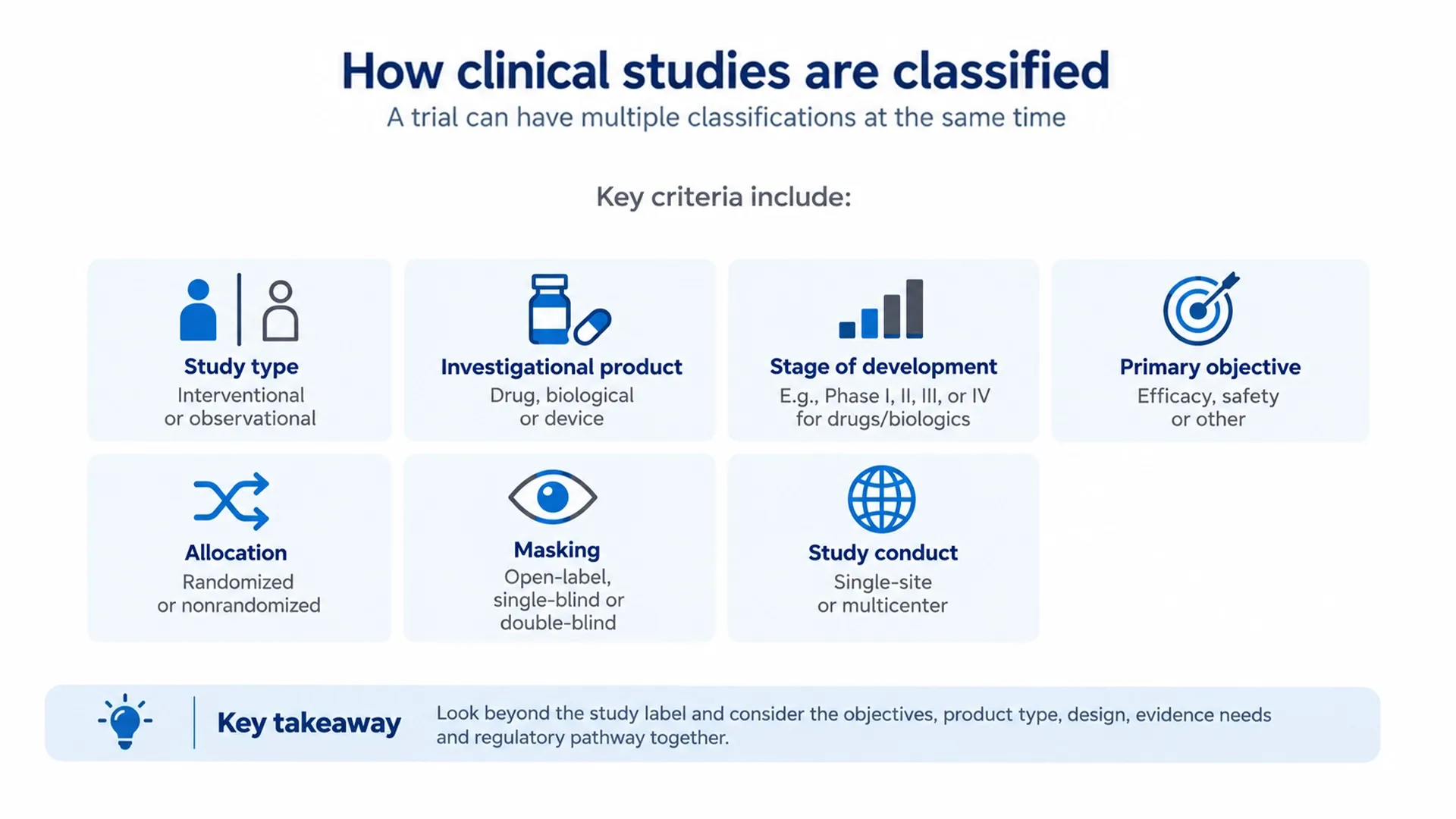
How clinical studies are classified
There is no single classification that fully describes every clinical study. A trial can simultaneously be interventional, randomized, multicenter, double-blind, parallel-group, and Phase III, for example.
Useful classification criteria include:
- Whether the study is interventional or observational
- The type of investigational product
- The stage of clinical development
- The study’s primary objective
- The intervention model
- Randomized or nonrandomized allocation
- Masking or blinding
- Single-site or multicenter conduct
- Pre-market, post-approval, or postmarket objectives
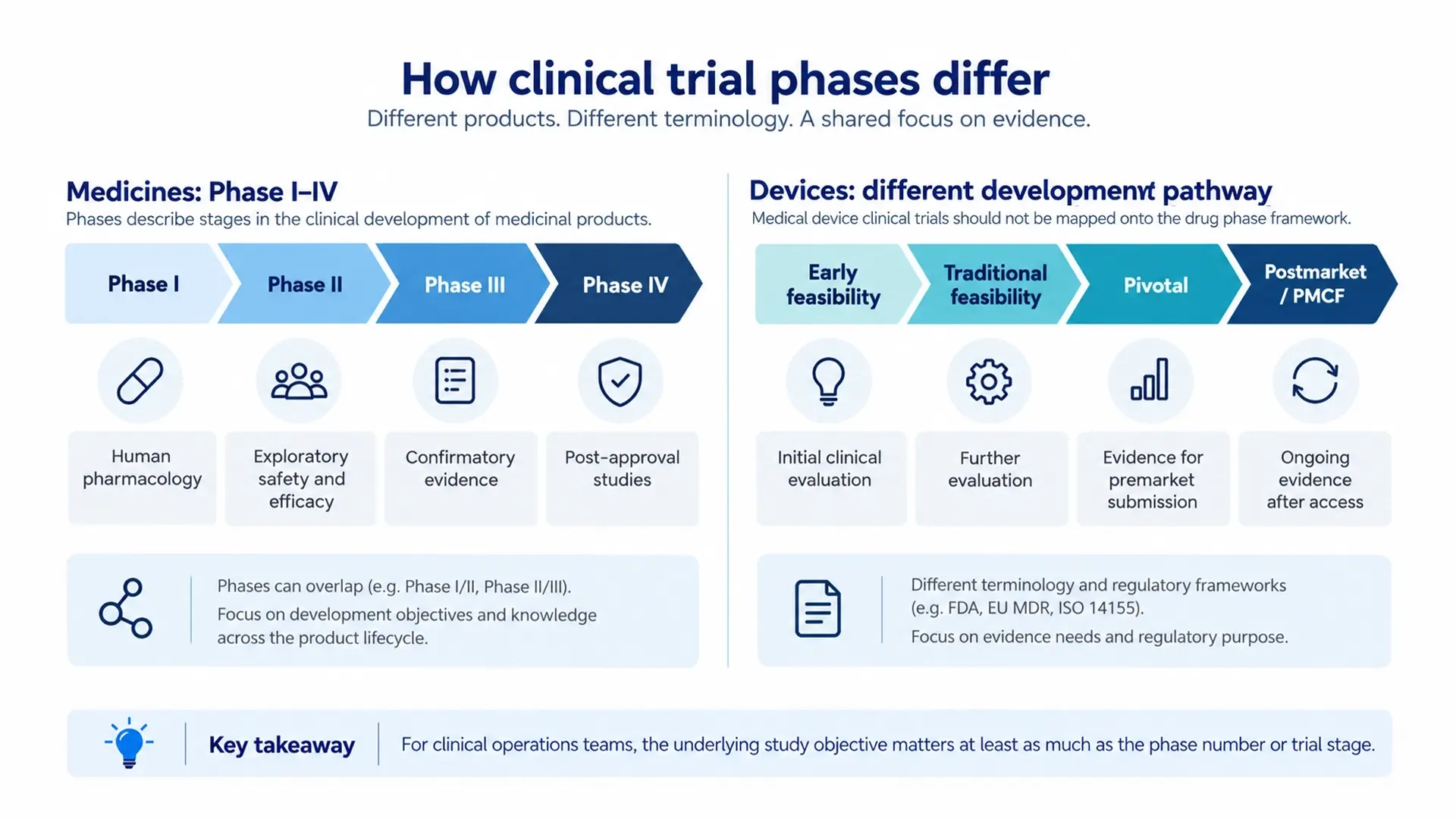
The terminology also changes according to the product being studied. Phase I through Phase IV terminology is principally associated with drugs and biological products, while medical device development uses different regulatory and clinical investigation concepts.
ClinicalTrials.gov makes this distinction particularly clear. Its phase terminology applies to drug and biological product trials, while “Not Applicable” is used for trials without FDA-defined phases, including device trials.
The practical takeaway is to look beyond the study label and consider the objectives, product type, design, evidence needs, and regulatory pathway together.
Interventional and observational studies
One of the most fundamental distinctions is whether investigators prospectively assign participants to an intervention.
ClinicalTrials.gov defines an interventional study as one in which participants are prospectively assigned to one or more interventions according to a protocol to evaluate biomedical or health-related outcomes. In an observational study, investigators assess outcomes in predefined groups without assigning the specific interventions received by participants.
ClinicalTrials.gov also identifies Patient Registry as an observational study subtype.
Consider a hypothetical cardiovascular development program. A randomized investigation comparing an investigational therapy with a control would be interventional. A registry prospectively collecting outcomes from patients treated according to routine clinical practice could be observational.
Both approaches may generate valuable clinical evidence, but their protocols, data flows, participant interactions, monitoring strategies, and applicable regulatory requirements can differ substantially.
Types of clinical trials by primary purpose
For interventional studies, ClinicalTrials.gov asks sponsors to declare a primary purpose. This is also the classification most people have in mind when they refer to the types of clinical trials. The categories include:
- Treatment: evaluating interventions for treating a disease or condition
- Prevention: assessing interventions intended to prevent a disease or condition from developing
- Diagnostic: evaluating interventions for identifying a disease or condition
- Screening: identifying a condition or its risk factors in people not yet known to have it
- Supportive care: maximizing comfort, reducing side effects, or limiting decline in health or function
- Health services research: evaluating how healthcare is delivered, organized, managed, or financed
- Basic science: examining the underlying mechanism of action of an intervention
- Device feasibility: evaluating the feasibility of a device or prototype rather than health outcomes
The primary purpose shapes the endpoints, the participant population, and the data that must be collected. A prevention trial in healthy volunteers and a treatment trial in hospitalized patients can differ as much operationally as two trials at different phases.
How clinical trial phases differ for medicines
Phase I through Phase IV terminology primarily describes stages in the clinical development of medicinal products.
ICH E8(R1), General Considerations for Clinical Studies, adopted at Step 4 on October 6, 2021, describes human pharmacology studies as usually referred to as Phase I, exploratory studies as usually Phase II, confirmatory studies as usually Phase III, and post-approval studies as usually Phase IV.
| Clinical trial phase | Typical focus |
|---|---|
| Phase I | Human pharmacology, including initial safety, tolerability, pharmacokinetics, and pharmacodynamics |
| Phase II | Exploratory safety and efficacy, including development of dose and treatment regimen |
| Phase III | Confirmatory evidence on efficacy and safety for the intended population and use |
| Phase IV | Additional studies after approval to further characterize safety, efficacy, or use |
The phases should not be viewed as four completely isolated steps. ICH E8(R1) emphasizes development objectives and the accumulation of knowledge across the product lifecycle, and some studies combine characteristics of more than one phase.
ClinicalTrials.gov likewise recognizes combined phases such as Phase I/Phase II and Phase II/Phase III, as well as Early Phase 1, formerly known as Phase 0, which covers exploratory studies with very limited human exposure and no therapeutic or diagnostic intent.
In the European Union, clinical trials of medicinal products are authorized under Regulation (EU) No 536/2014, the Clinical Trials Regulation, regardless of whether they are classified as Phase I, II, III, or IV.
For clinical operations teams, the underlying study objective therefore matters at least as much as the phase number.
Device clinical trials follow a different development pathway
Medical device clinical trials should not automatically be mapped onto the Phase I through Phase IV drug framework.
In the United States, FDA terminology commonly includes early feasibility, traditional feasibility, and pivotal clinical investigations.
FDA’s October 2013 guidance describes an early feasibility study as a limited clinical investigation conducted early in device development. Such studies typically involve a small number of participants and may evaluate initial clinical safety, device functionality, and the device design concept. Findings can also inform modifications to the device and subsequent clinical development.
Traditional feasibility investigations build on this early evidence and can help refine the device, study procedures, endpoints, and design of a later pivotal investigation.
Pivotal investigations have a different evidentiary purpose. FDA’s November 2013 guidance addresses clinical investigations intended to support premarket submissions and discusses how study design should be matched to the evidence needed for a particular device and regulatory pathway.
| Device investigation stage | Primary role |
|---|---|
| Early feasibility | Initial clinical evaluation of the device concept, functionality, and safety early in development |
| Traditional feasibility | Further evaluation that can inform device development and the design of a later pivotal investigation |
| Pivotal | Generation of clinical evidence intended to support the relevant premarket regulatory submission |
| Postmarket / PMCF | Continued collection and evaluation of clinical evidence after market access, as applicable |
The European framework uses different terminology. Regulation (EU) 2017/745 on medical devices addresses clinical investigations supporting clinical evaluation and conformity assessment, while post-market clinical follow-up, or PMCF, supports continued clinical evidence generation after market access. ISO 14155:2026 provides the international good clinical practice framework for the design, conduct, recording, and reporting of clinical investigations of medical devices.
For international device programs, the practical question is therefore not simply “Which phase is this trial?” It is what evidence is required at this stage of device development, for what regulatory purpose, and under which jurisdictional framework.
Study design creates another layer of difference
Two trials at the same development stage may require substantially different operational models because their study designs differ.
ClinicalTrials.gov recognizes interventional models including single-group, parallel, crossover, factorial, and sequential designs. Interventional trials can also differ by allocation, masking, primary purpose, endpoints, follow-up, and other design characteristics.
| Study characteristic | Example | Operational consideration |
|---|---|---|
| Single-group | All participants receive one intervention | Data collection centers on predefined outcomes within the study group |
| Parallel | Two or more groups receive different interventions | Requires consistent data collection and management across study arms |
| Crossover | Participants receive interventions during different periods | Requires careful management of treatment periods, sequence, and timing |
| Randomized | Participants are assigned according to a randomization method | Requires allocation processes consistent with the protocol |
| Multicenter | Multiple sites conduct the same study | Increases the importance of standardized data and study workflows |
| Long-term follow-up | Participants remain in follow-up for several years | Requires sustained management of visits, data, sites, and participants |
Consider a medical device program moving from a small feasibility investigation to a multinational pivotal study. Even where the investigational device remains similar, additional sites, larger participant numbers, more complex endpoints, and longer follow-up can materially change the operational requirements.
Study technology should therefore be planned around the protocol rather than selected solely on the basis of a broad label such as “Phase III” or “pivotal.”
How Medigen Suite can support different clinical trial designs
As study designs and development stages change, the underlying eClinical environment needs enough flexibility to reflect different protocols, participant pathways, data structures, and oversight models.
Catchtrial EDC+ supports configurable study structures, including visits, electronic case report forms, and individual fields. Its configuration options also include eCRF versioning, edit checks, conditional forms, and study-role management. These capabilities are designed to help teams adapt electronic data capture workflows to differences in protocol design, study stage, site setup, and participant journey.
For example, a feasibility study may require a relatively focused set of forms and visits, while a later pivotal investigation may involve additional assessments, different site groups, protocol amendments, or more complex data-review workflows. A configurable EDC environment can support those differences without treating every study as operationally identical.
The wider Medigen Suite extends beyond data capture. Maptrial CTMS+ supports trial and site management workflows, Catchtrial Apps+ covers patient-facing ePRO, eCOA, and eConsent activities, Mastertrial LMS+ supports study-team training, and Fastrial AI+ supports AI-assisted clinical research workflows where appropriate.
The objective is not to deploy every module in every trial. It is to align the technology stack with the protocol, study scale, participant interactions, and operational requirements of the individual program.
Visit the Medigen Suite product page to review the available solutions and how they can be configured around different clinical trial designs.
Choosing the right approach for your study
Before configuring systems and operational workflows, sponsors and CROs can ask:
- Is the study interventional or observational?
- Is the investigational product a medicinal product, biological product, medical device, or combination product?
- What clinical development or lifecycle stage is being addressed?
- What evidence must the study generate?
- Which regulatory framework applies?
- How are participants assigned to interventions?
- How many sites and countries will participate?
- Which data must be collected from investigators or directly from participants?
- How long will participants be followed?
- Which processes require centralized oversight or standardized workflows?
Different types of clinical trials can involve very different evidence strategies and operational requirements. Starting from the study’s purpose, design, and applicable regulatory pathway helps teams build an eClinical environment proportionate to those needs.
Planning a new clinical study? Request a demo to see how Medigen Suite can support an eClinical setup configured around your study design and operational requirements.
Frequently Asked Questions
What are the main types of clinical trials?
Clinical studies can first be distinguished as interventional or observational and then classified further by product type, development stage, study purpose, allocation, intervention model, masking, and other design characteristics. A single study therefore usually belongs to several classifications at the same time rather than fitting into only one “type.”
What are the four main clinical trial phases?
Phase I through Phase IV principally describe clinical development of drugs and biological products. ICH E8(R1) describes human pharmacology, exploratory, confirmatory, and post-approval studies, which are usually referred to as Phases I, II, III, and IV respectively. The phases describe development objectives rather than four completely isolated study formats.
Do medical device clinical trials have Phase I, II, and III studies?
Medical device trials generally do not use the Phase I through Phase IV framework applied to drug development. In the United States, terms such as early feasibility, traditional feasibility, and pivotal are commonly used. In the EU, the MDR instead frames clinical investigations according to their role in clinical evaluation, conformity assessment, and postmarket evidence generation.
What is the difference between a feasibility and pivotal medical device study?
A traditional feasibility investigation obtains earlier clinical information that can inform device design, study procedures, endpoints, and the design of a later pivotal investigation. A pivotal investigation is designed to generate the clinical evidence needed to support the relevant premarket regulatory submission. The precise development pathway depends on the device and applicable regulatory requirements.
Are patient registries observational studies?
Yes. ClinicalTrials.gov identifies Patient Registry as a subtype of observational study. Registries use observational methods to collect defined information about a population and may support scientific, clinical, policy, safety, or other evidence-generation objectives depending on their design.
Does every clinical trial need the same eClinical systems?
No. Technology requirements depend on study design, data sources, participant interactions, number of sites, geographic scope, follow-up, and operational processes. A small feasibility investigation and a multinational pivotal study may therefore require different system configurations even when they investigate the same product.
Sources
- ICH E8(R1), General Considerations for Clinical Studies. Adopted by the ICH Assembly under Step 4 on October 6, 2021.
- ClinicalTrials.gov, Protocol Registration Data Element Definitions for Interventional and Observational Studies. Definitions covering study type, patient registries, phases, allocation, and study design.
- Regulation (EU) No 536/2014 of April 16, 2014 on clinical trials on medicinal products for human use.
- Regulation (EU) 2017/745 of April 5, 2017 on medical devices. See Article 62 and Annex XIV Part B for clinical investigations and PMCF.
- ISO 14155:2026, Clinical investigation of medical devices for human subjects – Good clinical practice, Edition 4. Published March 2026; replaces ISO 14155:2020.
- FDA, Investigational Device Exemptions (IDEs) for Early Feasibility Medical Device Clinical Studies, Including Certain First in Human Studies. Final Guidance, October 1, 2013.
- FDA, Design Considerations for Pivotal Clinical Investigations for Medical Devices. Final Guidance, November 7, 2013.
Table of Contents
- How clinical studies are classified
- Interventional and observational studies
- Types of clinical trials by primary purpose
- How clinical trial phases differ for medicines
- Device clinical trials follow a different development pathway
- Study design creates another layer of difference
- How Medigen Suite can support different clinical trial designs
- Choosing the right approach for your study
- Frequently Asked Questions
- Sources
Latest Articles

21 CFR Part 11 password requirements: what the regulation actually says
A 90-day password change is not a 21 CFR [...]

Clinical trial software for the connected study stack
Clinical trials are generating more data from more sources, [...]
A practical guide to the main types of clinical trials
The type of clinical trial you run shapes almost [...]
This article provides general information and does not constitute regulatory, legal, clinical, or compliance advice. Requirements and appropriate processes may vary by study, product, jurisdiction, and organization. Medigen Suite functionality should be used in accordance with applicable regulations, study documentation, and internal procedures.