

Electronic informed consent is becoming an increasingly established option in clinical research, but regulatory acceptance does not mean that the same eConsent model can be deployed everywhere. FDA, European, and international Good Clinical Practice guidance increasingly address electronic methods as part of informed consent and modern trial conduct [1][2][3].
For sponsors planning eConsent in clinical trials, the key question is therefore not simply whether electronic consent is permitted. The consent process, signature method, participant identification, documentation, data protection, and applicable national requirements all need to be considered as part of study design. For the data protection side, see our guide to GDPR in clinical trials.
Why eConsent in Clinical Trials Is Becoming More Common
The expansion of eConsent reflects the broader digitalization of clinical research.
Electronic approaches can present study information through text, graphics, audio, video, websites, tablets, or smartphones and document participant consent electronically. FDA guidance has recognized the use of multiple electronic media for informed consent since 2016, while European guidance also addresses electronic consent as part of contemporary trial conduct [1][2].
For ClinOps teams, this creates opportunities to integrate consent more closely with digital study workflows, particularly in decentralized, hybrid, and geographically distributed trials.
The available evidence also provides encouraging signals around participant understanding and practical implementation. A systematic review published in Trials found that some studies reported improvements in participant comprehension and recall with electronic approaches, although results varied across studies and implementation models [4].
The practical takeaway: eConsent can support a more structured and digitally integrated consent process, while allowing the workflow to be adapted to the needs of the study and its participants.
eConsent and eSignature Are Not the Same Thing
eConsent describes the informed consent process, while an electronic signature describes a method used to sign an electronic record. FDA guidance defines electronic informed consent broadly through electronic systems and processes that may use multiple forms of media to convey information and obtain informed consent [1].
An eConsent process can include electronic presentation of participant information, opportunities to ask questions, multimedia content, comprehension support, document version management, consent documentation, provision of a copy, and re-consent.
An eSignature is narrower. It relates to how the participant or another required signatory signs or approves the relevant electronic record.
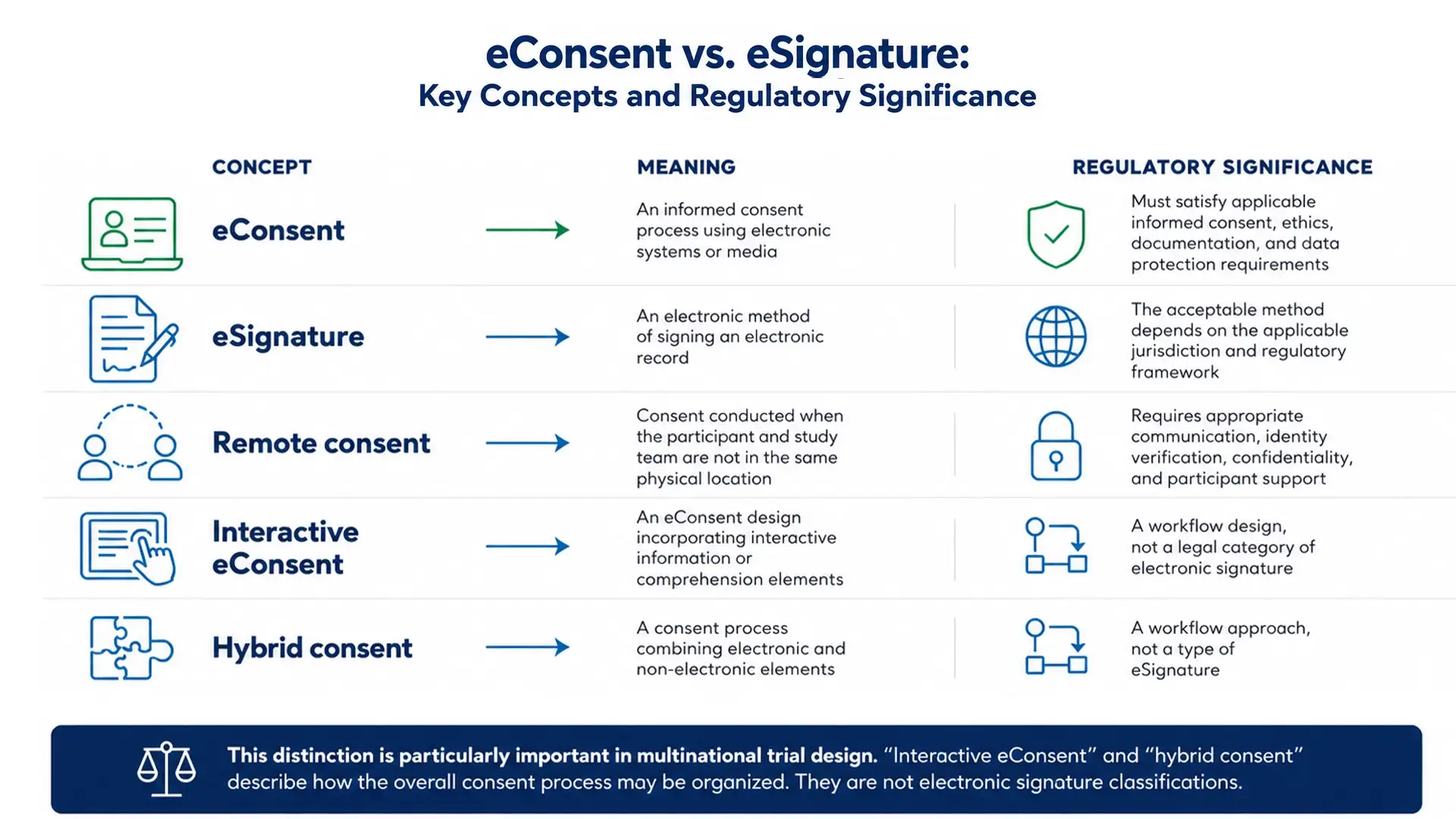
| Concept | Meaning | Regulatory significance |
|---|---|---|
| eConsent | An informed consent process using electronic systems or media | Must satisfy applicable informed consent, ethics, documentation, and data protection requirements |
| eSignature | An electronic method of signing an electronic record | The acceptable method depends on the applicable jurisdiction and regulatory framework |
| Remote consent | Consent conducted when the participant and study team are not in the same physical location | Requires appropriate communication, identity verification, confidentiality, and participant support |
| Interactive eConsent | An eConsent design incorporating interactive information or comprehension elements | A workflow design, not a legal category of electronic signature |
| Hybrid consent | A consent process combining electronic and non-electronic elements | A workflow approach, not a type of eSignature |
This distinction is particularly important in multinational trial design. “Interactive eConsent” and “hybrid consent” describe how the overall consent process may be organized. They are not electronic signature classifications
ICH E6(R3) as a Common GCP Baseline
ICH E6(R3) provides an important international GCP framework for electronic informed consent. Annex 1, Section 2.8 expressly addresses informed consent in paper or electronic format and recognizes approaches using text, images, video, and other interactive methods [3].
In the EU, the ICH E6(R3) Principles and Annex 1 became effective on July 23, 2025 [3]. ICH E6(R3) Annex 2, which addresses decentralised elements, pragmatic trial designs and real-world data sources, reached Step 4 in June 2026 and is particularly relevant where consent is obtained remotely. Jurisdiction-specific regulatory requirements continue to apply alongside the guideline.
For ClinOps teams, the principle is clear: electronic consent should support participant understanding, appropriate identity controls, reliable documentation, and protection of participant rights while remaining aligned with applicable local requirements.
United States: FDA Rules for eConsent and eSignatures
FDA permits electronic systems and processes to be used to obtain informed consent in FDA-regulated clinical investigations. Its 2016 guidance applies to investigations involving drugs, biological products, medical devices, and combination products and confirms that the electronic process must satisfy applicable informed consent and documentation requirements [1].
For FDA-regulated research, the core framework includes:
- 21 CFR Part 50 for informed consent requirements;
- 21 CFR Part 56 for Institutional Review Board requirements; and
- 21 CFR Part 11 for electronic records and electronic signatures where applicable.
FDA’s October 2024 guidance provides additional direction on electronic systems, records, and signatures used in clinical investigations. It addresses expectations around system controls, user identification, record integrity, signature attribution, and the linkage between an electronic signature and the corresponding electronic record [5].
The practical takeaway: for US studies, eConsent should be planned as an end-to-end regulated workflow. ClinOps teams should consider participant identification, consent documentation, electronic signatures, system controls, record integrity, and retention together rather than treating signing as a standalone activity.
European Union: eConsent and the Role of eIDAS
In the EU, electronic informed consent must be assessed against both EU clinical trial requirements and applicable Member State rules. The European Commission, EMA, and HMA recommendation paper on decentralized trial elements provides practical guidance on eConsent, but expressly states that its recommendations are not legally binding [2].
Version 02 also includes an updated National Provisions Overview, providing sponsors with a practical starting point for identifying Member State-specific requirements. The paper specifies that the method used to record consent should follow national requirements concerning the acceptability of electronic signatures [2].
For multinational studies, a signature approach accepted in one Member State should therefore not automatically be assumed to be acceptable in another.
Where eIDAS Fits
The eIDAS Regulation, short for Electronic Identification, Authentication and Trust Services, provides the EU legal framework for electronic identification, electronic signatures, and trust services. It is relevant to eConsent because it defines electronic signature categories and establishes their legal effect [6].
A qualified electronic signature, or QES, has the equivalent legal effect of a handwritten signature under Article 25 of eIDAS [6].
However, eIDAS does not determine which type of electronic signature must be used for informed consent in every clinical trial. That depends on the applicable clinical trial requirements and national rules in each Member State [2].
The practical takeaway: eIDAS defines the legal framework for the electronic signature itself, while clinical trial and national requirements determine which signature approach is appropriate for a specific study.
The practical takeaway: eIDAS defines the legal framework for the electronic signature itself, while clinical trial and national requirements determine which signature approach is appropriate for a specific study.
United Kingdom: A Separate Regulatory Framework
The UK should be assessed separately from the EU. The Medicines for Human Use (Clinical Trials) (Amendment) Regulations 2025, SI 2025/538, came into force on April 28, 2026 and apply to CTIMPs conducted in the UK [7].
The HRA and MHRA joint eConsent statement was published in 2018 under the previous regulatory framework. It confirms that electronic methods may be used for seeking, confirming, and documenting informed consent and sets out expectations for electronic signatures in clinical research [8]. Current MHRA UK-specific annotations to ICH E6(R3) continue to refer to this joint statement in relation to electronic consent and identity verification [9].
The amended regulations also allow sponsors of eligible low-intervention CTIMPs to apply to use simplified arrangements for seeking and evidencing consent. These arrangements do not permit consent to be waived or presumed: consent must remain informed, freely given, explicit, and prospectively obtained, with the proposed approach described in the protocol and approved by a Research Ethics Committee [10].
ICH E6(R3) also has specific regulatory significance in the UK from April 28, 2026. Compliance with the ICH E6(R3) GCP Principles, rather than the entire guideline, became a legal requirement under the amended UK Clinical Trials Regulations [11]. Sponsors and investigators must also have regard to relevant guidance, which means the ICH E6(R3) Annexes cannot simply be disregarded [11]. MHRA’s UK-specific annotations further map references to “applicable regulatory requirements” in ICH E6(R3) to the corresponding UK requirements and guidance [9].
The practical takeaway: UK eConsent should be assessed against current UK clinical trial legislation, the applicable ICH E6(R3) framework, and HRA and MHRA guidance rather than treated as an extension of the EU framework.
Switzerland: Electronic Consent Expressly Permitted Since 2024
Swiss law expressly permits informed consent to be given electronically. Article 7c of the Clinical Trials Ordinance, in force since November 1, 2024, states that consent may be signed by hand or given in electronic form [12][13].
Under Article 7c, electronic consent is permissible where the method unequivocally identifies the person concerned, prevents an overhasty decision, protects the consent against modification in accordance with the state of the art, and explains in the application documentation how these requirements are met [12].
Swissethics guidance provides further operational expectations for electronic signatures used in eConsent, including:
- authentication of the signatory;
- recording of the date, time, and time zone;
- non-repudiation; and
- an unbreakable link between the approved consent information and the electronic signature [14].
The currently published swissethics eIC guidance is Version 2.1 from August 2024. The 2025 Swissmedic and swissethics position paper on decentralized clinical trials continues to refer sponsors to this guidance for implementation of electronic informed consent, supporting its continued relevance [15].
Swissethics also distinguishes responsibilities: the investigator remains responsible for the informed consent process, while the sponsor is responsible for validation and operation of the computerized eConsent system [14].
The practical takeaway: Switzerland provides a clear legal basis for eConsent, with specific expectations around identity, record integrity, documentation, validation, and ethics review.
How Catchtrial eConsent Can Support an Electronic Consent Workflow
Across jurisdictions, informed consent remains a process, while electronic signing is one element within it. For multinational studies, eConsent technology therefore needs enough flexibility to support different consent, identity verification, documentation, and audit requirements.
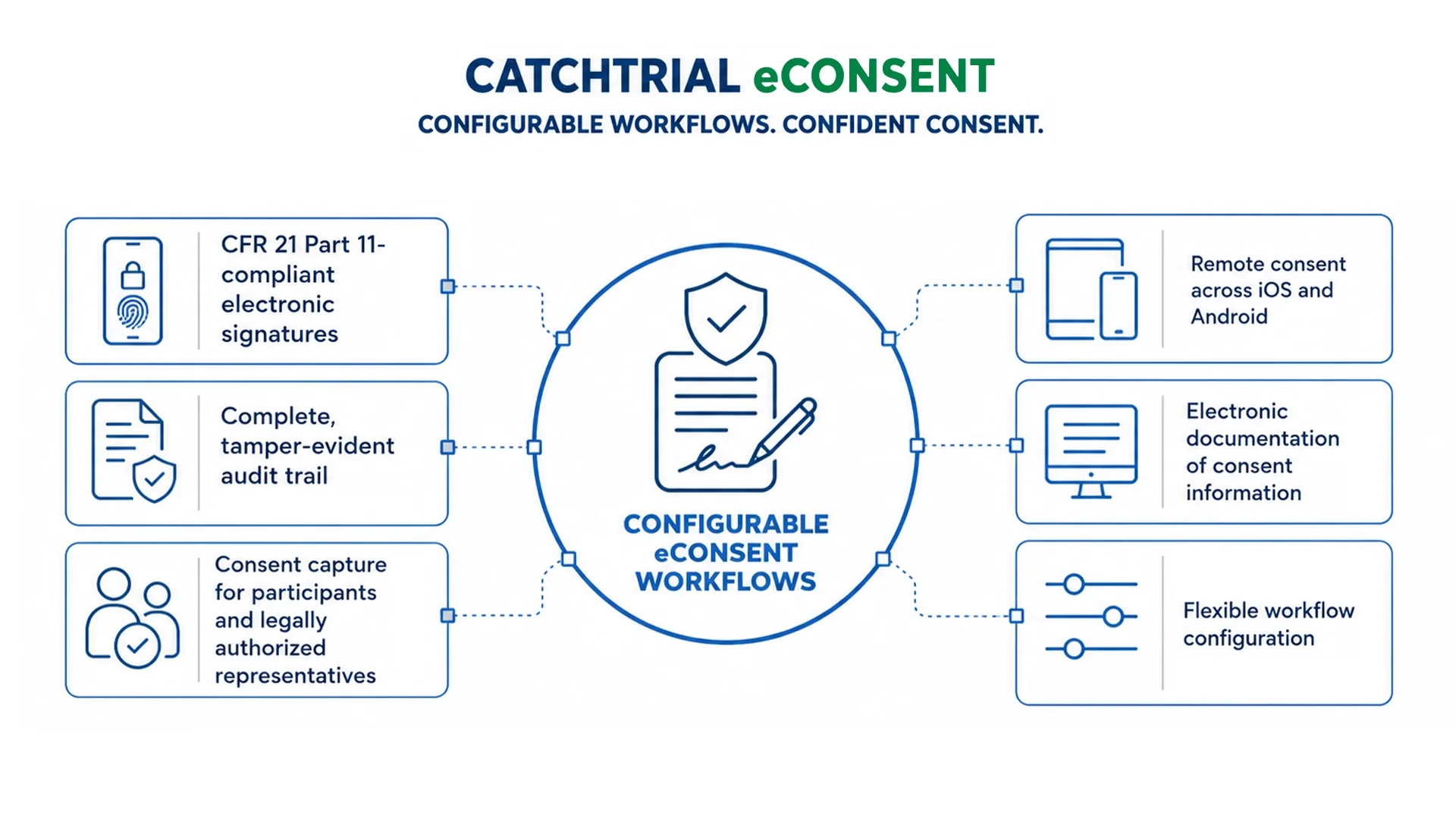
Catchtrial eConsent, part of Catchtrial Apps+, supports configurable electronic informed consent workflows with capabilities including:
- Electronic signatures supported by multi-factor authentication and, where configured, biometric verification;
- A complete, tamper-evident audit trail supporting traceability throughout the consent workflow;
- Consent capture for participants and legally authorized representatives, where applicable;
- Remote consent across iOS and Android, supporting decentralized and hybrid trial designs;
- Electronic presentation and documentation of consent information; and
- Flexible workflow configuration to accommodate different study and jurisdictional requirements.
Because Catchtrial eConsent is part of Medigen Suite, it can also connect with Catchtrial EDC+, allowing consent-related information to be incorporated into the broader clinical data environment and potentially reducing manual re-entry and disconnected workflows.
The practical value of a flexible eConsent solution is its ability to help translate the approved study-specific consent approach into a controlled electronic workflow.
Learn more at Catchtrial eConsent.
Choosing the Right eConsent Approach
A strong eConsent strategy starts with regulatory mapping before technology configuration. Acceptance of electronic consent in a jurisdiction does not mean that every eSignature method, remote consent process, or identity verification approach will be appropriate for every trial.
The distinction between eConsent and eSignature remains central to that assessment.
In the US, sponsors apply FDA requirements including Parts 11, 50, and 56 where relevant. In the EU, the eIDAS electronic signature framework interacts with clinical trial legislation and Member State rules. The UK applies its amended Clinical Trials Regulations together with ICH E6(R3) and UK-specific guidance. Switzerland permits electronic consent under Article 7c ClinO, subject to defined conditions.
For sponsors evaluating eConsent in clinical trials, the goal is therefore not to identify one supposedly “global” signature standard. It is to build an electronic consent process that can be configured around the regulatory, ethical, participant, and operational requirements of the specific study.
Visit the Catchtrial Apps+ page or request a demo to discuss how Catchtrial eConsent could support the electronic informed consent requirements of your next clinical study.
Frequently Asked Questions
Is eConsent the same as an electronic signature?
No. eConsent refers to the broader electronic informed consent process, while an eSignature is a method used to sign an electronic record. Electronic signing can form part of eConsent alongside information delivery, participant questions, comprehension support, documentation, and re-consent [1].
Does ICH E6(R3) address electronic informed consent?
Yes. ICH E6(R3) Annex 1 expressly addresses informed consent in paper or electronic format. Section 2.8 also recognizes different methods of providing information and requires the informed consent process to comply with applicable regulatory requirements [3].
Does eIDAS regulate eConsent in EU clinical trials?
No. eIDAS regulates electronic identification, electronic signatures, and trust services rather than the clinical trial informed consent process itself. Clinical trial requirements and applicable Member State rules determine how electronic signatures may be used for a particular trial [2][6].
Can a qualified electronic signature be used for EU clinical trial consent?
Yes, where appropriate under the applicable national and clinical trial requirements. A QES has the equivalent legal effect of a handwritten signature under eIDAS. The required signature method still needs to be assessed for the Member State and study concerned [2][6].
Are electronic signatures permitted for eConsent in Switzerland?
Yes. Swiss law expressly permits consent in electronic form subject to the conditions in Article 7c ClinO. Swissethics guidance further addresses authentication, timestamping, non-repudiation, and the link between the approved consent information and electronic signature [12][14].
Does 21 CFR Part 11 define eConsent in the United States?
No. 21 CFR Part 11 addresses electronic records and electronic signatures rather than defining the complete informed consent process. FDA informed consent requirements are addressed separately, including under 21 CFR Part 50, while FDA guidance explains how electronic systems may be used to obtain and document informed consent [1][5].
References
[1] U.S. Food and Drug Administration (FDA) and Office for Human Research Protections (OHRP). Use of Electronic Informed Consent in Clinical Investigations: Questions and Answers. Guidance for Institutional Review Boards, Investigators, and Sponsors. December 2016.
[2] European Commission, European Medicines Agency (EMA), and Heads of Medicines Agencies (HMA). Recommendation Paper on Decentralised Elements in Clinical Trials. Version 02, 1 October 2025. Update announced 31 October 2025.
[3] International Council for Harmonisation. ICH E6(R3) Guideline for Good Clinical Practice, Principles and Annex 1. See Annex 1, Section 2.8, Informed Consent of Trial Participants. EU effective date: 23 July 2025.
[4] Mazzochi AT, Dennis M, Chun HYY. Electronic informed consent: effects on enrolment, practical and economic benefits, challenges, and drawbacks – a systematic review of studies within randomized controlled trials. Trials. 2023;24:127. DOI: 10.1186/s13063-022-06959-6.
[5] U.S. Food and Drug Administration (FDA). Electronic Systems, Electronic Records, and Electronic Signatures in Clinical Investigations: Questions and Answers. October 2024.
[6] European Parliament and Council of the European Union. Regulation (EU) No 910/2014 on electronic identification and trust services for electronic transactions in the internal market (eIDAS), as amended. See Articles 25 and 26.
[7] UK Government. The Medicines for Human Use (Clinical Trials) (Amendment) Regulations 2025. SI 2025/538, in force 28 April 2026.
[8] Health Research Authority (HRA) and Medicines and Healthcare products Regulatory Agency (MHRA). Joint Statement on Seeking Consent by Electronic Methods. Version 1.2, September 2018.
[9] Medicines and Healthcare products Regulatory Agency (MHRA). UK-specific annotations to ICH E6(R3). Current version updated 28 April 2026.
[10] Health Research Authority (HRA). Simplified arrangements for seeking and evidencing consent in low intervention CTIMPs guidance. Updated 28 April 2026.
[11] Medicines and Healthcare products Regulatory Agency (MHRA). Clinical trials for medicines: Compliance with ICH E6 good clinical practice (GCP) in the United Kingdom. Published 27 March 2026; updated 28 April 2026.
[12] Swiss Federal Council. Ordinance on Clinical Trials in Human Research, Clinical Trials Ordinance, ClinO, SR 810.305. Article 7c, Form of consent, in force since 1 November 2024. Official Fedlex text.
[13] Swissmedic. New implementing regulations apply as of 1 November 2024. 7 June 2024.
[14] swissethics. Guidance document on the development and use of an Electronic Informed Consent (eIC): Guidance Document and Checklist. Version 2.1, 25 August 2024.
[15] Swissmedic and swissethics. Position Paper: Decentralised Clinical Trials with Medicinal Products in Switzerland. Version 3.2, 15 August 2025.
Table of Contents
- Why eConsent in Clinical Trials Is Becoming More Common
- eConsent and eSignature Are Not the Same Thing
- ICH E6(R3) as a Common GCP Baseline
- United States: FDA Rules for eConsent and eSignatures
- European Union: eConsent and the Role of eIDAS
- Where eIDAS Fits
- United Kingdom: A Separate Regulatory Framework
- Switzerland: Electronic Consent Expressly Permitted Since 2024
- How Catchtrial eConsent Can Support an Electronic Consent Workflow
- Choosing the Right eConsent Approach
- Frequently Asked Questions
- References
Latest Articles
21 CFR Part 11 password requirements: what the regulation actually says
A 90-day password change is not a 21 CFR [...]

Clinical trial software for the connected study stack
Clinical trials are generating more data from more sources, [...]

A practical guide to the main types of clinical trials
The type of clinical trial you run shapes almost [...]
This article provides general information and does not constitute regulatory, legal, clinical, or compliance advice. Requirements and appropriate processes may vary by study, product, jurisdiction, and organization. Medigen Suite functionality should be used in accordance with applicable regulations, study documentation, and internal procedures.