GDPR compliance in clinical trials is rarely about one document or one department. It is about knowing what participant data are collected, why they are needed, where they move, who can access them, and how they are protected throughout the study.
For sponsors operating in the EU, the General Data Protection Regulation (GDPR) sits alongside clinical research requirements rather than replacing them. The European Data Protection Board (EDPB) has specifically addressed this relationship for medicinal-product trials, confirming that the Clinical Trials Regulation (CTR) and GDPR apply together.
For Clinical Operations, that makes GDPR a practical study-management topic. The following seven areas are where privacy requirements translate most directly into operational decisions.
1. Map the personal data your clinical trial processes
Before deciding how to protect clinical trial data, sponsors need a clear view of what data the study actually processes.
Health information is a special category of personal data under GDPR Article 9. At the same time, Article 5 requires personal data to be adequate, relevant, and limited to what is necessary for the purposes for which they are processed.
In a modern trial, that data can pass through EDC, ePRO, eCOA, eConsent, imaging systems, laboratories, safety platforms, CRO environments, and other specialist providers. Each additional workflow may introduce another access point, processor, transfer, or retention requirement.
For ClinOps, the useful question is not simply “Where is the database hosted?” A more complete data map should show:
- what participant information is collected;
- the purpose of each processing activity;
- which organization determines the purpose and means of processing;
- which vendors and subprocessors receive or access the data;
- where the data are stored or remotely accessed;
- how long different records must be retained.
The ClinOps takeaway: map the data flow early enough for privacy requirements to influence study setup, vendor qualification, system configuration, and participant-facing processes.
2. Trial consent is not the GDPR legal basis
Clinical trial informed consent and consent under GDPR are not interchangeable.
This distinction is particularly important because both are commonly discussed under the single word “consent.” The EDPB states explicitly that informed consent under the CTR primarily serves the ethical requirements associated with participation in research and should not be confused with consent as a GDPR legal basis for processing personal data.
The appropriate GDPR legal basis instead depends on the purpose of the processing activity. The EDPB distinguishes, for example, processing necessary for safety and regulatory obligations from processing conducted for research purposes. Research-related processing may rely on different legal bases depending on the circumstances of the trial and applicable law.
That distinction has a very practical consequence: withdrawal from a clinical trial does not automatically require deletion of every record already collected.
For medicinal-product trials governed by the CTR, Article 58 requires sponsors and investigators to archive the clinical trial master file for at least 25 years after the end of the trial, unless other EU legislation requires longer retention.
The privacy notice, consent documentation, withdrawal process, retention schedule, and study systems therefore need to reflect the same underlying regulatory analysis.
The ClinOps takeaway: define the legal basis by processing purpose, not simply by study or system.
3. GDPR data minimisation in clinical research
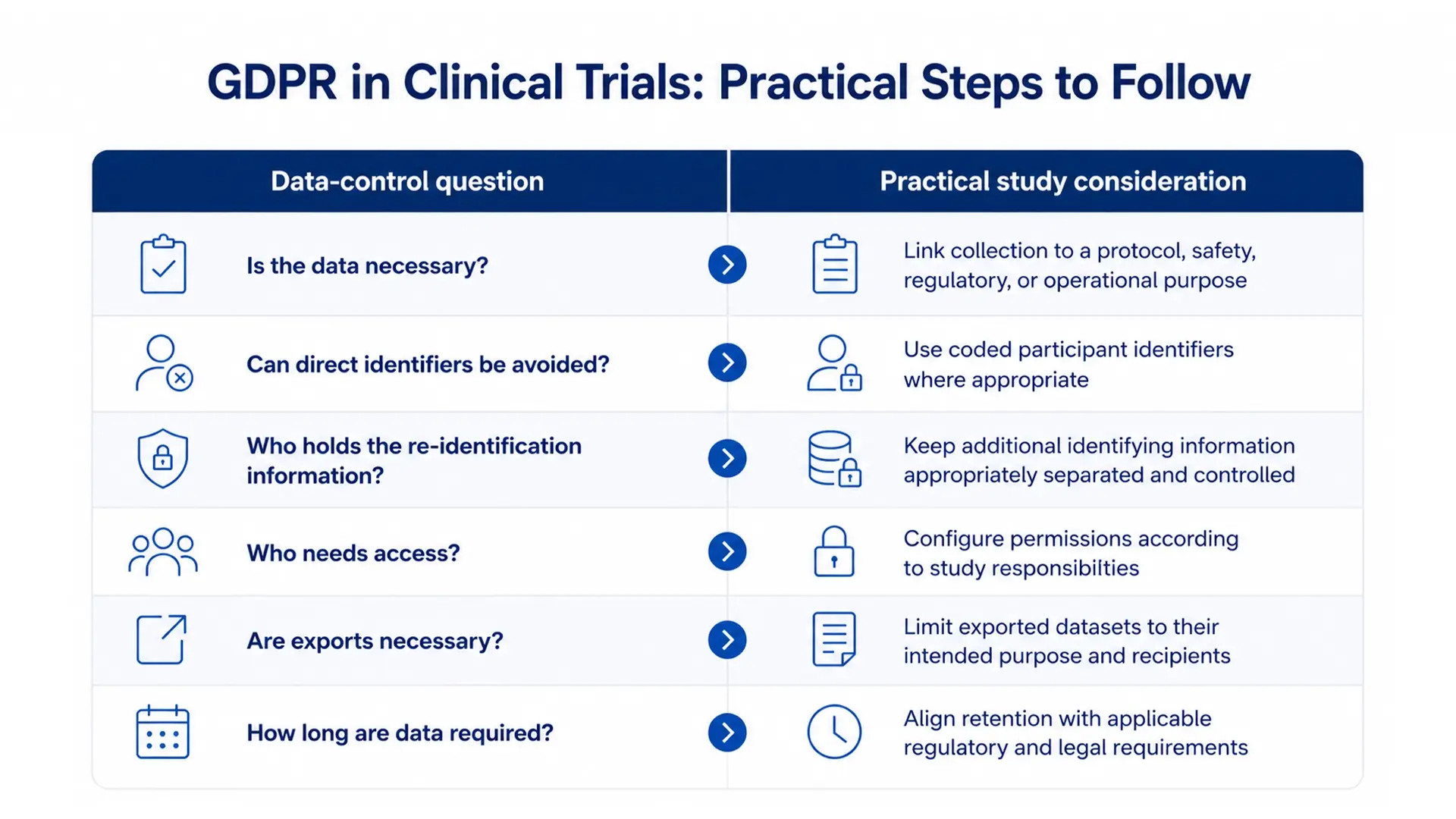
GDPR data minimization does not mean collecting as little data as possible. It means collecting the data that are necessary for a defined purpose.
That difference matters in protocol-driven research. A clinically required endpoint, safety variable, or participant-reported outcome should not be removed simply to reduce the number of fields. The objective is to avoid unnecessary personal data while preserving the information required to conduct and evaluate the study.
Pseudonymization is an important part of this model, but it should not be mistaken for anonymization. The EDPB confirms that pseudonymized information that can be linked back to an individual using additional information remains personal data and remains subject to GDPR.
In practical terms, replacing a participant’s name with a study ID is valuable, but it does not end the privacy analysis.
The ClinOps takeaway: good data minimization starts during study design and system configuration, not during database closeout.
4. Vendor oversight and international data transfers
Outsourcing data processing does not outsource the sponsor’s need for visibility.
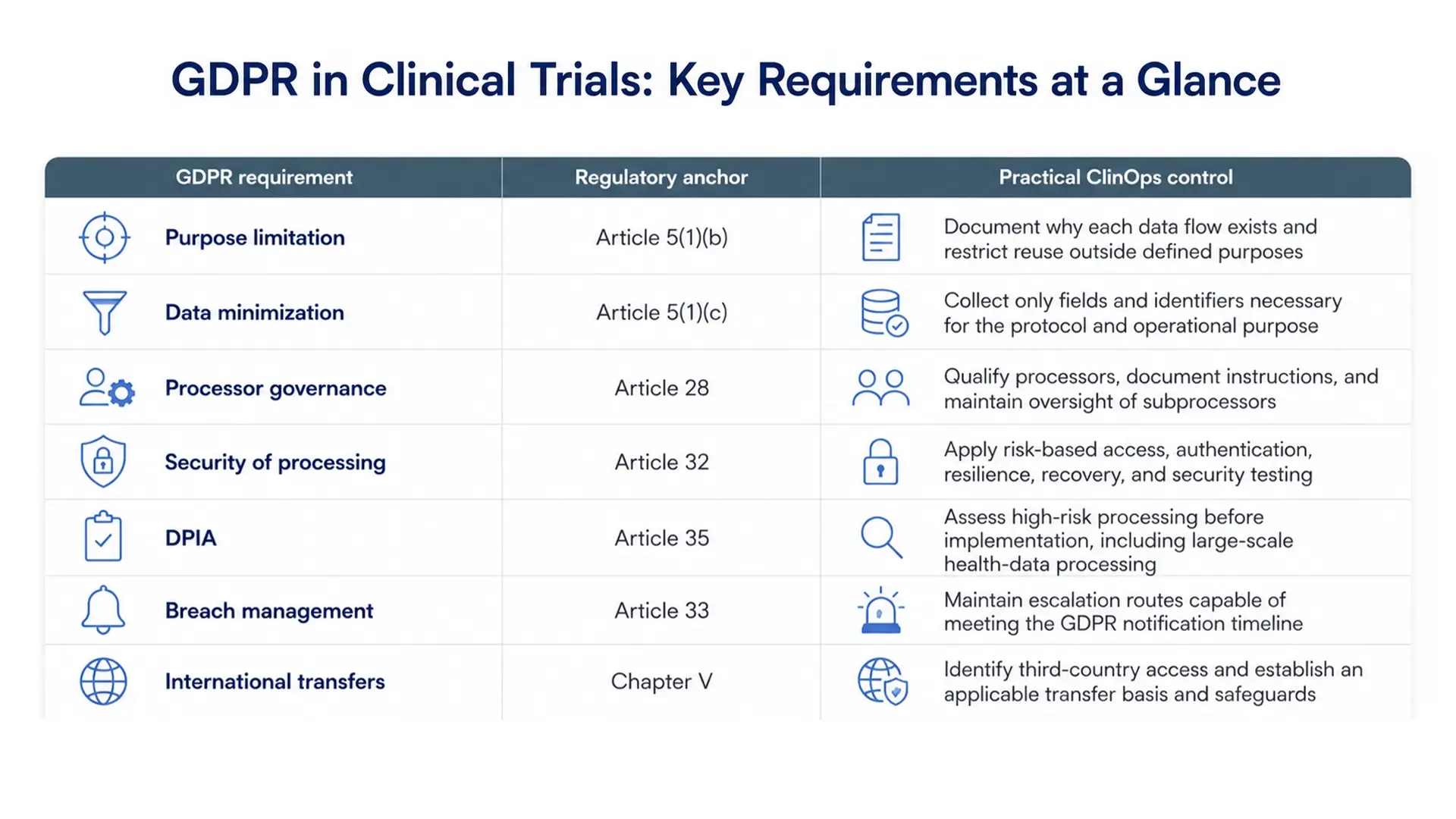
GDPR Article 28 requires controllers using processors to select processors that provide sufficient guarantees regarding appropriate technical and organizational measures. It also regulates the processor’s use of additional processors.
In clinical research, the relevant chain can extend beyond the primary CRO or eClinical vendor. Hosting providers, central laboratories, technical helpdesks, imaging vendors, patient technology providers, and subprocessors may all form part of the processing environment.
International trials add another dimension. GDPR Chapter V governs transfers of personal data to third countries and international organizations, including mechanisms such as adequacy decisions and appropriate safeguards.
Consider a hypothetical European study using an ePRO platform hosted in the EU. The hosting location alone does not describe the complete data flow if technical teams, subprocessors, backup environments, or specialist providers elsewhere can access participant information.
For ClinOps teams, vendor oversight should therefore answer practical questions:
- Where can study data be accessed?
- Which subprocessors are involved?
- Which interfaces or exports move data elsewhere?
- What happens if a vendor or hosting arrangement changes?
- Are responsibilities in the contract consistent with the actual workflow?
The ClinOps takeaway: follow the data through the full vendor chain, not only to the first contracted provider.
5. GDPR security requirements and breach readiness
GDPR does not prescribe one universal security configuration. It requires security appropriate to the risk.
Article 32 specifically identifies measures such as pseudonymization and encryption, ongoing confidentiality, integrity, availability and resilience, timely restoration after incidents, and regular testing of security controls.
This makes role design, authentication, user lifecycle management, auditability, backups, system monitoring, and incident procedures directly relevant to clinical trial data governance.
A Data Protection Impact Assessment (DPIA) may also be required when processing is likely to result in high risk to individuals. Article 35 expressly identifies large-scale processing of special categories of personal data as one of the circumstances requiring a DPIA.
The DPIA can therefore become more than a privacy deliverable. Used early, it can expose operational questions around participant-facing technology, integrations, authentication, remote access, vendors, transfers, and retention before system configuration is finalized.
Incident preparedness matters just as much. Article 33 requires a controller to notify the competent supervisory authority of a qualifying personal data breach without undue delay and, where feasible, within 72 hours after becoming aware of it. Processors must notify the controller without undue delay.
A sponsor therefore needs escalation routes that can move information from a site, CRO, or technology provider to the appropriate privacy and security decision-makers quickly.
The ClinOps takeaway: security controls matter, but so does knowing what happens operationally when one of them fails.
6. GDPR controls in the eClinical workflow: ePRO and eCOA
An eClinical platform cannot make a study GDPR-compliant on its own, but the right system controls can help translate the sponsor’s governance model into daily operations.
This is particularly relevant for ePRO and eCOA, where participant-level data can be collected repeatedly and remotely throughout a study.
Within the supplied Medigen Suite specifications, Catchtrial includes granular role and privilege management, allowing access to be configured according to study responsibilities. The same documentation identifies two-factor authentication as an available capability for Catchtrial ePRO.
Catchtrial also maintains audit information covering modifications to patient information and system login attempts, including the user, date and time, affected area, and action performed. The documented reporting functionality can capture audit-trail information including who changed data, when the change occurred, the reason, and before-and-after values.
These capabilities are relevant to a GDPR-ready operating model because they can help sponsors implement controlled access and traceability within the clinical data environment. Their effectiveness still depends on appropriate study configuration, procedures, vendor governance, and the sponsor’s own privacy framework.
For teams evaluating participant-facing data collection, the Catchtrial Apps+ page can provide additional information on how Catchtrial ePRO and Catchtrial eCOA may fit within a broader clinical data strategy.
7. Keep GDPR governance active for the whole trial
The privacy model designed at study startup should not remain static while the trial changes around it.
Protocol amendments, new countries, additional sites, vendor changes, new integrations, revised participant-facing tools, or expanded data uses can all change the processing environment.
This is where structured change control becomes valuable. Privacy should be one of the questions considered whenever an operational change affects personal data.
A practical review can be simple:
- Has the purpose of processing changed?
- Are new data being collected?
- Has a new processor or subprocessor been introduced?
- Will data become accessible from another country?
- Do permissions need to change?
- Does the DPIA need to be reviewed?
- Are participant-facing notices still accurate?
- Have retention or archival requirements changed?
The goal is not to create a parallel privacy workflow for every operational decision. It is to make data protection part of the same governance process used to manage study quality, vendors, systems, and change.
For experienced ClinOps teams, that is ultimately the most useful way to approach GDPR: know the data, define the purpose, control access, understand the vendor chain, and keep those controls aligned as the study evolves.
To see how Medigen Suite, Catchtrial ePRO, and Catchtrial eCOA can be configured within a controlled clinical data environment, visit the relevant product page or request a demo to discuss your study requirements.
Frequently Asked Questions
Does GDPR apply to pseudonymized clinical trial data?
Yes, when the data can still be attributed to an individual using additional information. Pseudonymization is an important safeguard, but it is not automatically equivalent to anonymization. The EDPB confirms that pseudonymized data that can be linked back to an individual remain personal data and are therefore subject to GDPR requirements.
Is clinical trial informed consent always the GDPR legal basis?
No. Trial informed consent and consent as a GDPR legal basis are different concepts. The EDPB specifically distinguishes the ethical consent required for participation in a clinical trial from the GDPR legal basis for processing personal data. The appropriate basis depends on the purpose and circumstances of the processing activity.
Does every clinical trial require a DPIA?
No, but a DPIA is required where the planned processing is likely to result in high risk to individuals. GDPR Article 35 specifically includes large-scale processing of special-category data as a relevant case. Sponsors should therefore assess the scale, sensitivity, technologies, monitoring, transfers, and overall processing model early in study planning.
What does GDPR mean for ePRO and eCOA?
GDPR requires sponsors to consider how participant data are collected, accessed, transferred, secured, and retained within ePRO and eCOA workflows. Relevant controls can include data minimization, coded identifiers, authentication, role-based access, vendor governance, transfer mechanisms, and appropriate security measures based on the risks of the specific study.
How long must clinical trial data be retained?
GDPR does not establish one universal retention period for every type of clinical trial record. Applicable research and regulatory requirements must also be considered. For medicinal-product trials under the EU CTR, Article 58 requires the sponsor and investigator to archive the clinical trial master file for at least 25 years after the end of the trial, unless other EU law requires longer retention.
Sources
European Union, General Data Protection Regulation, Regulation (EU) 2016/679. Official text covering processing principles, special-category data, processors, security, DPIAs, breach notification, and international transfers.
Read the GDPR on EUR-Lex
European Data Protection Board, Opinion 3/2019. EDPB guidance specifically addressing the relationship between the Clinical Trials Regulation and GDPR, including informed consent and legal bases for clinical trial processing.
Read EDPB Opinion 3/2019
European Union, Regulation (EU) No 536/2014 on clinical trials. Official CTR text, including the 25-year clinical trial master file archiving requirement in Article 58.
Read the Clinical Trials Regulation on EUR-Lex
European Data Protection Board, Pseudonymisation Guidance. EDPB explanation of pseudonymization and the status of pseudonymized information as personal data.
Read the EDPB pseudonymisation overview
International Council for Harmonisation, ICH E6(R3) Good Clinical Practice. Current consolidated ICH GCP guideline, finalized in June 2026.
Table of Contents
Latest Articles
21 CFR Part 11 password requirements: what the regulation actually says
A 90-day password change is not a 21 CFR [...]
Clinical trial software for the connected study stack
Clinical trials are generating more data from more sources, [...]
A practical guide to the main types of clinical trials
The type of clinical trial you run shapes almost [...]
This article provides general information and does not constitute regulatory, legal, clinical, or compliance advice. Requirements and appropriate processes may vary by study, product, jurisdiction, and organization. Medigen Suite functionality should be used in accordance with applicable regulations, study documentation, and internal procedures.