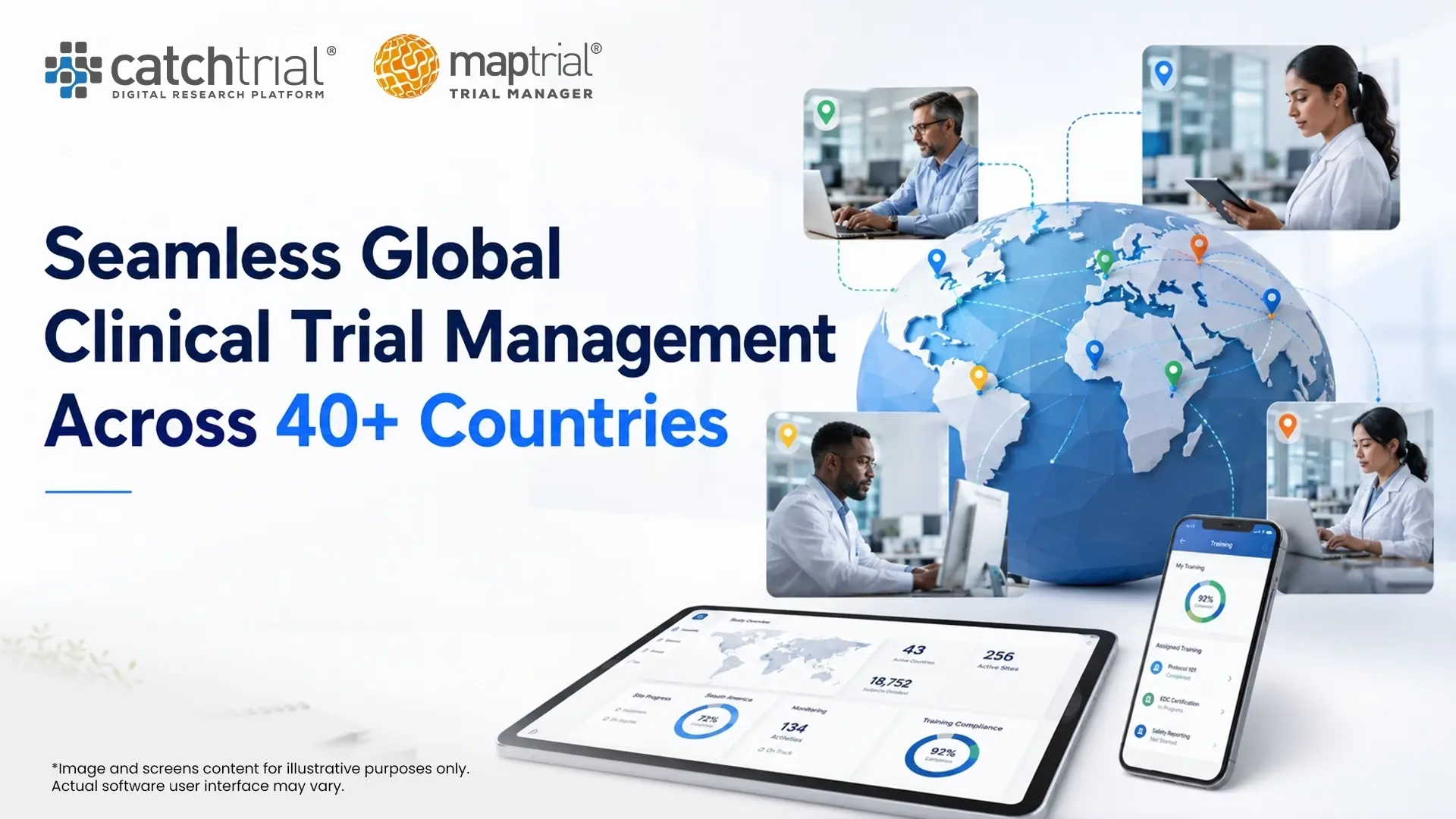
Expanding a clinical program across 40 or more countries opens access to broader patient populations, diverse research networks, and evidence generated across multiple healthcare settings. It also turns global clinical trial management into a coordination problem, spanning country start-up, site activation, data review, monitoring, and study-specific training.
The challenge is coordinating these activities without overlooking local requirements or placing unnecessary administrative pressure on regional teams. A unified eClinical approach that brings electronic data capture, trial management, and training under one roof can help sponsors and contract research organizations build a more consistent operating model while preserving appropriate local flexibility.
What changes when clinical operations scale across 40+ countries
Each region may introduce different submission pathways, languages, site practices, timelines, and training expectations. These variations are a normal part of conducting research across diverse regulatory and clinical environments.
The goal is not to make every country work identically. It is to establish shared definitions, responsibilities, and escalation paths while accommodating justified local differences.
For a 40-country program, teams may need to coordinate country and site milestones, user access, electronic case report form changes, monitoring activities, protocol amendments, training assignments, and data review priorities. When these activities are managed through unrelated tools and local trackers, status reconciliation may become more demanding. A coordinated eClinical environment is designed to make those relationships easier to manage, depending on study governance and configuration.
Building consistency around clinical data capture
Electronic data capture, or EDC, is the controlled environment for entering, reviewing, querying, and preparing structured clinical data. In a multinational study, the EDC design should balance common protocol definitions with practical considerations such as local language, clinical workflows, and applicable data handling requirements.
A centrally governed electronic case report form, or eCRF, structure can help teams apply common data definitions across participating sites. Validation rules, edit checks, user roles, and amendment processes can then be configured around the study design rather than recreated independently by country.
Country and site teams may identify implementation details that are not visible during central design. A scalable approach creates a controlled path for incorporating that input while maintaining traceability.
When a protocol amendment changes an endpoint-related field, the update may affect eCRFs, completion guidance, monitoring expectations, and training materials. Catchtrial EDC+ is designed to support structured clinical data capture and review, while a broader suite approach can help teams coordinate the operational and training activities surrounding the change.
Connecting operational oversight with site realities
A clinical trial management system, or CTMS, organizes the operational state of a study across countries, sites, activities, milestones, and responsible teams. At country scale, this structure becomes especially valuable because operational questions are rarely isolated.
A delayed site activity may relate to a pending approval, staffing change, or incomplete training. A CTMS is built to place these elements in context through common status definitions.
Maptrial CTMS+ is designed to support planning and tracking across studies, countries, and sites. Depending on configuration and governance, it can help teams organize milestones, monitoring activities, responsibilities, and follow-up in a consistent structure.
Central visibility should not be confused with rigid control. Regional teams need workflows that reflect their responsibilities and applicable requirements. A well-designed CTMS model can support common escalation routes while leaving room for country-specific execution and proportionate oversight.
Treating training as part of study execution
Training is often discussed separately from data and operations, even though it directly supports both. Investigators, coordinators, monitors, data managers, and other trial personnel may join at different times, change roles, or require updated instruction after protocol and system changes.
A learning management system, or LMS, supports the assignment, delivery, and documentation of study-specific training. At multinational scale, it can help teams coordinate training without relying entirely on repeated live sessions and local completion lists.
Mastertrial LMS+ is designed to support digital training for distributed study teams. Within a coordinated eClinical environment, it can help organize protocol, system, and workflow training alongside the operational context held in the CTMS and the data capture activities managed in the EDC.
This relationship becomes particularly relevant during change management, when a protocol amendment may affect eCRFs, monitoring instructions, training content, assignments, and completion records.
The TMF Reference Model includes protocol amendments and trial team evidence of training among core trial records. This reinforces the practical importance of treating training and change implementation as traceable parts of study conduct rather than isolated administrative tasks.
Fragmented tools and a unified eClinical approach
EDC, CTMS, and LMS address different functions and may remain distinct systems. The more relevant question is whether they operate within a coordinated product and governance model.
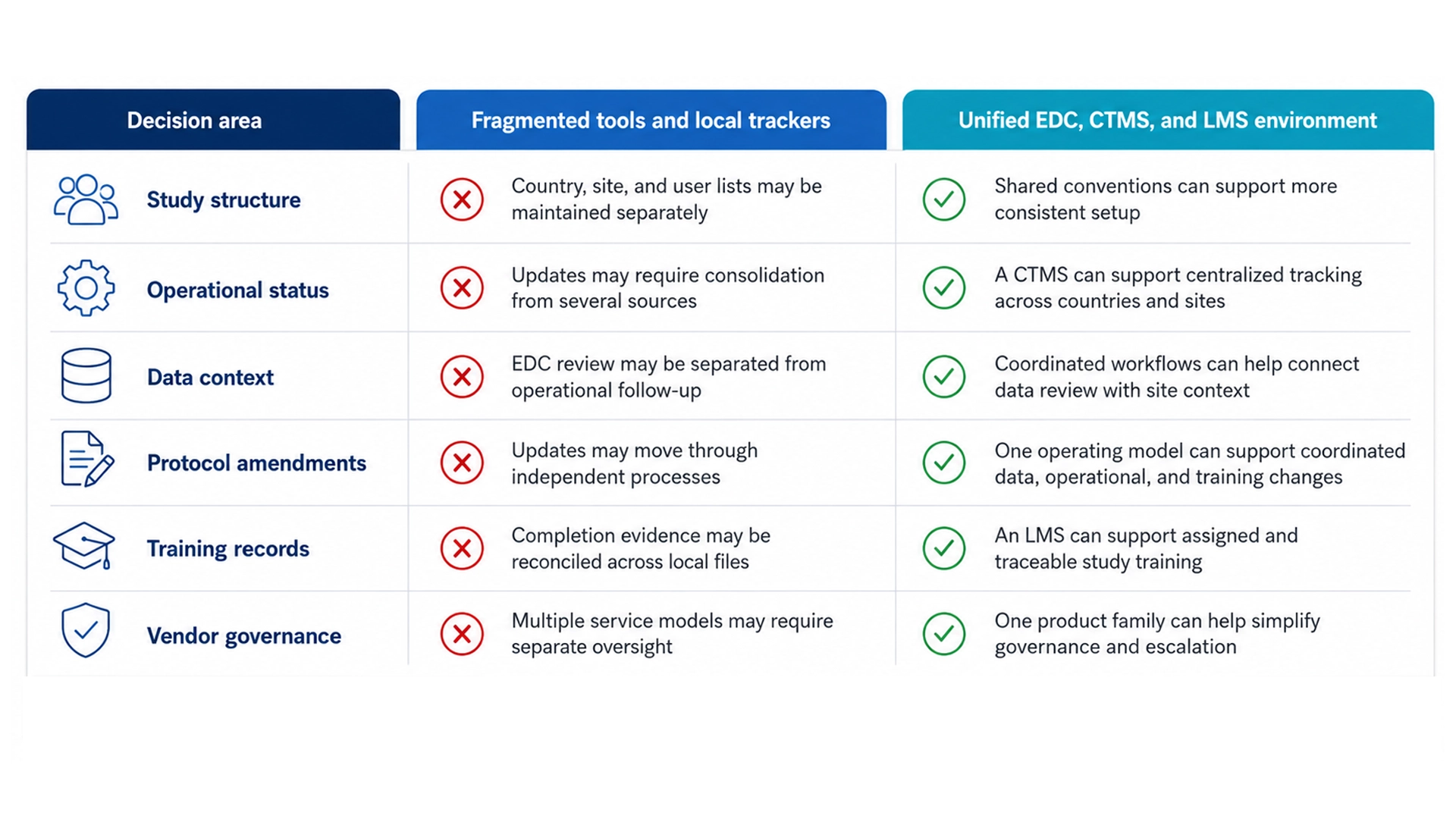
A unified approach does not replace standard operating procedures, validation, ownership, or local expertise. It is designed to give those controls a more coherent technical foundation. Working with one eClinical provider may also help simplify vendor qualification, implementation planning, and service coordination, depending on the study model and selected services.
How Medigen Suite supports global clinical trial management
Medigen Suite brings Catchtrial EDC+, Maptrial CTMS+, and Mastertrial LMS+ together within one eClinical product family.
Each solution addresses a distinct part of the clinical trial lifecycle, while the suite model is built to support a more coordinated approach to data, operations, and training.
Catchtrial EDC+ supports structured clinical data capture, review, and query workflows. Maptrial CTMS+ supports operational planning and oversight across studies, countries, and sites. Mastertrial LMS+ supports the delivery and documentation of study-specific training for distributed teams.
Under one roof, these solutions can help sponsors and CROs design a clearer accountability chain:
- Clinical data and review activities are managed in the EDC
- Country, site, milestone, and monitoring activities are organized in the CTMS
- Assigned training and completion records are managed in the LMS
- Governance defines how changes move across the three areas
The value lies in coordination rather than in claiming that every process is automatically connected. Depending on configured workflows, teams can align identifiers, roles, terminology, and change controls across the suite. This may reduce avoidable reconciliation and make cross-functional review more straightforward.
A shared provider relationship may also support more consistent implementation when rolling out systems, onboarding personnel, or planning amendments across regions.
Choosing a compliant approach for expansion
Technology supports regulated clinical trial processes, but sponsors and CROs remain responsible for defining and overseeing how systems are used.
ICH Good Clinical Practice requires documented responsibilities, appropriate oversight, reliable trial information, and records that are secure and available for review. Under 21 CFR Part 11, applicable electronic record and electronic signature systems require controls such as validation, access limitation, record protection, accurate and complete copies, and secure, time-stamped audit trails.
The General Data Protection Regulation (GDPR) also requires a lawful basis for processing personal data and adherence to principles including purpose limitation and data minimization.
A unified eClinical environment can support these obligations when systems are appropriately validated, configured, and governed through documented procedures. It should be assessed together with the sponsor’s quality framework, role model, data flows, change control process, and vendor oversight approach. Shared systems can support common controls, while local specialists guide country-specific implementation.
Scaling clinical operations across 40 or more countries starts with a clear operating model. Teams should define which system owns each record, how country and site structures are maintained, how roles are assigned, and how protocol or system changes move through data, operations, and training workflows.
A practical evaluation can test the environment against realistic scenarios such as launching a new country, activating a site, implementing a protocol amendment, following up on an overdue monitoring activity, or assigning updated training to affected personnel.
Medigen Suite offers a coordinated eClinical approach through Catchtrial EDC+, Maptrial CTMS+, and Mastertrial LMS+. For sponsors and CROs planning multinational programs, this combination can support a more consistent foundation for clinical data, operational oversight, and study-team readiness.
Visit the Medigen Suite product pages or request a demo focused on your country footprint, study model, and rollout priorities.
Frequently Asked Questions
What is a unified eClinical solution?
A unified eClinical solution brings complementary systems, such as electronic data capture, clinical trial management, and learning management, within one coordinated product environment. The systems may retain distinct functions, but shared conventions, governance, and provider oversight can help teams manage them as parts of the same clinical operating model.
Why does clinical trial management become more complex across 40 or more countries?
Large multinational trials involve a broader range of regulatory pathways, languages, healthcare practices, site structures, and operational timelines. ICH E17 recognizes that multi-regional clinical trials require careful planning across regions and countries to support the acceptability of trial data in global regulatory submissions.
A common operating framework can help teams coordinate these differences without assuming that every country should follow an identical process.
What are the potential benefits of combining EDC, CTMS, and LMS solutions under one roof?
A coordinated EDC, CTMS, and LMS environment can help align study structures, site identifiers, user roles, operational terminology, and change-management processes. It may also simplify implementation planning, vendor governance, and service coordination compared with managing unrelated providers.
The practical benefit depends on how the systems and associated workflows are configured. A shared product family does not automatically remove the need for reconciliation, documented ownership, or procedural controls.
Does a unified platform replace country-specific processes?
No. Country-specific regulatory, ethics, privacy, contractual, and operational requirements still need to be assessed and implemented by appropriately qualified teams.
A unified platform can support common structures and controlled workflows, while local processes remain configurable where justified. ICH E6(R3) promotes approaches that are proportionate, fit for purpose, and appropriate for the design and circumstances of the clinical trial.
Does using one eClinical suite ensure regulatory compliance?
No software platform can ensure compliance independently. Compliance depends on the combined use of appropriately validated systems, documented procedures, trained personnel, access controls, data governance, change control, and sponsor oversight.
For electronic records within FDA scope, 21 CFR Part 11 establishes requirements including system validation, record protection, access limitation, accurate and complete copies, and secure, computer-generated, time-stamped audit trails.
What should sponsors and CROs assess when choosing an eClinical environment?
The assessment should consider more than the number of available modules. Sponsors and CROs should evaluate:
- Which system is authoritative for each type of record
- How studies, countries, sites, and users are identified across systems
- How protocol amendments and other changes move through operational workflows
- How training is assigned, completed, and documented
- How roles and access rights are governed
- How data and records can be reviewed, reported, and exported
- How validation, vendor oversight, and service responsibilities are documented
- Whether the proposed configuration can accommodate justified country-level differences
Testing these areas against realistic study scenarios can help determine whether the environment is suitable for the intended country footprint and operating model.
Primary regulatory sources
- ICH E6(R3), Guideline for Good Clinical Practice
- ICH E8(R1), General Considerations for Clinical Studies
- ICH E17, General Principles for Planning and Design of Multi-Regional Clinical Trials
- 21 CFR Part 11, Electronic Records and Electronic Signatures
- FDA Guidance on Electronic Systems, Electronic Records, and Electronic Signatures in Clinical Investigations
- Regulation (EU) No 536/2014 on Clinical Trials
- Regulation (EU) 2016/679, General Data Protection Regulation
Table of Contents
Latest Articles
21 CFR Part 11 password requirements: what the regulation actually says
A 90-day password change is not a 21 CFR [...]
Clinical trial software for the connected study stack
Clinical trials are generating more data from more sources, [...]

A practical guide to the main types of clinical trials
The type of clinical trial you run shapes almost [...]
This article provides general information and does not constitute regulatory, legal, clinical, or compliance advice. Requirements and appropriate processes may vary by study, product, jurisdiction, and organization. Medigen Suite functionality should be used in accordance with applicable regulations, study documentation, and internal procedures.