
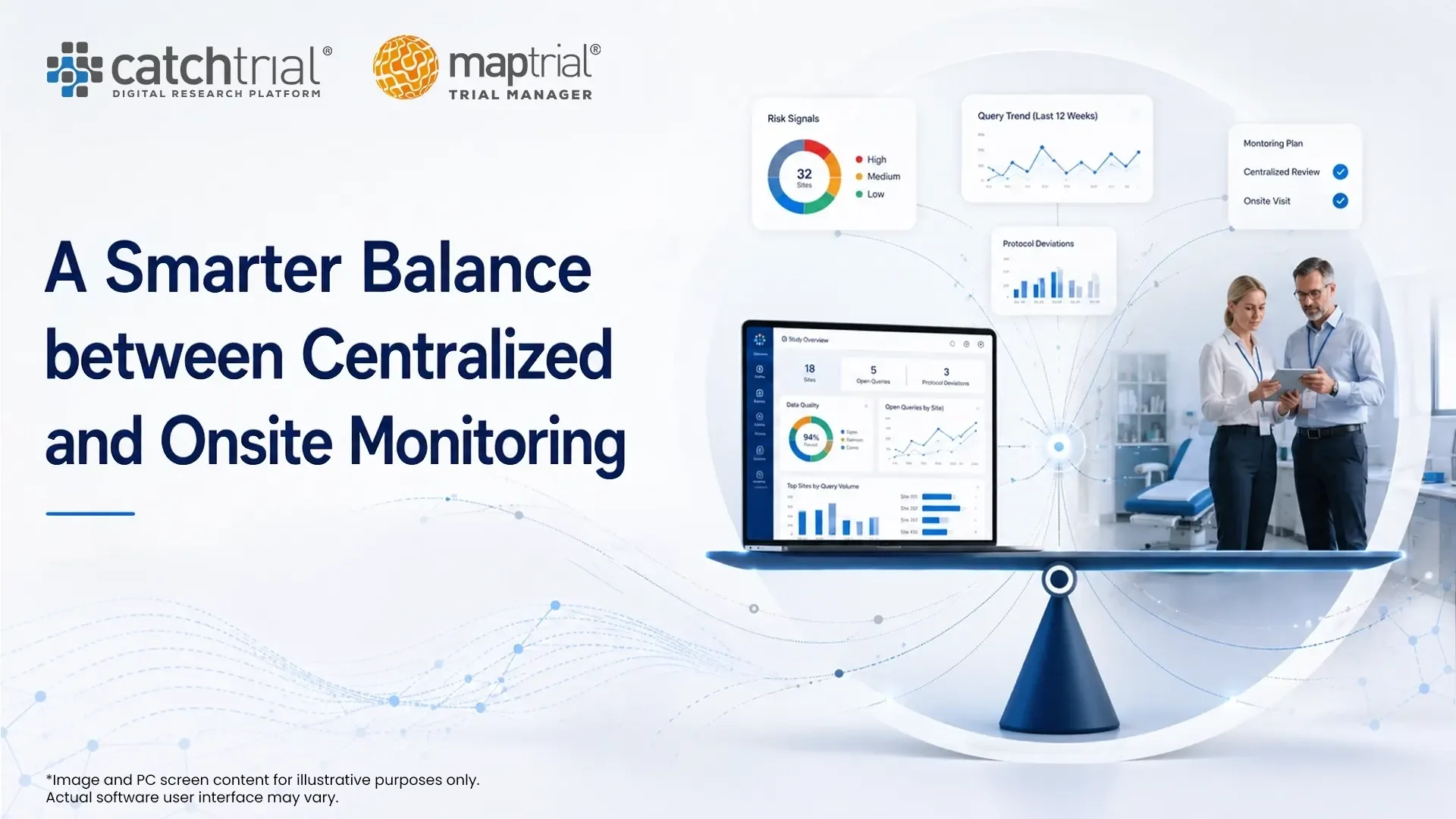
Every monitoring plan has to answer the same practical question: how much oversight should happen at the site, and how much can happen through centralized review of study data? The debate over centralized vs onsite monitoring in clinical trials is really a debate about that balance, not about choosing one method and discarding the other.
There is no single correct answer. The right balance depends on the study, and experienced teams often make different decisions for good reasons. What matters is treating that balance as an active decision that can be reviewed as the study progresses, with centralized and onsite monitoring working together as parts of a single oversight strategy.
Where Recent Guidance Places Centralized Monitoring
Recent regulatory guidance gives centralized monitoring a clearer and more explicit role within clinical trial oversight. ICH E6(R3) was adopted on 6 January 2025, became effective in the EU on 23 July 2025, and was published by the FDA as final guidance on 9 September 2025.
Annex 1 of the revised guideline includes separate sections for investigator site monitoring and centralized monitoring (3.11.4.1 and 3.11.4.2). It also notes that centralized monitoring may serve as the sole monitoring approach where the study’s risk assessment supports that decision.
The FDA’s April 2023 Questions and Answers on Risk-Based Monitoring guidance, which expands on its August 2013 guidance, takes a similar approach. It states that sponsors should determine the nature and extent of monitoring based on the specific characteristics and risks of the study.
The practical takeaway is straightforward: regulators leave the balance to the sponsor. What matters is documenting why a particular monitoring approach was chosen and keeping that rationale alongside the monitoring plan itself.
What Onsite Monitoring Still Does Best
Onsite monitoring means a Clinical Research Associate (CRA) reviewing trial conduct at the site in person. This includes verifying informed consent, comparing source data with the eCRF, and confirming protocol compliance directly.
Its value is both procedural and practical. A CRA visiting the site builds a working relationship with investigators and coordinators, answers questions as they arise, and notices operational details that do not always appear in the data.
For example, small differences in consent workflows between visits, inconsistent source document naming during a long study, or changes in site personnel are often easier to identify during a site visit than through reports alone.
The practical takeaway: onsite monitoring provides context that complements centralized data review. Some operational issues are simply easier to understand through direct observation and discussion at the site.
What Centralized Monitoring Adds
Centralized monitoring reviews trial conduct remotely by analyzing data across multiple sites to identify patterns. Common signals include slower query resolution, clusters of protocol deviations, unusual enrollment rates, or delayed adverse event reporting at individual sites.
Its strength lies in providing a broader view of the study. A single site’s data may appear unremarkable on its own, but comparison across many sites can reveal training needs, operational trends, or data entry patterns that warrant closer review.
This type of cross-site visibility is difficult to achieve through scheduled visits alone. Because dashboards and statistical reviews can run continuously, potential signals may be identified sooner than they would through a fixed visit schedule.
The practical takeaway: earlier visibility allows monitoring teams to focus onsite visits where they are most needed. That, in turn, depends on the underlying EDC platform presenting reliable and meaningful data.
What Each Monitoring Approach Actually Detects
Each approach provides a different perspective, which is why most monitoring plans combine both. The more useful comparison is not which method is better, but what each one is designed to detect and how quickly.
| Monitoring question | Onsite monitoring | Centralized monitoring |
| Informed consent process quality | Direct review of consent documents and site workflow | Limited to information captured as data or recorded as a deviation |
| Source data accuracy | Direct comparison of source records with the eCRF | Statistical review, edit check failures, and data integrity rules |
| Cross-site outlier detection | Limited to the sites assigned to the CRA | Aggregated view across all participating sites |
| Site staffing and training needs | Directly observable, including during staff handovers | Inferred from trends such as query volume or protocol deviations |
| Timing of the signal | Based on the visit schedule | Continuous, where the platform is configured accordingly |
How Catchtrial EDC+ and Maptrial CTMS+ Support a Blended Monitoring Plan
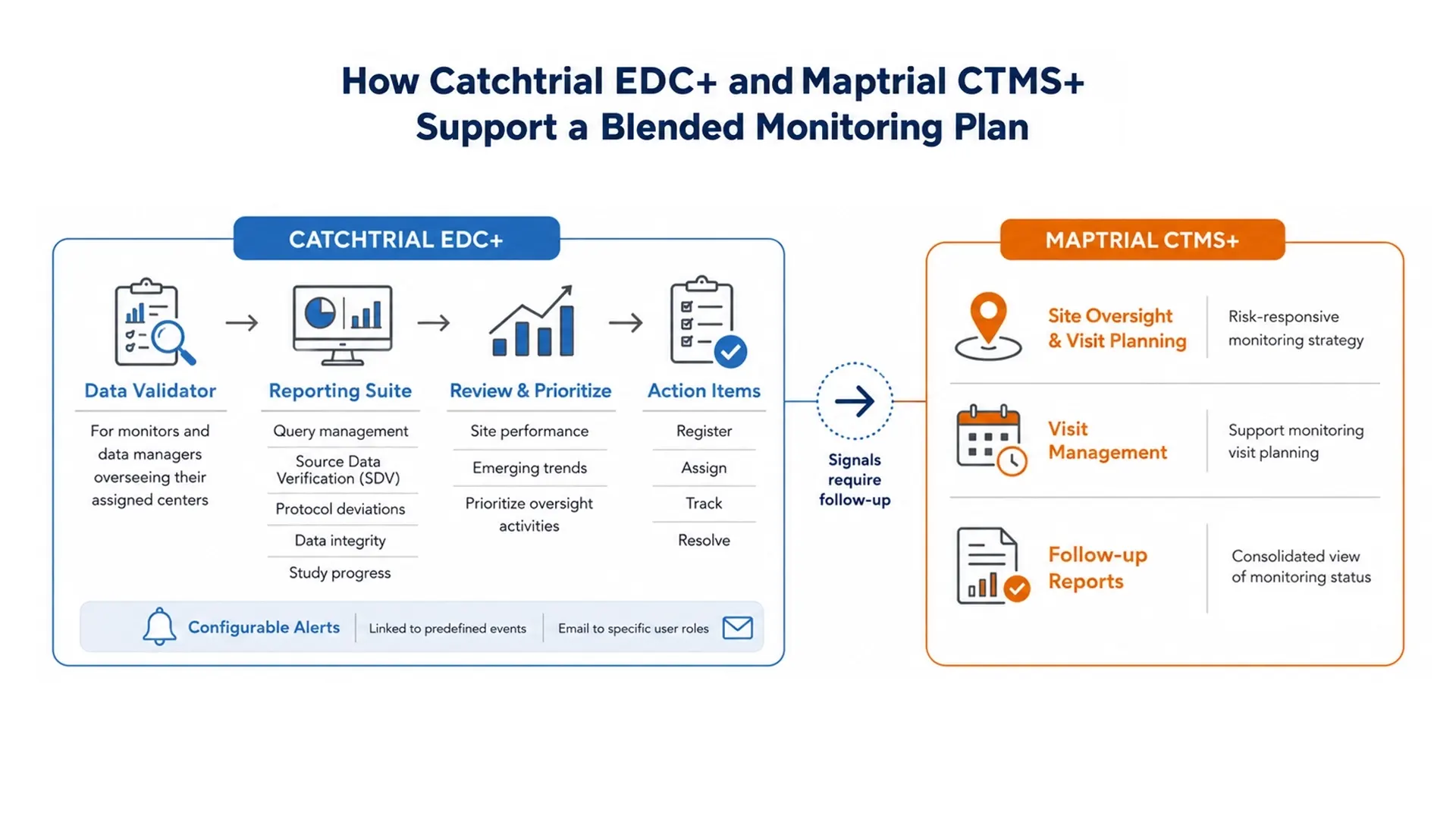
A blended monitoring strategy depends on risk signals reaching the people responsible for planning monitoring activities in a form they can act on. Catchtrial EDC+ includes a Data Validator module designed for monitors and data managers overseeing their assigned centers, and its reporting suite aligns closely with the decisions involved in a blended monitoring approach.
The platform also includes a range of reports that support centralized monitoring activities, covering areas such as query management, Source Data Verification (SDV), protocol deviations, data integrity, and overall study progress. Together, these reports are designed to help study teams review site performance, identify emerging trends, and prioritize oversight activities based on the evolving risk profile of the study.
When a signal requires follow-up, Action Items support the registration, assignment, tracking, and resolution of issues within the same environment. This is designed to keep the rationale for a targeted monitoring visit documented alongside the resulting actions. Configurable alerts can be linked to predefined events and sent by email to specific user roles.
On the operational side, Maptrial CTMS+ is designed to manage site oversight and visit planning that support a risk-responsive monitoring strategy, depending on study complexity. Follow-up reports summarize completed monitoring visits, giving study teams a consolidated view of the current monitoring status.
Documenting the Approach Against 21 CFR Part 11 and ICH GCP
A monitoring plan that evolves during a study requires clear and traceable documentation. When visit frequency changes because centralized review identifies a potential risk, both the decision and the underlying evidence should remain easy to trace.
21 CFR Part 11 establishes requirements for electronic records and electronic signatures, including secure, computer-generated, time-stamped audit trails. Catchtrial EDC+ maintains an audit log of patient data modifications and login attempts, recording the username, date and time, affected area, and a description of the action performed.
Electronic signature functionality in Catchtrial EDC+ complies with FDA 21 CFR Part 11 requirements, and sponsors can define which forms require electronic signatures. The E-Signature Status Report tracks forms that have been signed, are awaiting signature, or are still missing a signature.
For monitoring activities, the audit export covering SDV and Data Manager Review records identifies the user, timestamp, and data element whose review status changed. Under ICH GCP, this audit trail forms part of the documented evidence of sponsor oversight.
The practical takeaway: documenting the rationale behind monitoring decisions, together with a traceable audit trail, is generally easier to explain during an inspection than relying on visit frequency alone.
Choosing the Right Balance for Your Program
The right balance depends on the study itself. Factors such as study phase, device or drug risk classification, site experience, and data complexity all influence the appropriate mix of centralized and onsite monitoring. An early-phase, high-risk, multi-country study is likely to require more onsite monitoring than a lower-risk study involving experienced sites and well-established processes.
A few practical questions can help shape the monitoring strategy:
- Which sites are new, enrolling rapidly, or historically slower to resolve queries?
- What thresholds in the Protocol Deviation or SDV Tracking reports should trigger a targeted onsite visit?
- Which risks require direct onsite verification, and which can be monitored remotely?
Much of the discussion around centralized vs onsite monitoring in clinical trials is not about choosing one approach over the other. It is about building a documented, risk-based monitoring (RBM) strategy that uses both approaches where they are most appropriate.
Even organizations that have adopted RBM continue to adjust that balance from one study to the next, reflecting the specific risks and operational requirements of each trial.
Catchtrial EDC+ and Maptrial CTMS+ are designed to support this blended approach by bringing centralized review, operational oversight, and monitoring documentation together within an integrated eClinical platform. To see how these capabilities could fit your own clinical trial processes, visit the Catchtrial EDC+ product page or request a demo.
Frequently Asked Questions
Is centralized monitoring replacing onsite monitoring in clinical trials?
No. Current regulatory guidance does not position centralized monitoring as a universal replacement for onsite monitoring. Instead, ICH E6(R3) and FDA guidance support a risk-based approach in which sponsors determine the most appropriate combination of centralized and onsite monitoring based on the characteristics and risks of each study.
What is the difference between centralized and onsite monitoring?
Onsite monitoring involves a Clinical Research Associate (CRA) visiting the investigational site to review source documents, verify informed consent, and assess protocol compliance directly. Centralized monitoring is performed remotely by analyzing data across multiple sites to identify trends, outliers, and potential risks that may require further investigation.
When should sponsors increase onsite monitoring?
Additional onsite monitoring may be appropriate when centralized review identifies signals that warrant closer investigation. Examples include increasing protocol deviations, slower query resolution, unusual enrollment patterns, or other trends that suggest additional oversight may be beneficial. The decision should always reflect the study’s documented risk assessment.
How can an EDC system support centralized monitoring?
An Electronic Data Capture (EDC) system is designed to support centralized monitoring by making study data available for continuous review through dashboards, reports, edit checks, and data validation tools. Depending on study configuration, reports covering query management, Source Data Verification (SDV), protocol deviations, and study status may help monitoring teams identify sites that require additional attention.
How do Catchtrial EDC+ and Maptrial CTMS+ support blended monitoring?
Catchtrial EDC+ is designed to support centralized monitoring through reporting, data validation, configurable alerts, and audit trails, while Maptrial CTMS+ is designed to support site oversight and visit planning, depending on study configuration and complexity. Together, the two applications are intended to support organizations implementing a documented, risk-based monitoring strategy within an integrated eClinical platform.
Primary Regulatory Sources
- International Council for Harmonisation (ICH). ICH Harmonised Guideline E6(R3): Guideline for Good Clinical Practice (GCP), including Annex 1. Adopted 6 January 2025.
- U.S. Food and Drug Administration (FDA). Oversight of Clinical Investigations – A Risk-Based Approach to Monitoring. Guidance for Industry. August 2013.
- U.S. Food and Drug Administration (FDA). Questions and Answers: Risk-Based Approach to Monitoring of Clinical Investigations. Guidance for Industry. April 2023.
- U.S. Food and Drug Administration (FDA). 21 CFR Part 11 – Electronic Records; Electronic Signatures.
- European Medicines Agency (EMA). ICH E6(R3) Guideline for Good Clinical Practice (implementation information for the European Union).
Table of Contents
Latest Articles
21 CFR Part 11 password requirements: what the regulation actually says
A 90-day password change is not a 21 CFR [...]

Clinical trial software for the connected study stack
Clinical trials are generating more data from more sources, [...]

A practical guide to the main types of clinical trials
The type of clinical trial you run shapes almost [...]
This article provides general information and does not constitute regulatory, legal, clinical, or compliance advice. Requirements and appropriate processes may vary by study, product, jurisdiction, and organization. Medigen Suite functionality should be used in accordance with applicable regulations, study documentation, and internal procedures.