
Every regulatory submission rests on a simple assumption: the data behind it can be trusted. As trials grow more complex, spanning more sites, more data sources, and more electronic systems than ever before, maintaining that trust takes deliberate design rather than good intentions alone. This is where ALCOA++ data integrity comes in.
ALCOA++ is a framework used to define what “trustworthy data” actually means in practice. The original ALCOA principles were introduced by the U.S. Food and Drug Administration (FDA) in the 1990s to establish the fundamental characteristics of reliable records in GxP-regulated environments. Built around this core set of attributes and later extended to address the realities of electronic systems, ALCOA++ gives sponsors, CROs, and sites a shared language for data quality, one that inspectors, auditors, and study teams can all work from with confidence.
For clinical operations professionals evaluating eClinical software, ALCOA++ data integrity is not an abstract compliance checkbox. It is a practical lens for assessing whether an EDC, CTMS, eCOA, or eTMF platform will hold up under FDA or EMA scrutiny years after data collection ends.
Why ALCOA++ Data Integrity Matters for Trial Outcomes
Regulatory agencies do not just evaluate whether a trial’s conclusions look reasonable. They evaluate whether the underlying data can be traced, verified, and defended. A single unexplained data change, a missing audit entry, or an inconsistent timestamp can raise questions that ripple through an entire submission.
This is a shared challenge across the industry. As studies incorporate more devices, more electronic patient-reported outcomes, and more decentralized data capture points, the number of places where data integrity can be tested grows accordingly. The organizations that manage this well are not the ones avoiding complexity. They are the ones that have built systems and processes designed for it from the start.
The ALCOA++ Attributes in Practice
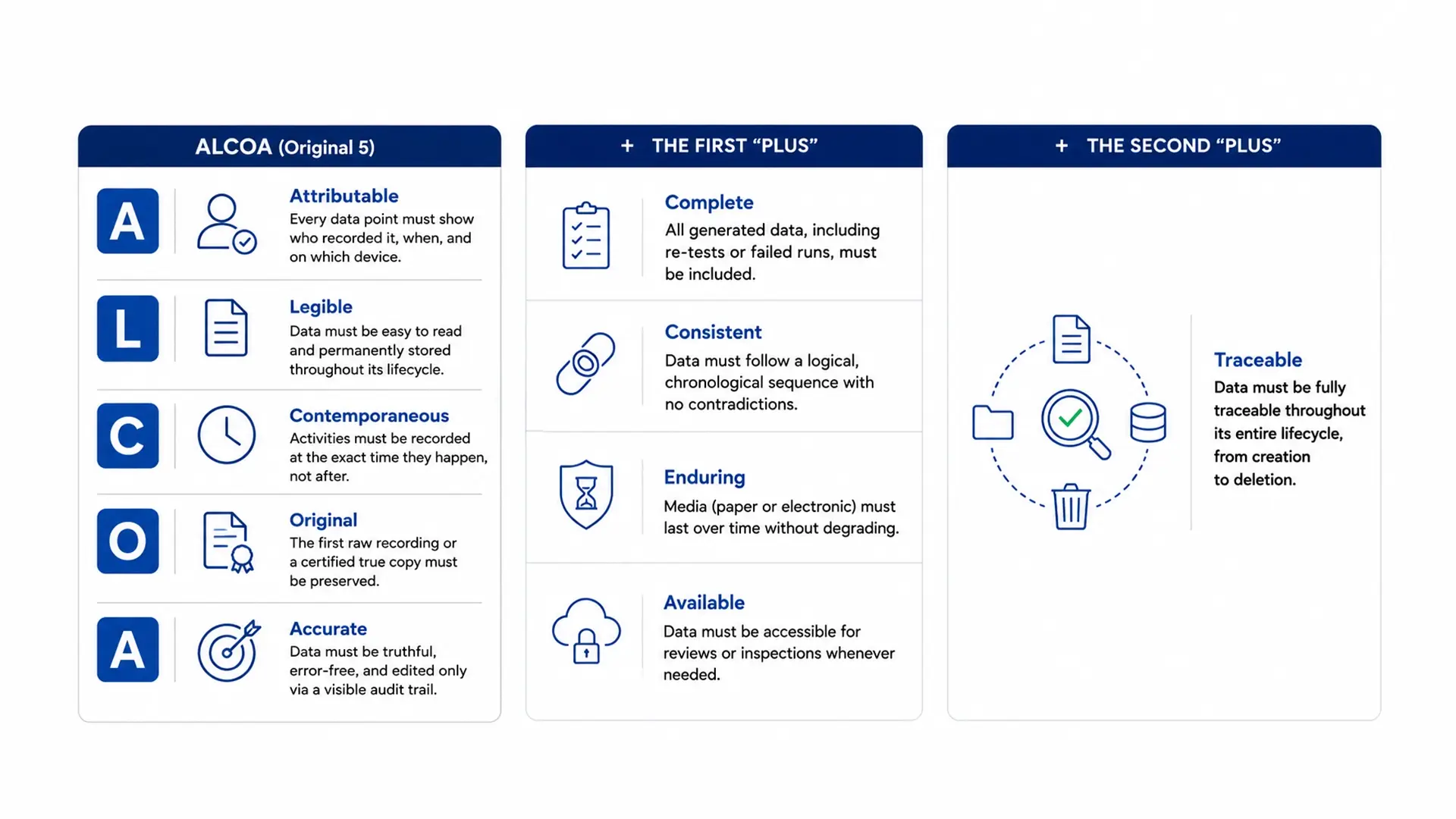
The original ALCOA acronym covers five attributes: Attributable, Legible, Contemporaneous, Original, and Accurate. The first “+” extension adds Complete, Consistent, Enduring, and Available, reflecting the realities of electronic records that paper-based systems never had to address. The second “+” adds Traceable, emphasizing the ability to reconstruct the full history and lifecycle of data, including its creation, modification, review, transfer, and final use.
Attributable and Legible. Every data point needs a clear owner and a readable record of who entered or changed it. In an eClinical platform, this depends on granular user and role management, so that each action in the system can be tied to a specific, authenticated individual rather than a shared login or an ambiguous entry.
Contemporaneous and Original. Data should be recorded at the time of the observation, in its first captured form or as a verified true copy. Electronic Case Report Forms (eCRFs) that timestamp entries automatically, rather than relying on manual logging, help preserve these attributes without adding burden to site staff.
Accurate and Complete. Accuracy depends on built-in validation, such as configurable edit checks and defined value ranges, that catch out-of-range or inconsistent entries as they happen rather than months later during monitoring visits. Completeness means missing data and missing fields are visible and trackable, not buried until database lock.
Consistent, Enduring, and Available. Data must hold together across forms, visits, and systems, remain accessible for as long as regulations require, and be retrievable on demand for inspection. This is largely a systems-architecture question: can the platform preserve the record in a durable format and reconstruct exactly what happened, and when, years after the fact?
Traceable. The full history of the data must be reconstructable throughout its lifecycle. This includes where the data originated, how it moved between systems, who or what changed it, why the change was made, and how it contributed to the final analysis or regulatory submission. Traceability depends on complete audit trails, preserved metadata, controlled system integrations, and documented data transformations.
Where Data Integrity Risk Actually Shows Up
Most data integrity gaps are not the result of anyone acting carelessly. They emerge at the seams: between systems, between manual and electronic processes, and between the moment data is captured and the moment it is reviewed.
Common friction points include:
- Cross-system inconsistencies, where a value entered in one form contradicts a related value elsewhere (for example, a date of death recorded earlier than a date of enrolment).
- Untracked corrections, where changes to data are made without a clear before-and-after record.
- Delayed validation, where errors surface only during monitoring visits instead of at the point of entry.
- Fragmented audit evidence, where activity logs live in separate systems and have to be manually reconciled for an inspection.
- Broken data lineage, where data has been transferred, transformed, or combined without sufficient metadata to trace it back to its original source.
Framed constructively, each of these is a solvable design problem. Modern eClinical platforms are built specifically to close these seams through automated checks, unified audit trails, and system-enforced workflows rather than manual policing.
Comparing Manual and System-Enforced Data Integrity Controls
The table below illustrates how the same integrity requirement is handled differently depending on whether it relies on a manual process or is enforced by the eClinical system itself.
| ALCOA++ Requirement | Manual/Paper-Based Approach | Modern eClinical System-Enforced Approach |
| Attributable | Sign-in sheets, handwritten signatures, shared logins | Role-based access and unique user credentials for each action |
| Legible | Handwritten records requiring manual interpretation | Standardized, human-readable electronic records and exports |
| Contemporaneous | Handwritten timestamps | Automatic system timestamps on entry and edit |
| Original | Original paper records or manually certified copies | Preserved source records, metadata, and verified electronic copies |
| Accurate | Post-hoc monitor review | Real-time edit checks and range validation |
| Complete | Manual missing-data tracking | Automated missing-field and missing-form reports |
| Consistent | Manual cross-form reconciliation | Automated cross-integrity checks between related fields |
| Enduring | Physical archives vulnerable to deterioration or loss | Validated electronic storage, backup, and long-term retention controls |
| Available | Physical archive retrieval | Searchable and exportable records and audit trails |
| Traceable | Manual reconciliation of logs and document histories | Version histories, metadata, and documented data lineage |
The pattern is consistent: system-enforced controls do not just make ALCOA++ easier to satisfy; they make it easier to demonstrate, which is often what an inspector is actually testing.
How Medigen Suite Supports ALCOA++ Data Integrity
Medigen Suite is built around the assumption that data integrity has to be engineered into the platform, not layered on top of it after the fact.
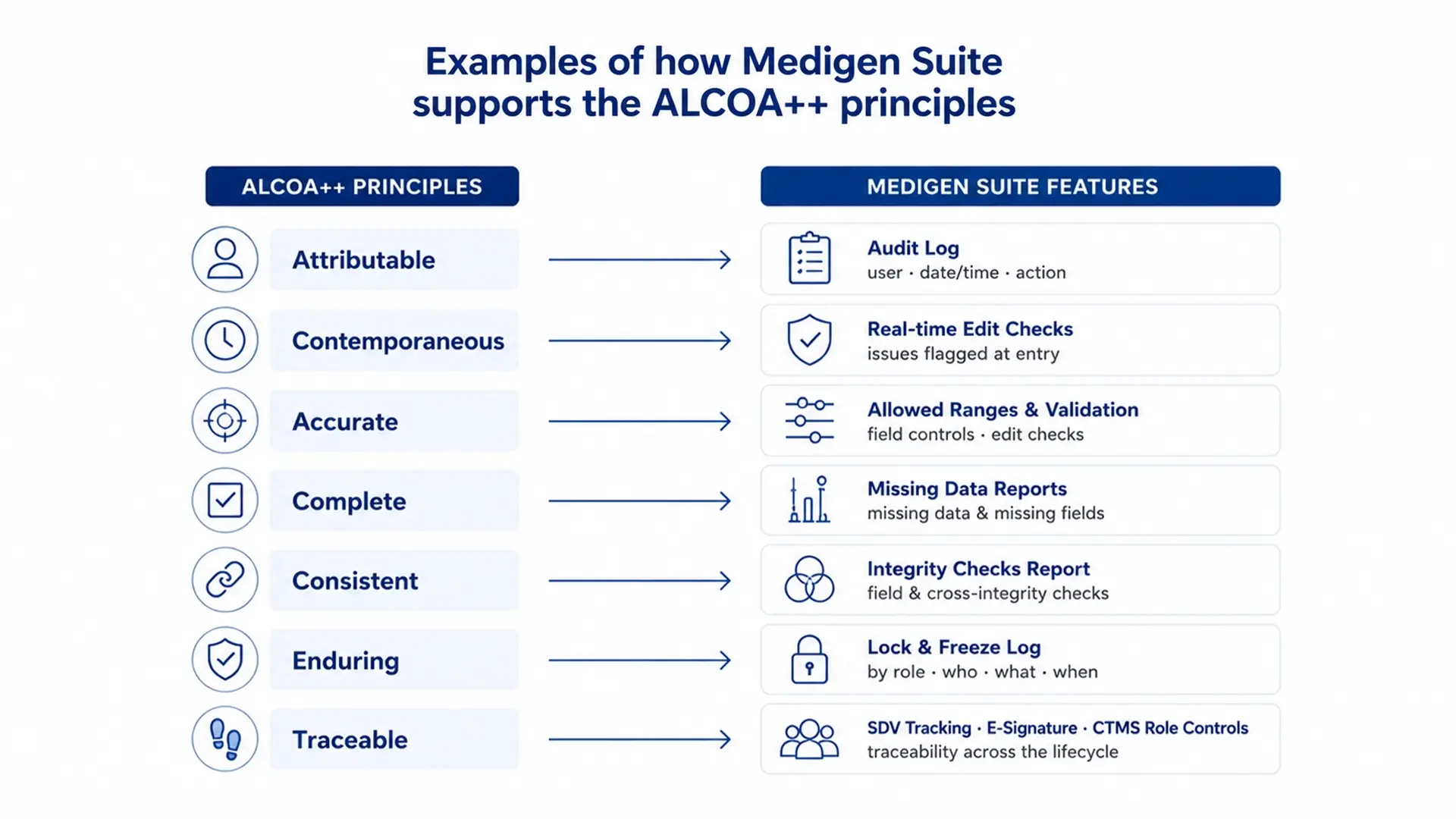
Catchtrial EDC+ addresses this at the point of data entry. Its eCRF module includes configurable edit checks and data integrity controls, such as defined allowed ranges for parameters, that flag issues as data is entered rather than weeks later. Every modification to patient information, and every login attempt, is captured in a detailed audit log recording the username, date and time, affected area, and a description of the action taken, directly supporting the attributable, contemporaneous, and traceable principles of ALCOA++.
For cross-checking data consistency, Catchtrial’s Data Validator module generates an Integrity Checks Report that distinguishes between field-integrity checks (a single value falling outside an acceptable range or format) and cross-integrity checks (a value on one form contradicting a value elsewhere, such as an inconsistent date sequence). This gives data managers a structured, exportable view of exactly where inconsistencies exist and what still needs resolution.
Completeness and traceability continue through the data lifecycle via Missing Data and Missing Fields reports, source data verification (SDV) tracking, and an E-Signature function that lets investigators formally confirm data accuracy, built to align with FDA 21 CFR Part 11 requirements. When data is finalized, lock and freeze actions are tracked in a dedicated online log by role, so the record of who finalized what, and when, is preserved.
Maptrial CTMS+ extends this integrity discipline into monitoring, with SDV and query management privileges that can be configured by role, keeping the chain of accountability and traceability intact from site entry through to sponsor oversight.
Reinforcing Compliance Through Regulatory Alignment
ALCOA++ does not exist in isolation. Its principles intersect directly with ICH GCP expectations for data quality, 21 CFR Part 11 requirements for electronic records and electronic signatures, and, for European trials, GDPR requirements for the handling of personal data. They are also reflected in EMA expectations for computerized systems and electronic data used in clinical trials.
A platform’s audit trail functionality, e-signature workflows, and access controls are the practical mechanisms that turn these regulatory principles into demonstrable practice, which is exactly what an inspector will want to see traced end to end during an audit.
Choosing the Right Approach for Your Trial
Not every study carries the same data integrity risk profile. A single-site Phase I study involving a small number of participants has different exposure points than a multinational pivotal trial of a Class III device involving dozens of sites, central imaging review, ePRO assessments, and multiple interconnected eClinical systems.
The right approach starts with an honest look at where your current process depends on manual reconciliation rather than system-enforced controls, and prioritizing the highest-risk gaps first, whether that is audit trail fragmentation, delayed validation, or inconsistent e-signature workflows.
Strong ALCOA++ data integrity is ultimately a design outcome, not a policy document. The trials best positioned for a smooth inspection are the ones where the eClinical platform itself is doing the enforcing and where every significant data point can be traced throughout its lifecycle.
To see how Catchtrial EDC+ and Maptrial CTMS+ apply ALCOA++ principles across your study, visit the Medigen Suite product pages or request a demo with our team.
Primary Regulatory Sources
- FDA, Data Integrity and Compliance With Drug CGMP: Questions and Answers (final guidance, Dec 2018) — https://www.fda.gov/regulatory-information/search-fda-guidance-documents/data-integrity-and-compliance-drug-cgmp-questions-and-answers
- FDA, 21 CFR Part 11 (Electronic Records; Electronic Signatures) — https://www.ecfr.gov/current/title-21/chapter-I/subchapter-A/part-11
- ICH E6(R3) Good Clinical Practice guideline — https://www.ich.org/page/efficacy-guidelines
- EMA, Reflection Paper on Expectations for Electronic Source Data and Data Transcribed to Electronic Data Collection Tools in Clinical Trials (2010) — https://www.ema.europa.eu (search “reflection paper electronic source data”)
- EMA, Guideline on Computerised Systems and Electronic Data in Clinical Trials — https://www.ema.europa.eu/en/documents/regulatory-procedural-guideline/guideline-computerised-systems-and-electronic-data-clinical-trials_en.pdf
- EU GDPR (Regulation (EU) 2016/679) — https://gdpr-info.eu
Table of Contents
- Why ALCOA++ Data Integrity Matters for Trial Outcomes
- The ALCOA++ Attributes in Practice
- Where Data Integrity Risk Actually Shows Up
- Comparing Manual and System-Enforced Data Integrity Controls
- How Medigen Suite Supports ALCOA++ Data Integrity
- Reinforcing Compliance Through Regulatory Alignment
- Choosing the Right Approach for Your Trial
- Primary Regulatory Sources
Latest Articles
21 CFR Part 11 password requirements: what the regulation actually says
A 90-day password change is not a 21 CFR [...]

Clinical trial software for the connected study stack
Clinical trials are generating more data from more sources, [...]

A practical guide to the main types of clinical trials
The type of clinical trial you run shapes almost [...]
This article provides general information and does not constitute regulatory, legal, clinical, or compliance advice. Requirements and appropriate processes may vary by study, product, jurisdiction, and organization. Medigen Suite functionality should be used in accordance with applicable regulations, study documentation, and internal procedures.