
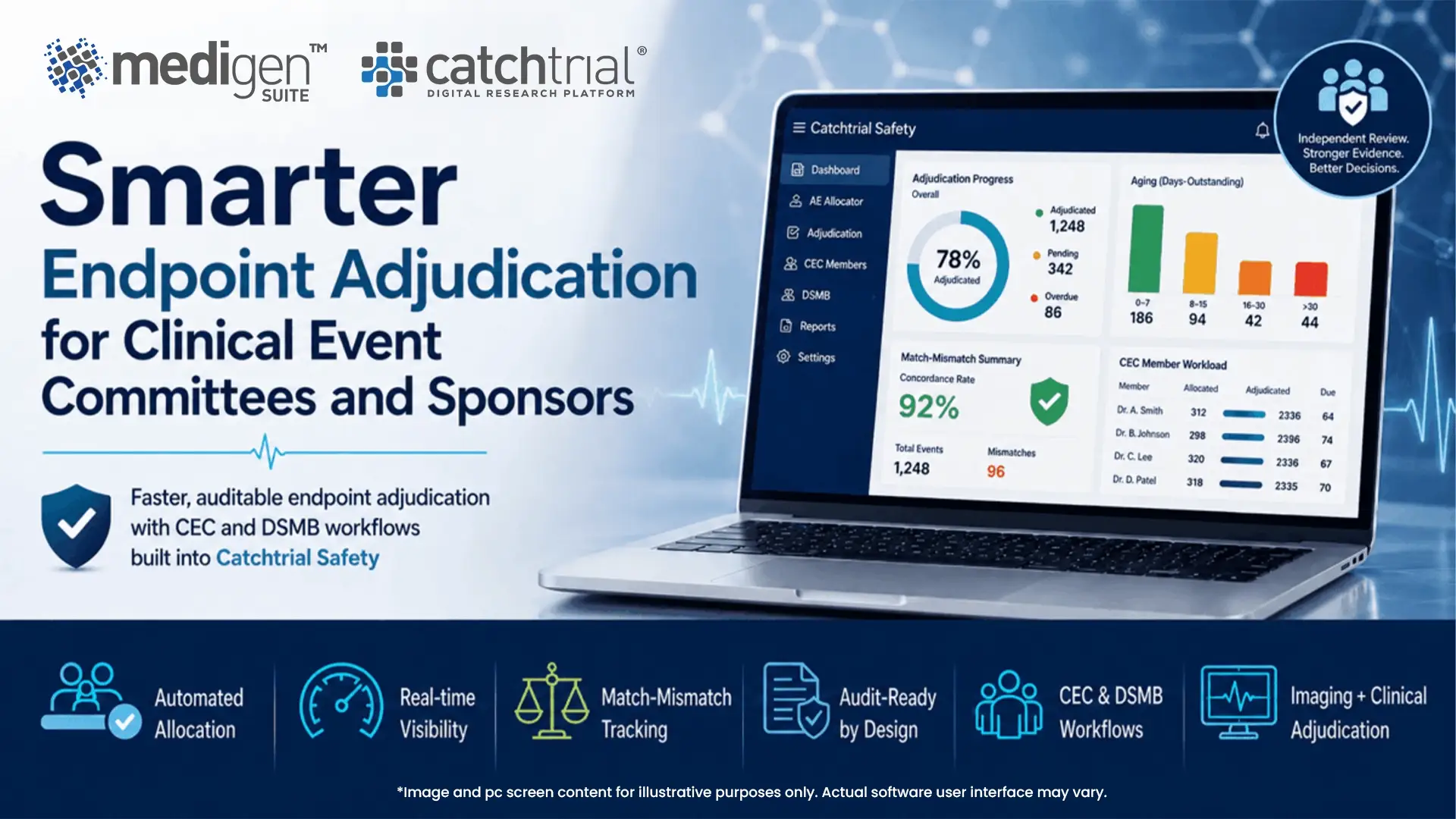
When a serious cardiac event occurs at one site and a similar event occurs at another, sponsors need to know the two were classified the same way. That consistency is the entire point of endpoint adjudication: an independent, standardized review of safety events and trial endpoints that removes investigator bias and produces a defensible, study-wide safety picture.
In practice, endpoint adjudication is one of the most operationally demanding parts of a clinical trial. A Clinical Events Committee, or CEC, must review narratives, source documents, and imaging for every reportable event, apply consistent criteria, and document a rationale that will hold up under regulatory scrutiny. When this process runs on spreadsheets, email threads, and PDF packets, it becomes slow, inconsistent, and hard to audit.
This article looks at why endpoint adjudication matters, where manual processes break down, and how purpose-built eClinical software changes the equation for CECs, sponsors, and data management teams. As part of the Medigen Suite eClinical platform, Catchtrial EDC+ approaches this challenge as a core safety capability rather than an add-on.
Why Endpoint Adjudication Matters
Endpoint adjudication exists because investigator-reported events are not always fully aligned. Site staff may classify an adverse event differently than a colleague at another center, particularly for complex or borderline cases such as device-related complications or composite cardiovascular endpoints. A CEC, often made up of independent specialists, reviews these events against a predefined charter to reach a consistent, blinded determination of causality and severity.
The stakes are high. Regulators expect a transparent, auditable adjudication process for pivotal trials, and an inconsistent or poorly documented CEC workflow can undermine confidence in the entire safety dataset. For sponsors, the goal is not just compliance, it is a safety profile that withstands scrutiny from regulatory reviewers, publication peer review, and post-market surveillance.
The Core Components of a CEC Workflow
A functioning adjudication process generally includes several recurring elements, regardless of therapeutic area:
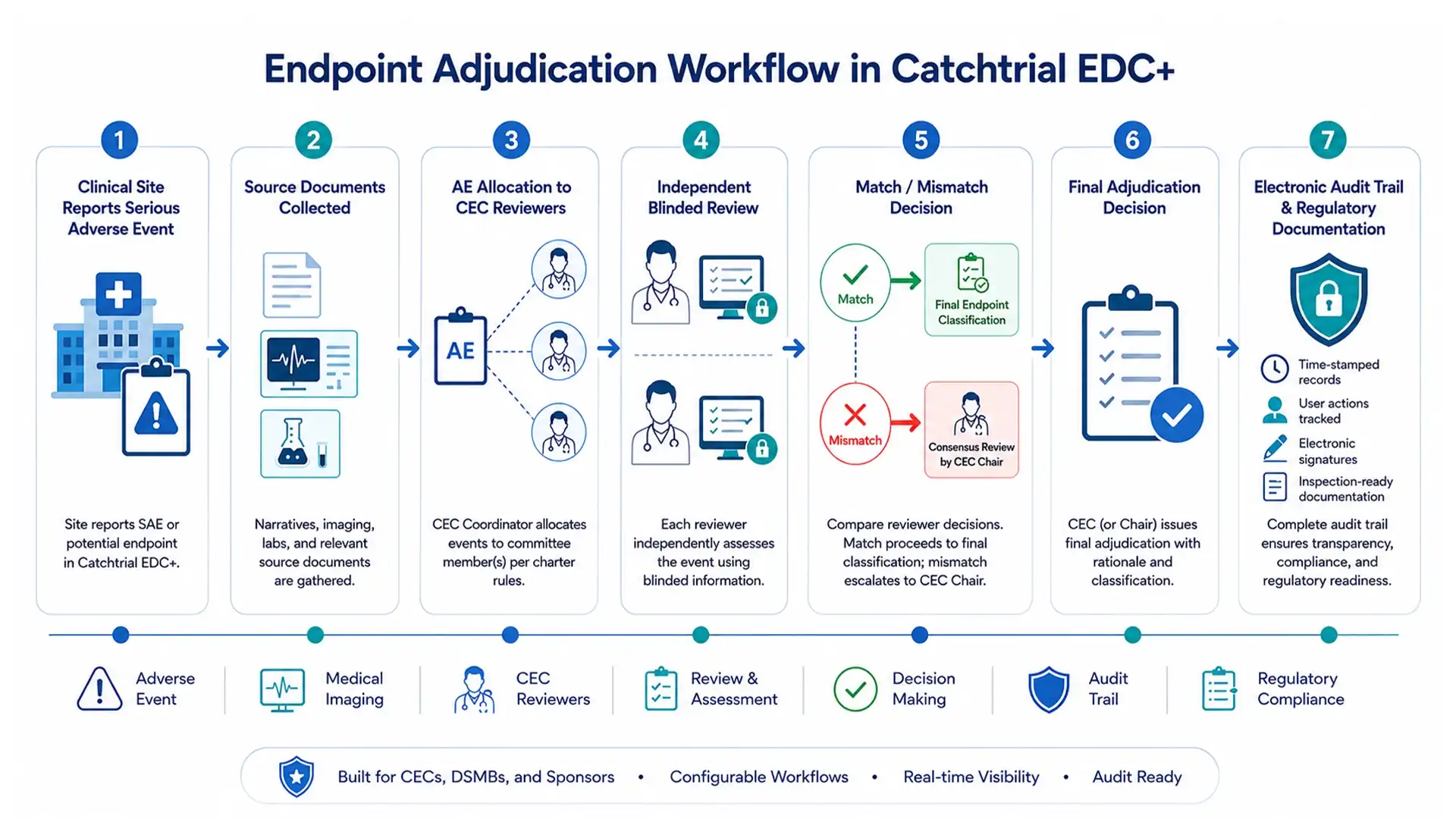
- Event allocation, where adverse events or potential endpoints are routed to one or more CEC members for independent review
- Source data review, including narratives, imaging, lab values, and site-entered case report form data
- Causality assessment, typically expressed as related, possibly related, or not related to the investigational device or procedure
- Consensus or match-mismatch resolution, when multiple reviewers disagree
- Documentation of rationale, sufficient to support the final classification during an inspection
Each of these steps generates data that needs to be tracked, time-stamped, and tied back to the original event. Manual coordination across these steps is where most delays and data quality issues originate.
Where Manual Adjudication Breaks Down
Spreadsheet-based or email-driven adjudication tends to fail in predictable ways. Event allocation becomes a manual task for a CEC coordinator, who must track who has reviewed what and chase down outstanding assignments. Mismatches between an initial site classification and the CEC’s final determination are easy to lose in version history. And aging events, those still pending review weeks after submission, often go unnoticed until a sponsor asks for a status update.
These are not just operational inconveniences. A backlog of unadjudicated events at database lock can delay a submission, and inconsistent causality determinations can raise questions during an FDA or EMA review. The DSMB, when one is involved, faces a similar challenge in tracking event-level detail across a study without a dedicated system.
Comparing Manual and System-Supported Adjudication
| Manual process (spreadsheets, email, PDF) | System-supported CEC workflow | |
| Event allocation | Coordinator manually assigns events to reviewers | Automated allocation across CEC members per charter rules |
| Tracking pending events | Status tracked in separate logs, prone to gaps | Real-time aging and status reports by event |
| Match-mismatch resolution | Manual comparison of initial vs. final classification | Automated comparison with concordance flags |
| Audit trail | Reconstructed after the fact from emails and files | Built-in, time-stamped, and inspection-ready |
| CEC member workload visibility | Limited, dependent on manual reporting | Per-member scorecards with allocated, adjudicated, and due counts |
| Blinding and bias control | Dependent on manual process discipline | Configurable blinded review built into the workflow |
How Catchtrial Safety Supports Endpoint Adjudication
Catchtrial EDC+, through its Catchtrial Safety module, is built specifically around the CEC and DSMB workflow rather than treating adjudication as an afterthought of the EDC.
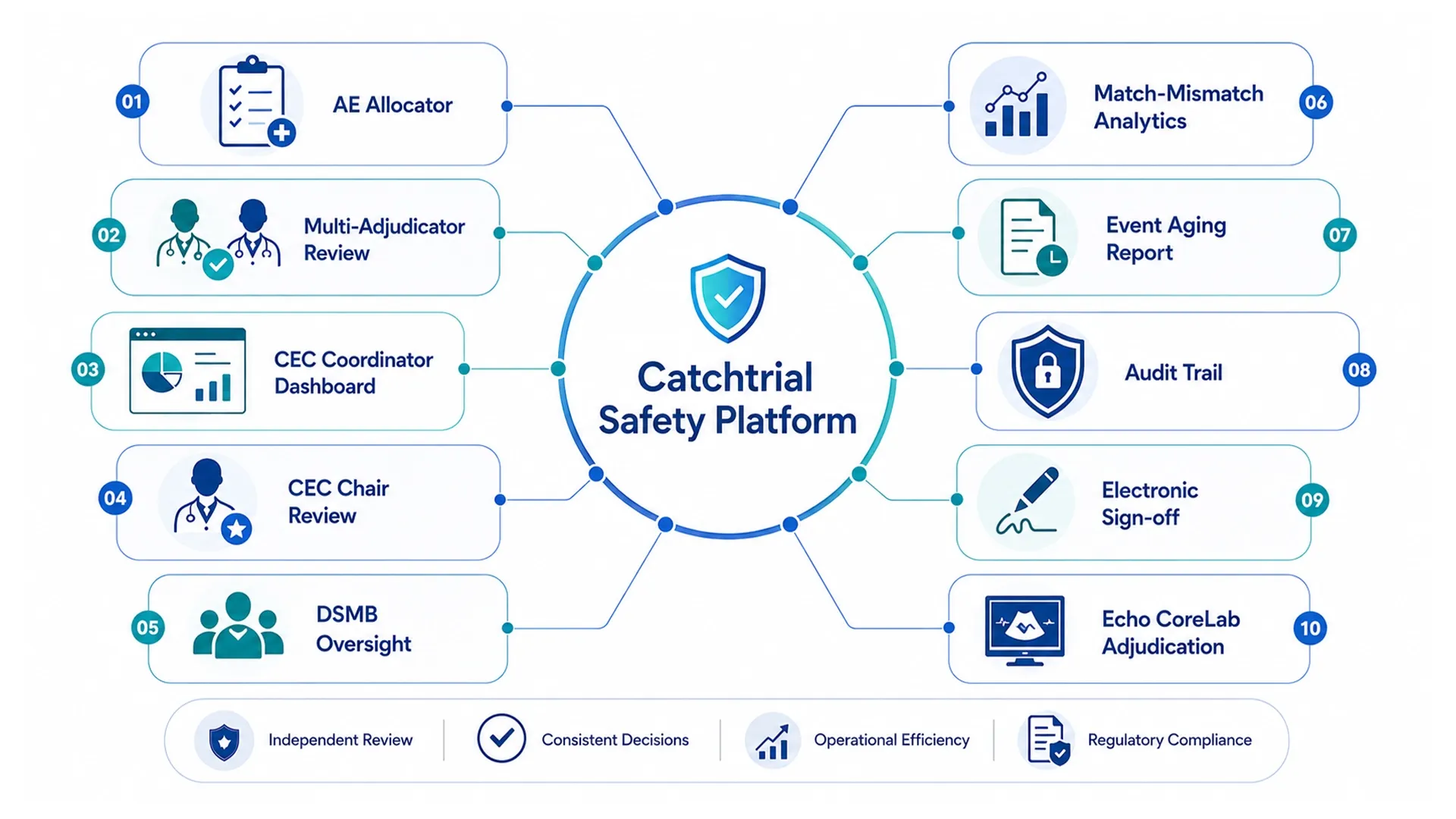
Event allocation is handled through the AE Allocator, which lets a CEC coordinator distribute adverse events and potential endpoints across committee members according to the study’s CEC charter. For trials requiring more rigorous review, the Multi-Adjudicator function supports a multi-reviewer model, where each event is independently assessed by two or more CEC members, with match-mismatch statistics generated automatically.
Reviewers and chairs get role-specific access. A dedicated CEC Chairman role allows read-only review of the same forms the CEC Board can see, along with the ability to lock or unlock safety forms once review is complete, supporting a controlled, auditable sign-off process.
Status and workload visibility come from a set of purpose-built reports rather than manual tracking. CEC coordinators can see an overview of adjudication progress by center, a per-member adjudication progress report showing events allocated, adjudicated, and still due, and an aging report that flags pending events by days outstanding, so bottlenecks surface before they affect timelines. For quality control, the CEC Adjudication Match-Mismatch Report compares each event’s initial classification against the CEC’s final determination across key variables, including AE term, safety endpoint status, and device or procedure relatedness.
For studies involving imaging-based endpoints, the Echo CoreLab Adjudication add-on extends this same structure to core lab review of echo images, so imaging-based and clinical adjudication can sit within a consistent workflow.
The result is an adjudication process that produces its own documentation as a byproduct of normal use, rather than requiring a separate reconstruction effort before submission.
The Regulatory and Compliance Angle
Endpoint adjudication sits squarely within ICH GCP expectations for data integrity and independent safety oversight. Reviewers and regulators alike expect a complete audit trail showing who reviewed an event, when, and on what basis a final classification was reached. Electronic signatures and locked, time-stamped records, consistent with 21 CFR Part 11 principles, support that expectation by making the chain of custody for each adjudicated event traceable from initial report to final CEC sign-off.
For studies with EU sites, the same audit trail and access-control principles also support GDPR-aligned handling of patient-level safety data reviewed by committee members who may be located outside the originating site or country.
Choosing the Right Approach for Your Study
Not every study needs a multi-reviewer CEC model or a DSMB charter as complex as a large cardiovascular outcomes trial. Smaller studies with straightforward safety profiles may be well served by a single-adjudicator workflow with strong reporting. Larger or higher-risk trials, particularly device studies with composite endpoints, generally benefit from multi-adjudicator review, formal match-mismatch tracking, and dedicated DSMB support from the outset.
The right starting point depends on event volume, endpoint complexity, and the level of independent oversight your protocol and regulatory strategy require. What matters most is building the adjudication workflow into the trial’s data infrastructure early, rather than retrofitting it once events start arriving.
If your team is evaluating how to bring structure, speed, and auditability to endpoint adjudication, visit the Catchtrial EDC+ Safety Adjudication page or request a demo to see the CEC and DSMB workflow in action.
Table of Contents
Latest Articles
21 CFR Part 11 password requirements: what the regulation actually says
A 90-day password change is not a 21 CFR [...]

Clinical trial software for the connected study stack
Clinical trials are generating more data from more sources, [...]

A practical guide to the main types of clinical trials
The type of clinical trial you run shapes almost [...]
This article provides general information and does not constitute regulatory, legal, clinical, or compliance advice. Requirements and appropriate processes may vary by study, product, jurisdiction, and organization. Medigen Suite functionality should be used in accordance with applicable regulations, study documentation, and internal procedures.