What Is MedDRA Coding — and Why Does It Matter?
MedDRA coding is the process of translating free-text adverse event (AE) descriptions entered by clinical sites into standardized terminology from the Medical Dictionary for Regulatory Activities (MedDRA). Every AE reported in a clinical trial must be assigned the correct MedDRA Preferred Term (PT) and System Organ Class (SOC) before a study dataset can be submitted to regulatory authorities such as the FDA or EMA.
Without accurate MedDRA coding, a study’s safety data cannot be properly analyzed, compared across trials, or submitted for regulatory review.
MedDRA serves as the foundation for standardized adverse event classification and safety reporting across clinical trials. Getting it right is not optional.
How Is MedDRA Coding Traditionally Done?
In most clinical trials, MedDRA coding is a manual, labor-intensive process. Here is what it typically looks like:
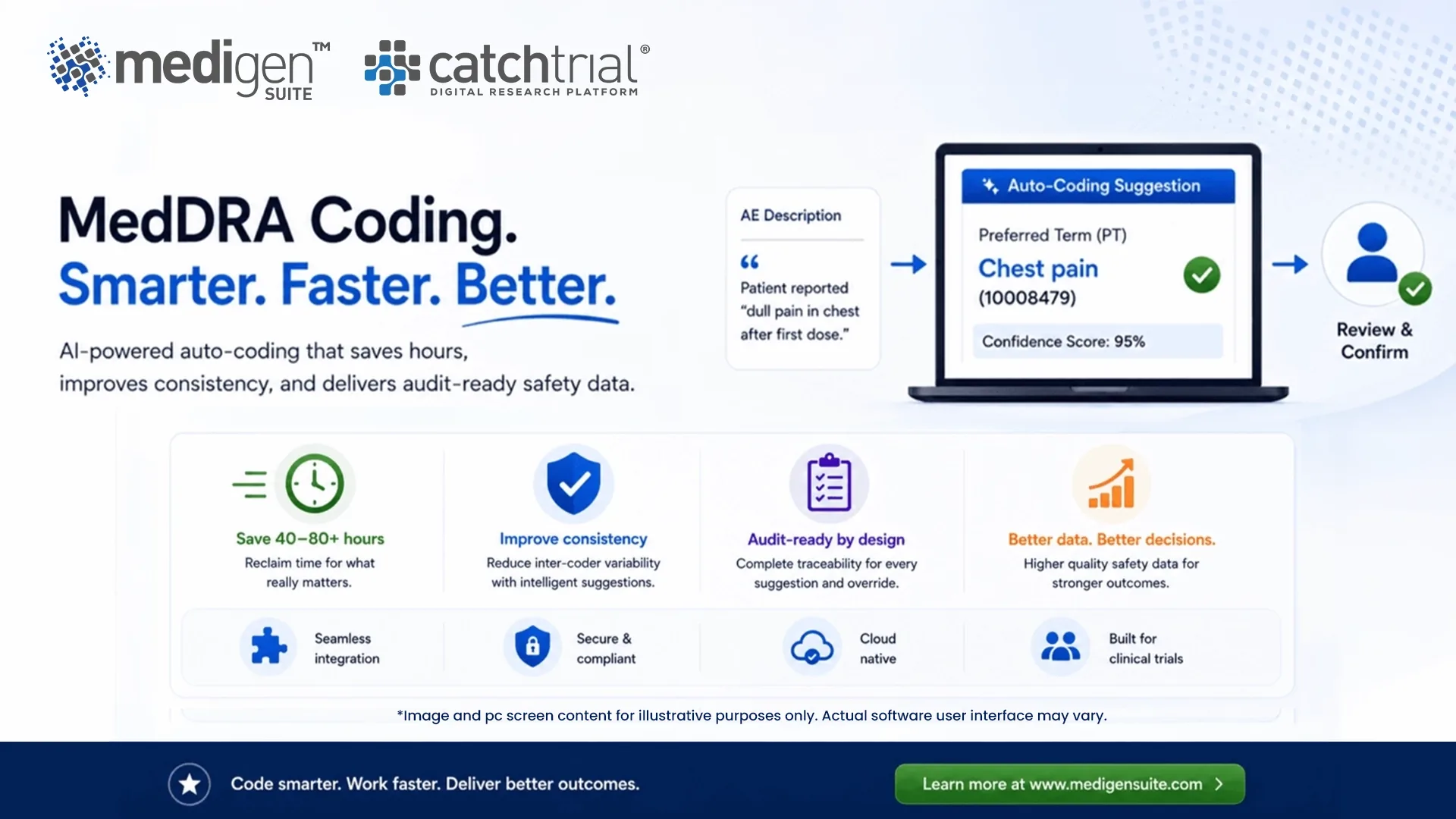
- A site coordinator enters a free-text adverse event description into the eCRF — for example, “patient reported dull pain in chest after first dose.”
- A data manager or medical coder reviews that text and searches the MedDRA hierarchy to find the best-matching Lowest Level Term (LLT), Preferred Term (PT), High Level Term (HLT), and System Organ Class (SOC).
- The coder records the selected terms, documents the rationale if the match is ambiguous, and flags the record for review.
- A second reviewer checks the coding for consistency across the study.
- If the MedDRA version changes mid-study — as it does twice per year — affected records must be re-evaluated.
Multiply this across hundreds of adverse events in a multi-center study, and the scope of the problem becomes clear. A Phase III device study with 500 patients enrolled across 30 sites may generate well over a thousand individual AE entries, each requiring manual review. Industry estimates suggest that manual MedDRA coding accounts for 10–20% of total data management effort in a typical study — a significant operational cost.
What Is Auto-Coding in MedDRA?
Auto-coding is the use of artificial intelligence or rule-based algorithms to automatically suggest or assign MedDRA terms to adverse event descriptions entered in an eCRF. Instead of a data manager manually searching a dictionary, the system analyzes the free-text input and proposes the most appropriate standardized code — often in real time, at the point of data entry.
Auto-coding does not replace the medical coder. Rather, it dramatically reduces the time needed for each coding decision by presenting a ranked shortlist of candidate terms, allowing the coder to confirm, adjust, or override the suggestion rather than starting from scratch.
Key components of an effective MedDRA auto-coding solution:
- Natural language processing (NLP) to parse and interpret clinical language in AE descriptions
- Integration with the current MedDRA version to ensure term validity and hierarchy accuracy
- Confidence scoring to flag low-confidence suggestions for closer human review
- Audit trail to document every auto-suggestion and every human override, as required by 21 CFR Part 11 and ICH E6(R3)
- Support for multi-language studies, since AE text may be entered in languages other than English
How Much Time Does Auto-Coding Actually Save?
The time savings from auto-coding vary depending on study complexity, the quality of free-text entries, and the percentage of terms that can be automatically resolved with high confidence. However, the efficiency gains are well established across data management teams.
| Task | Manual Coding (per AE) | With Auto-Coding |
| Initial term search | 5–10 minutes | < 1 minute |
| Review and confirmation | 2–5 minutes | 1–2 minutes |
| Query resolution (ambiguous terms) | 10–20 minutes | Reduced by ~60% |
| Re-coding after MedDRA version update | Full re-review | Automated flag + targeted review |
Across a typical 800-AE study, that adds up to roughly 40 to 80 hours of data management time recovered – hours that can be redirected to query resolution, SDV oversight, or database lock preparation.
Beyond time savings, auto-coding reduces inter-coder variability. When two data managers independently code the same AE differently — one assigns “Chest discomfort” and another assigns “Chest pain” — it creates inconsistency in the safety dataset that regulators may question. A consistent AI-assisted suggestion anchors the process and reduces that variability.
For a study with 800 AE records, auto-coding can realistically save 40 to 80 hours of data management time
Why Consistent Adverse Event Coding Matters
Accurate and consistent adverse event coding is essential for meaningful safety analysis. Variations in terminology, spelling, abbreviations, and local clinical practice can make it difficult to compare data across sites and studies.
Standardized MedDRA coding helps ensure that similar events are classified consistently, improving data quality, supporting regulatory submissions, and facilitating reliable safety signal detection throughout the clinical trial lifecycle.
Regulatory Requirements for MedDRA Coding
Regulatory agencies do not simply accept raw MedDRA codes — they scrutinize the coding methodology. Key requirements to be aware of:
- ICH E2B(R3): Specifies MedDRA as the required terminology for adverse event reporting in individual case safety reports (ICSRs).
- CDISC CDASH/SDTM: Requires MedDRA coding in the AE domain, with PT, SOC, and LLT fields mapped correctly for regulatory submissions.
- FDA 21 CFR Part 11: Requires that any electronic modification to coded data — including auto-coding suggestions and manual overrides — be captured in a validated, timestamped audit trail.
- EU MDR (2017/745): Mandates standardized adverse event reporting for medical device trials, with MedDRA as the accepted dictionary for clinical investigations under ISO 14155.
- MedDRA version currency: Regulatory submissions must use the MedDRA version current at the time of data cut. Studies that span multiple MedDRA release cycles must document how term changes were managed.
Auto-coding systems must themselves be validated under GAMP 5 principles to demonstrate that the AI suggestions are reproducible, traceable, and fit for a GxP environment.
4 Questions to Ask When Evaluating MedDRA Auto-Coding in an EDC
If you are evaluating whether your eClinical platform provides meaningful MedDRA coding support, these are the right questions to ask:
- Is MedDRA coding native to the eCRF, or does it require export to a third-party tool? Switching between systems adds steps, delays, and data reconciliation risk.
- Does the system use AI or NLP to suggest terms, or only exact-match dictionary lookups? AI-based suggestions handle the messy, abbreviated, multi-language clinical text that sites actually enter.
- Is the full MedDRA hierarchy accessible — LLT, PT, HLT, HLGT, SOC? Partial hierarchies produce incomplete coding that fails SDTM validation.
- Is every suggestion and override captured in a CFR Part 11-compliant audit trail? This is non-negotiable for regulatory submission.
MedDRA Coding in Catchtrial — Built Into the EDC, Powered by AI
Catchtrial, the Electronic Data Capture module of the Medigen Suite, includes native MedDRA coding functionality directly within the eCRF environment. There is no export, no third-party tool, and no manual handoff between systems.
When a site user enters an adverse event description in a Catchtrial form, the system’s AI analyzes the text and proposes the most appropriate MedDRA terms. The data manager or medical coder can review the suggestion, confirm it, or select an alternative — all within the same interface used for data entry and query management.
Key capabilities of MedDRA coding in Catchtrial:
- AI-assisted term suggestion at the point of AE data entry, reducing per-record coding time
- Full MedDRA hierarchy support — LLT through SOC — for SDTM-compliant submissions
- Integrated audit trail capturing every suggestion, confirmation, and override with user, timestamp, and rationale, compliant with 21 CFR Part 11
- Configured directly within the eCRF form design, so coding fields are part of the study build — not an afterthought
- Multi-event AE management, allowing updates to AE records through a protected working copy mechanism that preserves the integrity of the main eCRF
- Safety reporting integration, with MedDRA codes feeding directly into the AE Classification Report, CEC Adjudication workflows, and MDR-compliant safety reporting
Catchtrial is part of the Medigen Suite — an integrated clinical trial platform that also includes Maptrial CTMS, eTMF, ePRO/eCOA, and DICOM image management. MedDRA-coded safety data flows seamlessly into safety dashboards, AE listing reports, and CEC adjudication workflows without requiring manual data transfer between systems.
For study teams managing multi-center device trials, oncology studies, or any protocol with a high volume of adverse events, the efficiency gains from integrated AI-assisted MedDRA coding are immediate and measurable.
Frequently Asked Questions About MedDRA Coding
When was MedDRA introduced?
MedDRA was introduced in 1999 by the International Council for Harmonisation as a standardized medical terminology for regulatory reporting and analysis of clinical safety data. Since then, it has become the global standard for coding adverse events.
How often is MedDRA updated?
MedDRA is updated twice per year, typically in March and September. Studies that span multiple release cycles must manage version transitions carefully to ensure coding consistency.
Can auto-coding replace a medical coder?
No. Auto-coding assists the coder by providing ranked term suggestions, reducing search time and inter-coder variability. A qualified human reviewer must confirm all MedDRA assignments, particularly for serious or ambiguous events.
What is the difference between MedDRA and the WHO Drug Dictionary?
MedDRA codes adverse events, medical history, and indications. The WHO Drug Dictionary (WHODrug) codes concomitant and prior medications, mapping free-text drug names to standardized active ingredients and ATC classes. Most clinical trials require both: MedDRA for events, WHODrug for drugs. In Catchtrial, both coding workflows live inside the same eCRF environment.
Is MedDRA auto-coding accepted by regulators?
Yes, provided the system is validated, the audit trail is complete, and coding decisions are documented with appropriate human oversight. The auto-suggestion itself does not constitute a coding decision — the confirmed term does.
What is a MedDRA Preferred Term (PT)?
A Preferred Term is the distinct descriptor for a symptom, sign, disease, diagnosis, therapeutic indication, investigation, surgical or medical procedure, or medical, social, or family history characteristic. It is the primary level used in regulatory submissions.
Ready to reduce MedDRA coding time in your next study? Explore how Catchtrial‘s built-in AI-assisted MedDRA coding fits into your clinical data management workflow. Contact the Medigen Suite team to learn more.
Table of Contents
Latest Articles
21 CFR Part 11 password requirements: what the regulation actually says
A 90-day password change is not a 21 CFR [...]

Clinical trial software for the connected study stack
Clinical trials are generating more data from more sources, [...]

A practical guide to the main types of clinical trials
The type of clinical trial you run shapes almost [...]
This article provides general information and does not constitute regulatory, legal, clinical, or compliance advice. Requirements and appropriate processes may vary by study, product, jurisdiction, and organization. Medigen Suite functionality should be used in accordance with applicable regulations, study documentation, and internal procedures.