
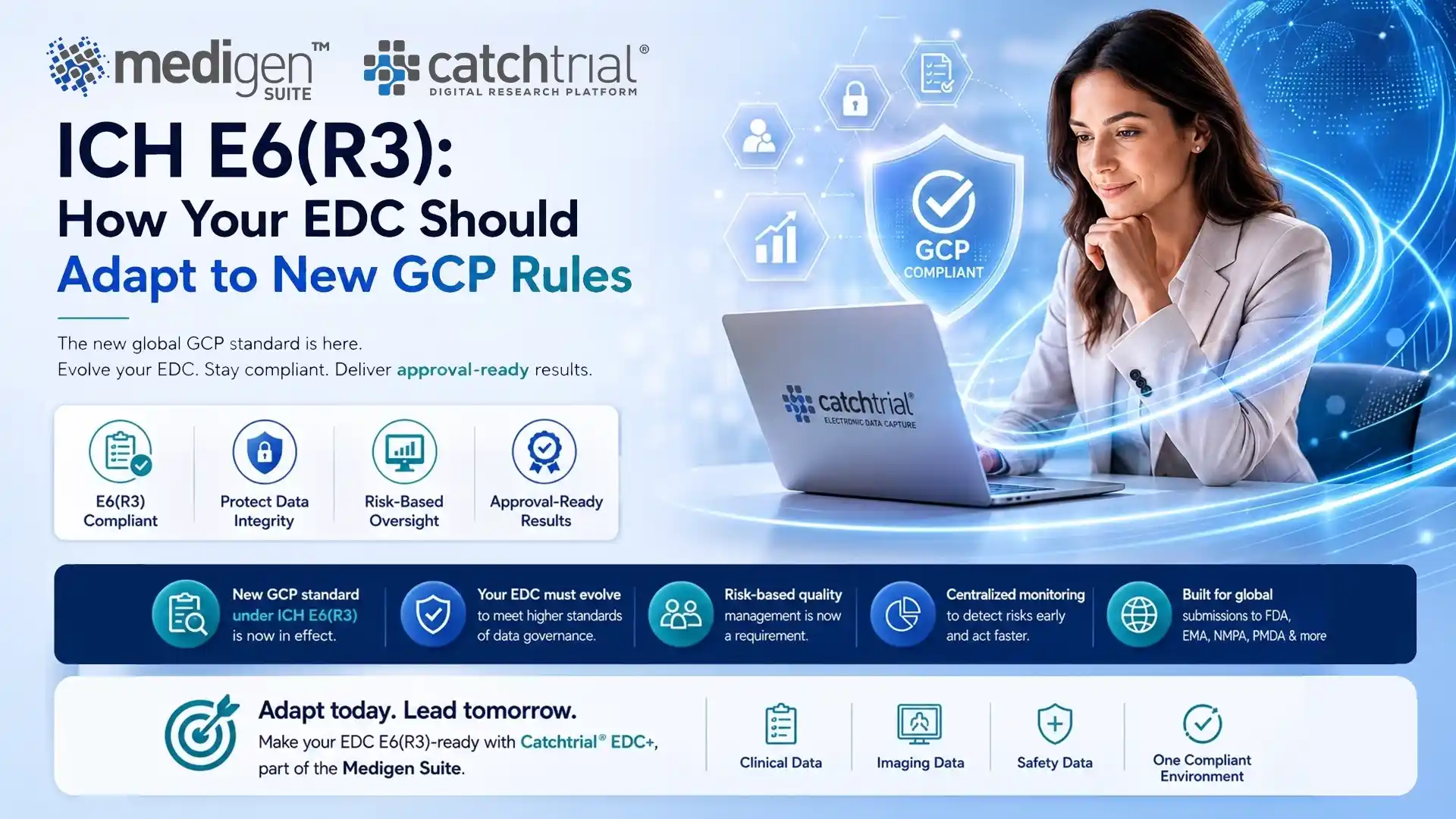
The ICH E6(R3) guideline, finalized in January 2025, represents the most significant rewrite of Good Clinical Practice standards in nearly three decades. For sponsors, CROs, and clinical data managers still operating under ICH E6(R2) assumptions, the message is clear: your Electronic Data Capture system must evolve — or risk falling behind regulatory expectations.
Understanding what has changed, and why it matters for your EDC infrastructure, is no longer optional. GCP compliance in modern trials depends on it.
From ICH E6(R2) to E6(R3): What Actually Changed?
ICH E6(R2), adopted in 2016, introduced the concept of risk-based monitoring and laid the groundwork for remote oversight. It was an addendum — a patch onto existing principles. ICH E6(R3) is different. It is a comprehensive restructuring of the entire GCP framework, organized around four major stakeholders: the IRB/IEC, the Investigator, the Sponsor, and a new standalone section on Data Governance shared between investigators and sponsors.
The R3 revision formally elevates data governance to a first-class concern. Section 4 of the guideline — dedicated entirely to the data life cycle — covers data capture, audit trails, metadata, data corrections, transfer and migration, finalization, retention, and destruction. This level of specificity has direct implications for how EDC systems must be built, validated, and operated.
For teams accustomed to the relatively looser ICH E6(R2) framing around electronic systems, the shift to E6(R3) requires both procedural and technological upgrades.
ICH E6(R3) is different. It is a comprehensive restructuring of the entire GCP framework.
Why the EDC system is now a regulatory asset
One of the most consequential changes in E6(R3) is the explicit framing of computerized systems as regulated tools — not simply operational conveniences. Section 4.3 of the guideline introduces detailed requirements around system validation, security, user management, audit trails, system failure protocols, and technical support.
Under E6(R3), your EDC must demonstrate:
- Documented validation that confirms the system does what it is designed to do, including evidence of testing and formal release procedures
- Audit trail integrity that captures who entered, modified, or reviewed data and when — with metadata that cannot be altered without detection
- User access controls that limit system functions based on role and responsibility, with records of onboarding and offboarding
- System failure protocols that ensure data is not lost, corrupted, or inaccessible in the event of technical disruption
These are not aspirational standards. They are baseline expectations for GCP compliance in any trial initiated or ongoing after the guideline’s adoption.
Risk-based quality management under ICH E6(R3)
ICH E6(R2) introduced risk-based monitoring as a concept. ICH E6(R3) operationalizes it with greater specificity. Section 3.10 on Quality Management now requires sponsors to implement a systematic approach to risk identification, evaluation, control, communication, and review — with documentation at each stage.
For your EDC, this means the platform must support centralized monitoring workflows that surface early risk signals across sites. Manual, retrospective data review is not sufficient. GCP compliance under E6(R3) requires an EDC that enables proactive, data-driven oversight — including the ability to detect outliers, flag data integrity issues, and track site performance in real time.
The guideline is explicit that monitoring activities must be proportionate to the complexity and risk profile of the trial. An EDC that cannot support adaptive monitoring strategies will struggle to meet the documentation and oversight expectations that E6(R3) now requires.
Manual, retrospective data review is not sufficient.
Data governance requirements for GCP compliance
The standalone Data Governance section (Section 4) of E6(R3) is new territory. It formalizes responsibilities that were previously scattered or implied, and creates a shared accountability framework between sponsors and investigators.
Key provisions include:
Data Capture (4.2.1): Data must be captured as close to the source as possible, with contemporaneous entry and clear identification of the person responsible. EDC systems must support direct data entry that preserves this chain of accountability.
Audit Trails and Metadata (4.2.2): Systems must generate audit trails automatically. Every data point must carry associated metadata — including timestamps, user identifiers, and version history — that is retained with the data itself.
Data Corrections (4.2.4): Corrections must be documented in a way that does not obscure the original entry. EDC systems that allow untracked overwriting of records are not E6(R3) compliant.
Data Transfer and Migration (4.2.5): When data is moved between systems, sponsors must verify that completeness and integrity are maintained. This is particularly relevant for trials that use multiple data sources — imaging, ePRO, labs — that feed into a central EDC environment.
These requirements signal that regulators are no longer willing to accept data governance as an afterthought. The EDC platform must embed compliance into its architecture.
What ICH E6(R3) means for EDC selection and configuration
The gap between legacy EDC platforms and the demands of E6(R3) is widening. Systems designed primarily for CRF completion and query management will need significant augmentation to meet the full scope of the guideline’s requirements.
When evaluating EDC readiness for E6(R3), teams should ask:
- Does the system maintain a complete, immutable audit trail at the field level?
- Can the platform support centralized monitoring with risk-based oversight dashboards?
- Is the validation documentation sufficient to satisfy regulatory inspection?
- Does the system accommodate multi-source data — imaging, safety, ePRO — in a single compliant environment?
- Are user roles and access permissions granular enough to reflect the accountability structures E6(R3) requires?
These are not feature requests. They are compliance prerequisites.
How Catchtrial EDC+ supports ICH E6(R3) compliance
This is precisely the challenge that Catchtrial EDC+, part of the Medigen Suite, was designed to address. Catchtrial EDC+ transforms clinical data, imaging, and safety management into one intelligent, compliant environment — built to deliver approval-ready trial results for submissions to the FDA, EMA, Swissmedic, NMPA, and PMDA, among others.
At the data capture layer, Catchtrial EDC+ provides dynamic, protocol-driven eCRFs that enforce contemporaneous entry and maintain field-level audit trails — directly aligned with E6(R3) Section 4.2.1 and 4.2.2. The platform’s Data Validator applies automated smart alerts and compliance checks in real time, reducing query volume while maintaining data integrity throughout the trial life cycle.
For risk-based oversight, Catchtrial EDC+ includes centralized monitoring tools that surface early risk signals and support efficient multi-site management — addressing the quality management expectations of E6(R3) Section 3.10 without requiring manual data aggregation or off-platform analysis.
Catchtrial EDC+ also integrates clinical imaging, safety adjudication, and ePRO within the same validated environment. This is critical under E6(R3)’s data transfer and migration requirements: when all data sources operate within a single compliant system, the risk of integrity loss during transfer is eliminated by design.
The platform’s next-generation AI layer — Catchtrial Next-Gen AI — further extends these capabilities by embedding artificial intelligence directly within validated clinical workflows. Rather than operating as a standalone analytics add-on, the AI works within the platform to detect risks earlier, accelerate study setup, and support informed trial decisions with full traceability — consistent with E6(R3)’s emphasis on documentation and accountability at every stage.
Why GCP compliance is now a continuous process
One of the most important shifts embedded in ICH E6(R3) is the move away from compliance as a snapshot — a validation exercise completed at study start — toward compliance as a continuous, documented practice throughout the trial life cycle.
Your EDC system must be part of that continuous process: generating evidence of oversight, capturing the data life cycle in real time, and maintaining the audit-ready records that regulators will scrutinize during inspection.
For sponsors and CROs still assessing how to align their technology stack with E6(R3), the starting point is a clear-eyed audit of your current EDC capabilities against the guideline’s data governance requirements. The gap analysis will likely reveal that modern, integrated platforms — designed from the ground up with regulatory compliance as a core requirement — offer a significant advantage over legacy systems adapted after the fact.
One of the most important shifts embedded in ICH E6(R3) is the move away from compliance as a snapshot — a validation exercise completed at study start — toward compliance as a continuous, documented practice throughout the trial life cycle.
Prepare your EDC infrastructure for ICH E6(R3)
ICH E6(R3) is in effect. The question is not whether to adapt — it is how quickly your EDC infrastructure can get there.
Catchtrial EDC+, as part of the Medigen Suite, offers the compliance architecture, monitoring capabilities, and integrated data environment that the new GCP rules demand. Built by clinical research experts with global regulatory requirements in mind, it is designed to support trials of any size, phase, or complexity — from first-in-human studies to large-scale global submissions.
To learn more about how Catchtrial EDC+ supports ICH E6(R3) compliance, contact the Medigen Suite team for a platform overview tailored to your organization’s needs.
Table of Contents
Latest Articles
21 CFR Part 11 password requirements: what the regulation actually says
A 90-day password change is not a 21 CFR [...]
Clinical trial software for the connected study stack
Clinical trials are generating more data from more sources, [...]

A practical guide to the main types of clinical trials
The type of clinical trial you run shapes almost [...]
This article provides general information and does not constitute regulatory, legal, clinical, or compliance advice. Requirements and appropriate processes may vary by study, product, jurisdiction, and organization. Medigen Suite functionality should be used in accordance with applicable regulations, study documentation, and internal procedures.