
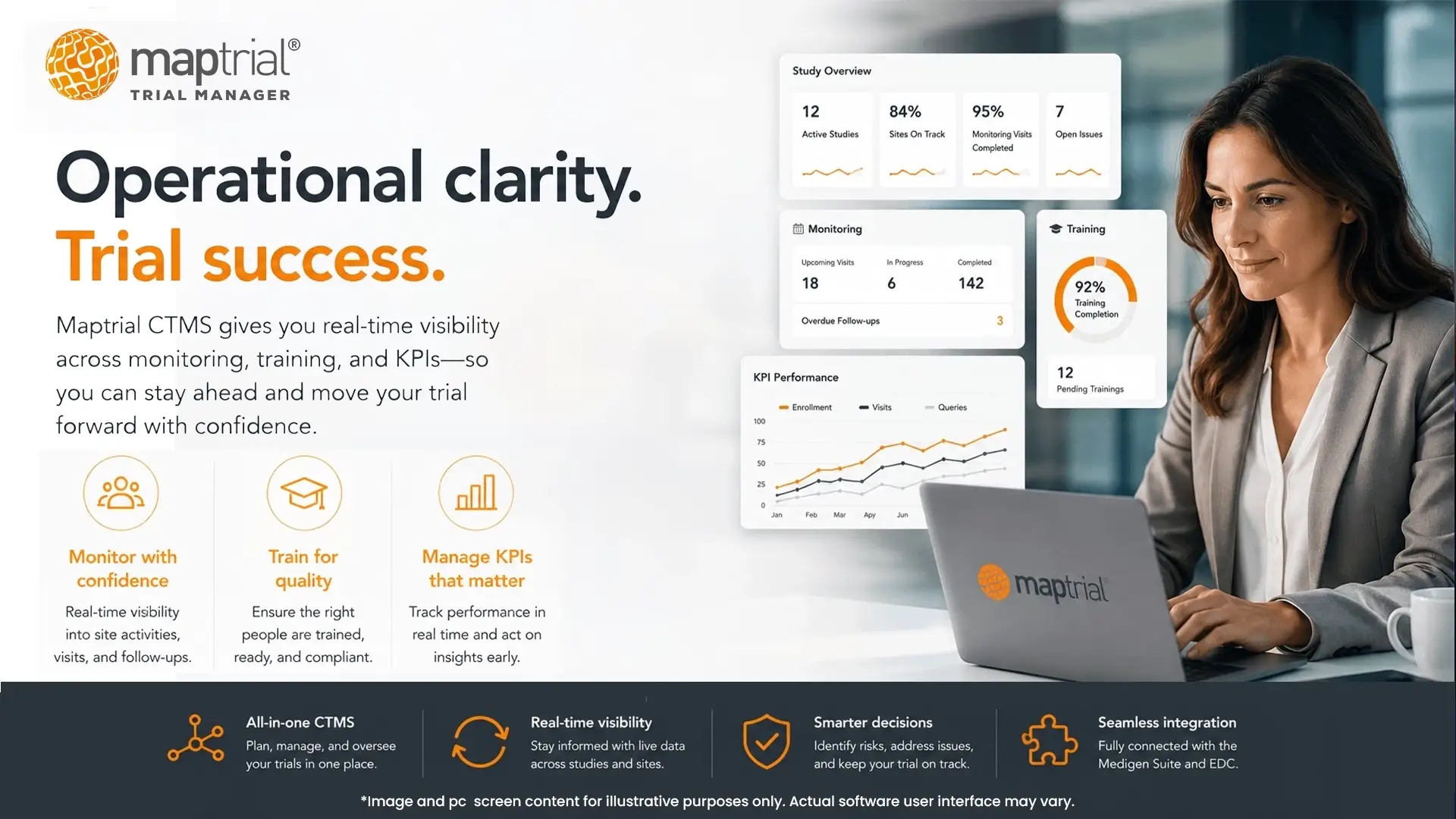
How Maptrial CTMS+ software supports monitoring, training, and performance oversight in modern clinical studies
As clinical trials increase in complexity, the challenge is no longer limited to data collection. Sponsors and CROs must ensure that study execution remains consistent across sites, regions, and teams, while maintaining visibility into performance and risk.
A Clinical Trial Management System (CTMS) is intended to support this operational layer. However, the effectiveness of a CTMS depends not only on its ability to capture information, but on how well it enables timely oversight, coordination, and decision-making.
This article examines how an integrated CTMS environment—specifically Maptrial within the Medigen Suite—supports three critical operational domains: monitoring, training, and performance management through KPIs.
Clinical trial monitoring with CTMS software
Monitoring remains a cornerstone of clinical trial execution. It ensures that study conduct aligns with protocol requirements, regulatory expectations, and data quality standards.
Traditionally, monitoring workflows have been episodic, with site visits and reports providing retrospective insight into site performance. This model can limit the ability to detect and address issues early.
An integrated CTMS environment allows monitoring to function as a more continuous oversight process. Monitoring activities, visit status, and follow-up actions are captured and reflected in real time, enabling a more current understanding of site-level execution.
This approach supports earlier identification of deviations, improved coordination between clinical research associates (CRAs) and central teams, and a more consistent view of study progress across sites.
Training oversight in clinical trial management software
Training is often considered a preparatory step in clinical trials. In practice, it functions as an ongoing control mechanism that directly influences study quality.
Variability in site training, delayed completion of required modules, or lack of visibility into training status can introduce inconsistencies that affect protocol adherence and data reliability.
Within an integrated environment, training can be aligned more closely with study execution. Visibility into training completion and readiness enables sponsors and CROs to ensure that site personnel are adequately prepared before and during study conduct.
This integration reduces reliance on external tracking methods and supports a more systematic approach to maintaining operational consistency across sites.
KPI management and real-time visibility in a CTMS
Key performance indicators (KPIs) are essential for assessing trial progress, site performance, and operational efficiency. However, their value depends on timeliness and interpretability.
In many settings, KPI reporting is retrospective, requiring aggregation across multiple systems and manual reconciliation. This can delay insight and limit responsiveness.
A CTMS that integrates operational data streams enables KPIs to be updated dynamically. Metrics related to enrollment, monitoring activity, site performance, and timelines can be visualized in near real time, providing a more accurate representation of current study status.
This allows clinical operations teams to move from reactive to proactive management, identifying trends and addressing risks before they impact study timelines.
Why flexibility matters in CTMS software adoption
The effectiveness of a CTMS is closely linked to its adoption by operational teams. Systems that impose rigid workflows or require extensive workarounds may lead to partial use or parallel tracking outside the platform.
A flexible CTMS environment allows workflows to align with existing operational practices while maintaining standardization where needed. Ease of use supports consistent engagement from CRAs, project managers, and clinical operations teams, ensuring that the system remains a reliable source of truth.
This reduces fragmentation and supports more coherent study management.
Integrating CTMS software within the clinical trial ecosystem
The operational value of a CTMS increases significantly when it is integrated with other clinical systems, particularly the Electronic Data Capture (EDC) system.
Alignment between clinical data and operational data enables more efficient workflows. For example, enrollment updates can directly inform site performance metrics, and study milestones can trigger operational or financial processes.
Within the Medigen Suite, Maptrial operates as part of a connected environment, reducing duplication of effort and improving data consistency across systems.
Advancing clinical trial operations with an integrated CTMS
The increasing complexity of clinical trials requires a shift from fragmented operational tools to integrated systems that support continuous oversight.
Monitoring, training, and KPI management are interdependent functions. When managed within a unified CTMS environment, they provide a more complete and timely view of study execution.
This integration supports not only operational efficiency but also risk mitigation and regulatory readiness.
A new standard for clinical trial management software
A CTMS is no longer simply a repository for operational data. It is a critical component of clinical trial execution.
By supporting real-time monitoring, structured training oversight, and dynamic KPI management within an integrated environment, Maptrial CTMS enables sponsors and CROs to maintain clarity and control throughout the study lifecycle.
In doing so, it contributes to more consistent study conduct, improved data reliability, and a more predictable path to trial completion.
Table of Contents
Latest Articles
21 CFR Part 11 password requirements: what the regulation actually says
A 90-day password change is not a 21 CFR [...]
Clinical trial software for the connected study stack
Clinical trials are generating more data from more sources, [...]

A practical guide to the main types of clinical trials
The type of clinical trial you run shapes almost [...]
This article provides general information and does not constitute regulatory, legal, clinical, or compliance advice. Requirements and appropriate processes may vary by study, product, jurisdiction, and organization. Medigen Suite functionality should be used in accordance with applicable regulations, study documentation, and internal procedures.