
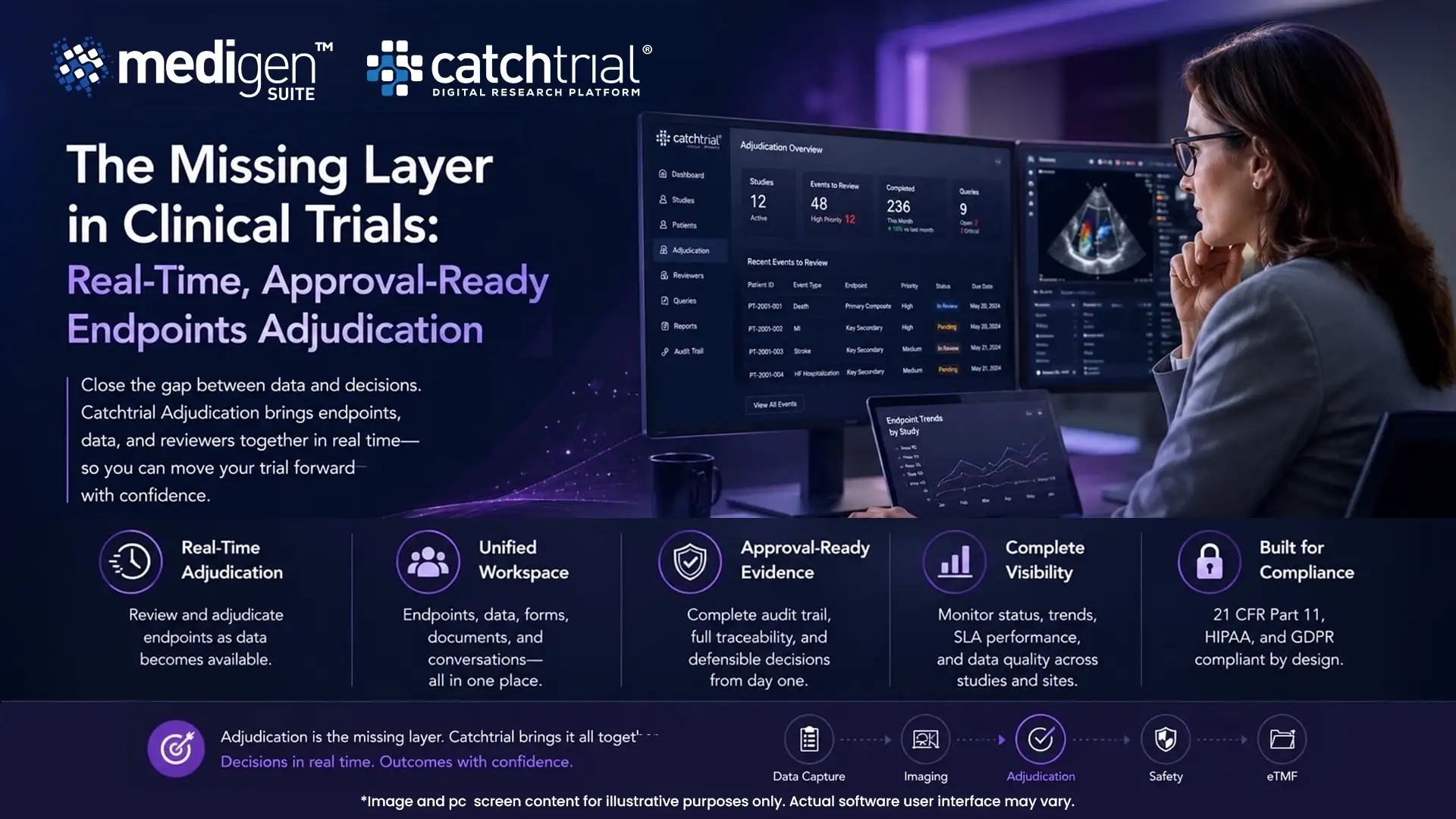
Clinical adjudication is where trials are decided
Clinical adjudication is often described as a validation step. In reality, it is where trials are decided.
In complex studies—particularly in cardiovascular trials, medical device studies, and other high-risk programs—the integrity of clinical endpoints determines everything. If safety events are interpreted differently across sites, if documentation is incomplete, or if reviews happen too late, the issue is not operational inefficiency. The issue is that the clinical evidence itself becomes uncertain.
This is why clinical endpoint adjudication has become a central requirement in modern clinical trial design. It is not just about review—it is about producing consistent, reliable, and regulatory-grade data.
Why traditional clinical trial adjudication models fail
Most adjudication processes were not designed for today’s trials.
They operate as disconnected layers, separate from the core clinical data management system (EDC) and clinical trial workflows. Events are collected in one environment, reviewed in another, and often discussed through emails and static documents. This fragmentation introduces delays, inconsistencies, and unnecessary complexity.
By the time discrepancies emerge, they are difficult to resolve and costly to fix. More importantly, they introduce risk into the final dataset.
Regulatory authorities such as the Food and Drug Administration and the European Medicines Agency increasingly expect independent adjudication of safety and efficacy endpoints, particularly in trials with subjective or complex outcomes. What they require is not just independence, but traceability, consistency, and methodological rigor.
The Catchtrial Safety Events Adjudication Portal
The Catchtrial Safety Events Adjudication Portal, part of the Medigen Suite, was built to address these exact limitations.
Rather than treating adjudication as a downstream activity, Catchtrial integrates it directly into the clinical trial ecosystem. Safety events flow seamlessly from EDC into the adjudication platform, already structured according to protocol definitions and adjudication charter requirements.
What reaches the adjudication committee is not fragmented data, but a complete, standardized, and decision-ready case package.
This approach transforms adjudication from a delayed, manual process into a real-time, digital adjudication workflow.
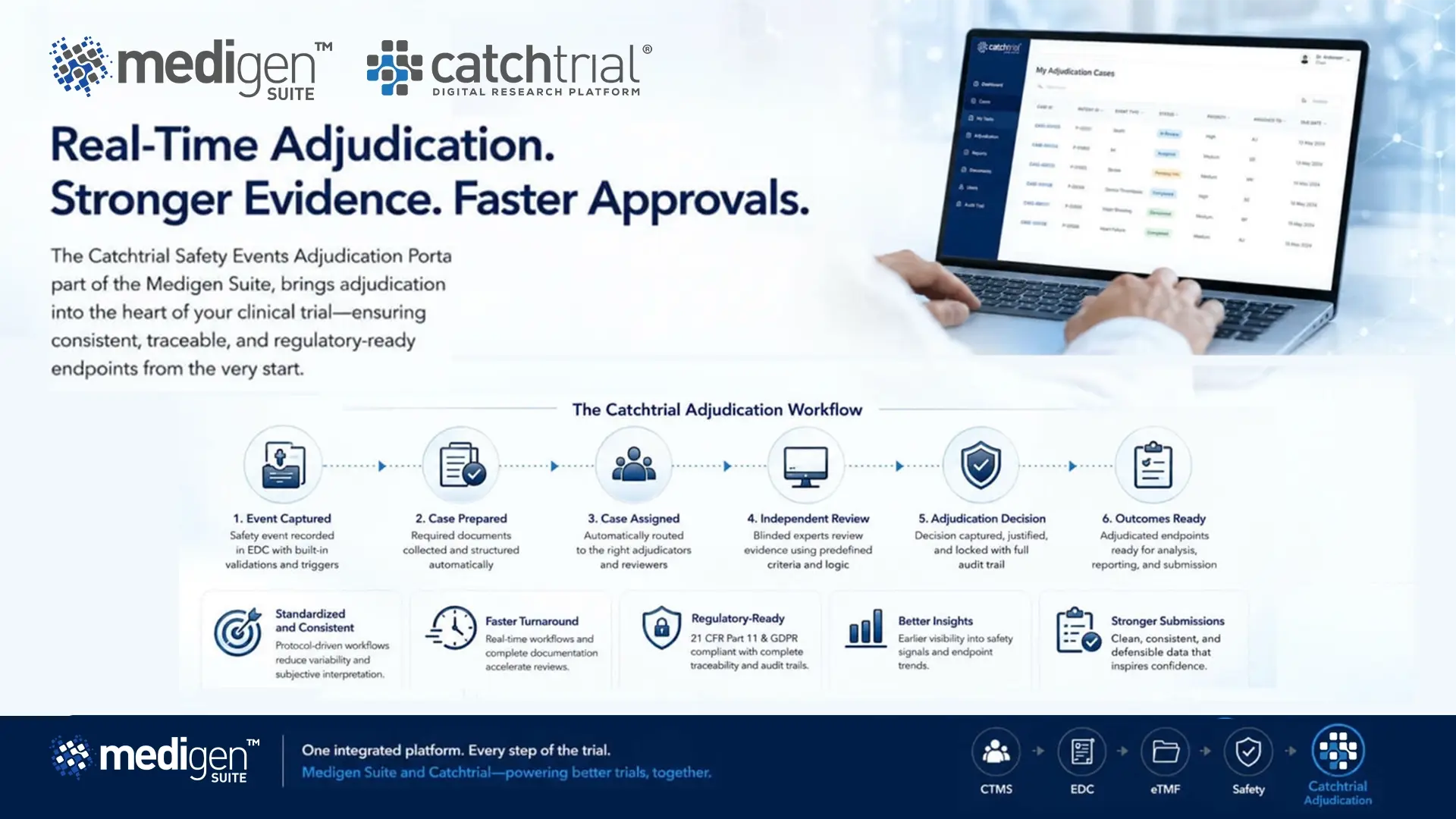
From event capture to adjudicated clinical endpoint—without friction
In Catchtrial, adjudication begins the moment a qualifying event is recorded.
The system ensures that required documentation is complete before the case progresses, reducing back-and-forth queries and eliminating incomplete submissions. Cases are automatically routed to adjudicators, enabling faster turnaround without compromising scientific rigor.
This creates a continuous adjudication process, where decisions are made earlier, timelines are shorter, and data quality is preserved from the start.
For sponsors, this means faster clinical trial execution and more reliable endpoint classification.
Standardization that removes variability
One of the most critical challenges in clinical adjudication is variability between reviewers.
Catchtrial addresses this by embedding adjudication logic and endpoint definitions directly into the platform. Each case is aligned with the adjudication charter, ensuring that decisions follow predefined clinical criteria rather than subjective interpretation.
Blinded review environments are enforced by design, and decision pathways are structured to ensure reproducibility.
This is how Catchtrial delivers standardized endpoint adjudication across global, multi-center trials, reducing variability and strengthening data integrity.
Built for regulatory-grade compliance
Adjudication must withstand regulatory scrutiny.
The Catchtrial Adjudication Portal is designed to meet the highest standards of clinical trial compliance, including alignment with 21 CFR Part 11 and GDPR requirements. Every action, review, and decision is fully traceable, with complete audit trails and version control.
This level of transparency ensures that adjudicated endpoints are not only accurate, but fully defensible during regulatory review and inspections.
Impact on trial timelines and submission readiness
When adjudication is integrated and structured from the beginning, the impact extends across the entire study.
Endpoint discrepancies are reduced because cases are complete at submission. Query cycles decrease because documentation is validated upfront. Safety signals can be identified earlier, supporting proactive decision-making.
At database lock, there is no need for extensive re-adjudication or reconciliation. The dataset is already aligned, consistent, and ready for analysis.
This translates into faster time to clinical study report (CSR) and accelerated regulatory submission timelines.
Eliminating the hidden risks of adjudication
Many adjudication challenges originate earlier than expected.
Ambiguous adjudication charters, inconsistent site documentation, and poorly defined workflows create hidden risks that only surface late in the trial. These issues can delay submissions, trigger additional analyses, and undermine confidence in the results.
By embedding adjudication within the clinical trial platform, Catchtrial removes these structural weaknesses before they impact outcomes.
A fully integrated clinical trial platform advantage
The true strength of Catchtrial lies in its integration within the Medigen Suite.
Because adjudication is connected to EDC, CTMS, and clinical trial oversight systems, it operates within a single, controlled environment. Data flows seamlessly, processes are aligned, and compliance is maintained across all trial activities.
This unified approach ensures that adjudication is not an isolated function, but a core component of clinical evidence generation.
The future of clinical adjudication
In today’s regulatory and scientific landscape, clinical adjudication is no longer optional—especially for trials involving complex endpoints, safety events, or innovative medical technologies.
However, the value of adjudication depends entirely on how it is implemented.
The Catchtrial Safety Events Adjudication Portal transforms adjudication from a manual, fragmented process into a real-time, standardized, and regulatory-ready system.
The result is not just faster trials, but stronger evidence.
Because ultimately, clinical trials are not judged by how they are conducted—but by how well their data stands up to scrutiny.
Table of Contents
Latest Articles
21 CFR Part 11 password requirements: what the regulation actually says
A 90-day password change is not a 21 CFR [...]

Clinical trial software for the connected study stack
Clinical trials are generating more data from more sources, [...]

A practical guide to the main types of clinical trials
The type of clinical trial you run shapes almost [...]
This article provides general information and does not constitute regulatory, legal, clinical, or compliance advice. Requirements and appropriate processes may vary by study, product, jurisdiction, and organization. Medigen Suite functionality should be used in accordance with applicable regulations, study documentation, and internal procedures.