
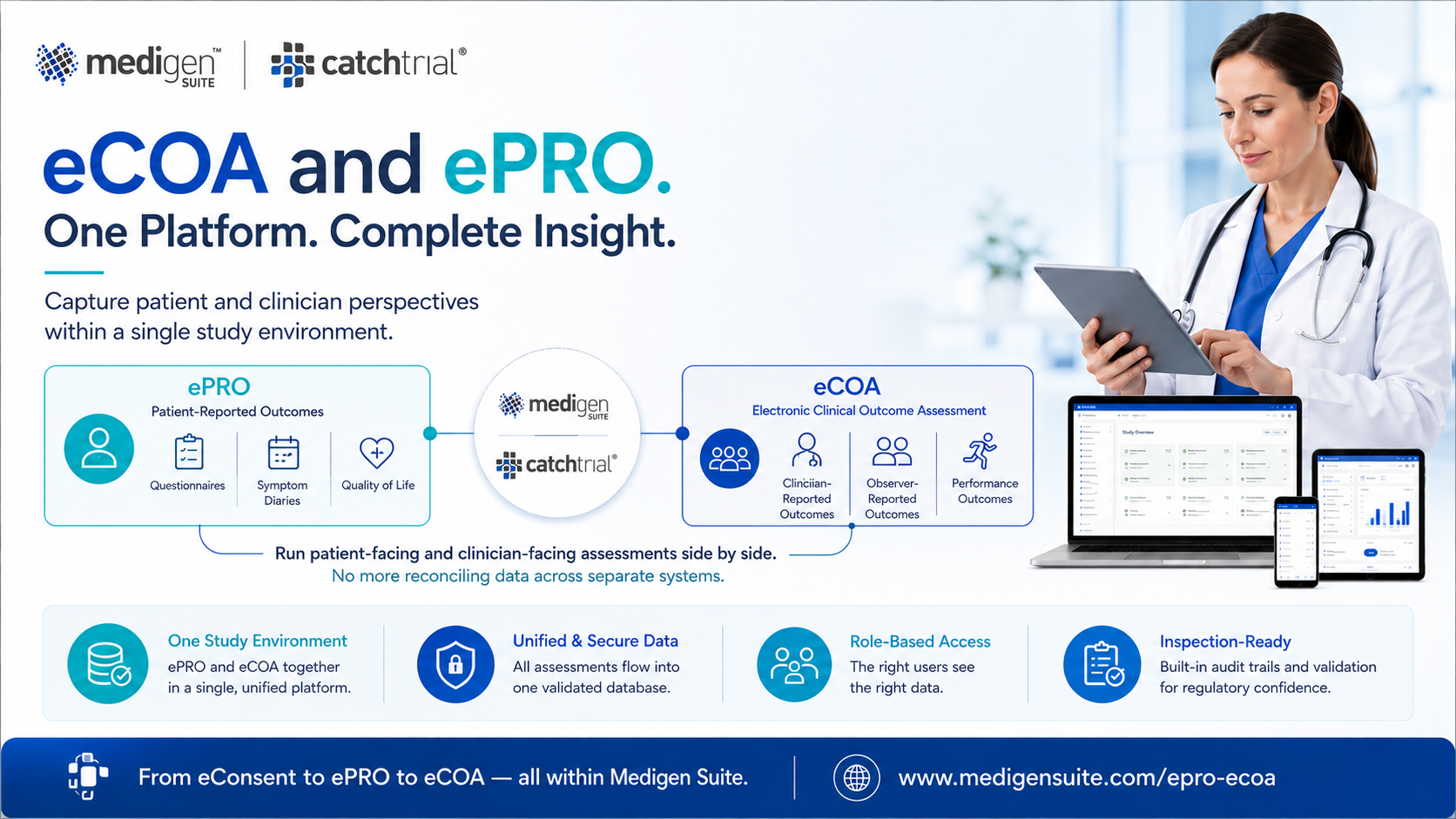
Summary: eCOA and ePRO are two of the most valuable tools available for capturing meaningful patient data in clinical trials. ePRO focuses on what patients report directly about how they feel and function. eCOA is the broader framework that includes ePRO alongside clinician-, observer-, and performance-based assessments. Understanding how they work together – and when to use each – helps teams design trials that produce richer data, smoother site workflows, and stronger regulatory submissions. This article explores both approaches and how Catchtrial eCOA and Catchtrial ePRO, part of the Medigen Suite, support them within one integrated platform.
When clinical trial teams discuss capturing patient data, the eCOA vs ePRO question comes up constantly. The two terms are often used interchangeably, which is understandable given how closely they overlap – but the distinction is worth exploring early, since it shapes data quality, regulatory submissions, and site workflows throughout the study.
Taking a moment to clarify the two at the protocol design stage makes everything downstream a little easier.
What eCOA Covers?
eCOA stands for Electronic Clinical Outcome Assessment. It is an umbrella term covering any electronic method used to measure how a patient feels, functions, or survives. Both the FDA and EMA recognize four types of clinical outcome assessments that fall within this category:
When any of these four types is collected electronically, it becomes part of the eCOA framework. ePRO is therefore a specific subset of eCOA – the patient-completed portion.
A trial built around what patients self-report will focus primarily on ePRO. A trial that also includes clinician-rated endpoints or rater-administered scales benefits from the full eCOA framework.
| Assessment Type | Who Completes It | Examples |
| Patient-Reported Outcome (PRO) | The patient directly | Pain scales, quality-of-life questionnaires, symptom diaries |
| Clinician-Reported Outcome (ClinRO) | A trained clinician | NYHA classification, NIHSS stroke scale |
| Observer-Reported Outcome (ObsRO) | A caregiver or observer | Pediatric studies, patients with cognitive impairment |
| Performance Outcome (PerfO) | Objective test scored by a rater | Six-minute walk test, grip strength |
What Makes ePRO Distinctive
ePRO – Electronic Patient-Reported Outcome – captures the patient’s perspective directly, without a clinician interpreting or transcribing the response first. Patients complete forms on their own device or a provisioned one, and that directness is a genuine regulatory asset.
Guidance from both the FDA and EMA highlights that PRO data carries its greatest weight when it reflects the patient’s authentic experience. Electronic capture supports that in several meaningful ways:
- Timestamped entries that confirm real-time, in-the-moment completion
- Audit trails preserving the original, unmodified response
- Compliance tracking showing whether patients completed forms within their scheduled windows
- Fewer transcription steps compared to paper-based data entry
For endpoints where the patient’s voice is central – symptom burden in oncology, fatigue in chronic disease, functional status in heart failure – ePRO has become the standard approach, and regulatory agencies increasingly expect it.
eCOA vs ePRO: Key Differences at a Glance
| Feature | ePRO | eCOA (Full Scope) |
| Who completes assessments | Patient only | Patient + clinician + observer + rater |
| Typical use case | PRO-primary endpoints, symptom diaries | Multi-endpoint trials, complex scales |
| Regulatory driver | FDA PRO Guidance, EMA Reflection Paper | Covers all four COA types |
| Site staff involvement | Minimal | Required for ClinRO/ObsRO/PerfO |
| Configuration scope | Focused | Multi-role, multi-form |
When to Use ePRO, eCOA, or Both
ePRO works well when:
- Your primary endpoint is patient-reported (pain, fatigue, health-related quality of life)
- You need real-time symptom data between clinic visits
- Your protocol relies on a validated PRO instrument (SF-36, EQ-5D, KOOS, BDI)
- Keeping site burden manageable is a priority
The full eCOA framework adds value when:
- Your endpoint mix includes clinician ratings alongside PRO data
- You are running a pediatric trial where a parent or caregiver completes assessments on the patient’s behalf
- Performance-based outcomes require a trained rater to administer and score
- Your protocol requires blinding that separates patient and clinician assessments
A combined approach is often the right answer when:
- Your trial has co-primary endpoints spanning both patient and clinician perspectives
- You want to analyze how patient-reported and clinician-rated findings relate to each other
- Regulatory strategy calls for demonstrating alignment between PRO data and clinical assessments
In many modern trials – particularly in cardiology, oncology, and rare disease – the most complete picture comes from using both. The key is having a platform that handles each type cleanly, with clear role separation, flexible scheduling, and consistent validation logic throughout.
How Catchtrial eCOA and Catchtrial ePRO Support Both Approaches
The Medigen Suite includes dedicated eCOA (Catchtrial eCOA) and ePRO (Catchtrial ePRO) modules, both designed to work within the same study environment. Teams can run patient-facing and clinician-facing assessments side by side, with no need to reconcile data from separate, additional systems.
Validated questionnaire scoring, built in. Catchtrial eCOA and Catchtrial ePRO both support automatic score calculation once a form is saved. This covers widely used instruments including MLHF, SF-36, Beck Depression Inventory, and KOOS, with custom scoring algorithms available for study-specific tools. Integrity checks based on those scores can be applied at the point of collection – for example, automatically flagging a patient for enrollment review if a baseline questionnaire score falls outside protocol-defined thresholds.
Flexible scheduling for patient-completed forms. With Catchtrial ePRO, forms can be scheduled on a recurring basis – daily, weekly, monthly, or on specific days and times, such as every Monday at 9:00 AM. This makes diary-style ePRO designs straightforward to configure and easy for patients to follow.
Clear role separation for every assessment type. Catchtrial supports granular role management across all four COA types. ClinRO forms are accessible only to qualified clinical staff, ePRO forms route directly to patients, and observer-reported assessments can be configured for designated caregiver accounts. Each role sees only what is relevant to them.
Dynamic forms that follow the patient. Form visibility adjusts automatically as patients progress through the study. If a patient transitions to a different protocol arm or reaches a new visit milestone, the active form set updates accordingly. Multilevel conditional logic allows fields to appear or stay hidden based on earlier responses, keeping questionnaires focused and reducing respondent burden.
Multi-language support across all form types. Both Catchtrial ePRO and Catchtrial eCOA forms can be configured in multiple languages, with each user’s preferred language set as their default. This makes the system well-suited for multinational trials where patient-facing forms need to feel natural and accessible in local languages.
eConsent within the same environment. Electronic informed consent is supported natively, so the full patient-facing journey – from initial consent through ongoing ePRO completion – runs within a single, connected system.
Security built for patient data. Two-factor authentication is available for ePRO user accounts, adding an extra layer of protection for sensitive patient-submitted data.
CRF versioning by protocol and randomization group. When protocol amendments call for questionnaire updates mid-study, or when different patient groups need different form sets, CRF versioning manages the transition smoothly. Forms display only the questions that apply to the relevant protocol version or randomization group.
Autocalculation displayed in a separate form. Total scores can appear in a dedicated form, separate from the data entry form. This is particularly useful in blinded designs where clinical staff need access to derived scores without viewing the underlying item-level responses.
Regulatory Compliance Across Both Modules
ePRO and eCOA data collected electronically need to meet the requirements of 21 CFR Part 11 (FDA) and equivalent standards in other jurisdictions, covering electronic signatures, audit trails, access controls, and system validation.
Both Catchtrial eCOA and Catchtrial ePRO are built with these requirements in mind. The Medigen Suite supports 21 CFR Part 11-compliant electronic signatures, with sponsor-configurable settings defining which forms require PI sign-off. Every data modification is captured in a detailed audit log that records the username, date and time, affected field, and the reason for the change.
Choosing the Right Approach for Your Protocol
The choice between ePRO, eCOA, or a combination is first a protocol design question – the platform’s job is to support that choice without adding friction.
A few questions worth working through early in study design:
- Which endpoints are patient-reported vs. clinician-rated vs. observer-reported?
- Does your protocol require validated PRO instruments with autoscoring?
- What are the regulatory filing requirements across your target regions?
- How will your team manage questionnaire updates and CRF versioning mid-study?
- Does your patient population require multilingual support at the form level?
With those answers in hand, configuring Catchtrial eCOA and Catchtrial ePRO to match the protocol is a straightforward process – because both modules were designed from the ground up to work together, and to adapt as study needs evolve.
To learn more about how Catchtrial eCOA and Catchtrial ePRO support your trial design, visit Catchtrial Apps+ | ePRO, eCOA + eConsent Software or request a demo today.