
A treatment assignment must remain concealed until disclosure is justified, but an urgent clinical decision cannot wait for an administrative bottleneck. This tension makes unblinding in clinical trials both a participant safety procedure and a data integrity consideration.
For study teams, the objective is to define when treatment information can be accessed, by whom, and how the remaining blind will be protected. With appropriate procedures and digital controls, sponsors can establish disclosure pathways suited to different clinical and operational situations.
Why a Controlled Code Break Matters
Randomization and blinding address different sources of bias. Randomization allocates participants to interventions using a chance-based process, while blinding limits knowledge of those assignments among relevant parties. Together, they can help protect the interpretability of trial findings.
A code break changes the information available to an individual. That change can be necessary for clinical care, yet it may influence subsequent assessments or communications if information reaches a blinded investigator, participant, endpoint assessor, or operational team member.
The impact depends on who learns the allocation, when the disclosure occurs, and what responsibilities that person retains. An individual disclosure does not automatically compromise the trial, but its implications require assessment.
ICH E6(R3) section 2.11 states that investigators should follow the protocol’s randomization procedures and break treatment codes in accordance with the protocol. It also expects investigators to be prepared from trial start for emergency disclosure without undue delay and to promptly document and explain premature code breaks to the sponsor. [1]
The practical implication: code-breaking arrangements belong in protocol development, system configuration, and site training, not only in the contingency plan reviewed after an incident.
When Unblinding in Clinical Trials Is Justified
The reason for disclosure should determine its timing, authorization, and scope. A planned final analysis, an independent interim safety assessment, an individual medical emergency, expedited safety reporting, and an accidental exposure are different situations. They should not all be handled through the same unrestricted permission.
In an emergency, a treating investigator may need to establish which investigational product a participant received to guide appropriate care. The protocol should specify the relevant procedure, but care must not be delayed by an approval process that prevents timely access when disclosure is medically necessary.
A planned interim analysis may instead require limited treatment information for an independent data monitoring committee or unblinded statistician. Operational personnel and those performing blinded assessments may need to remain unaware of group assignments, according to the trial design.
Safety reporting introduces another important scenario. When a participant’s treatment assignment must be disclosed for expedited safety reporting, the authorized safety function may need access while investigators and other study personnel remain blinded, as appropriate.
Accidental disclosure requires a different response: identify the information exposed, record who saw it, contain further access, and assess whether blinded responsibilities need to change.
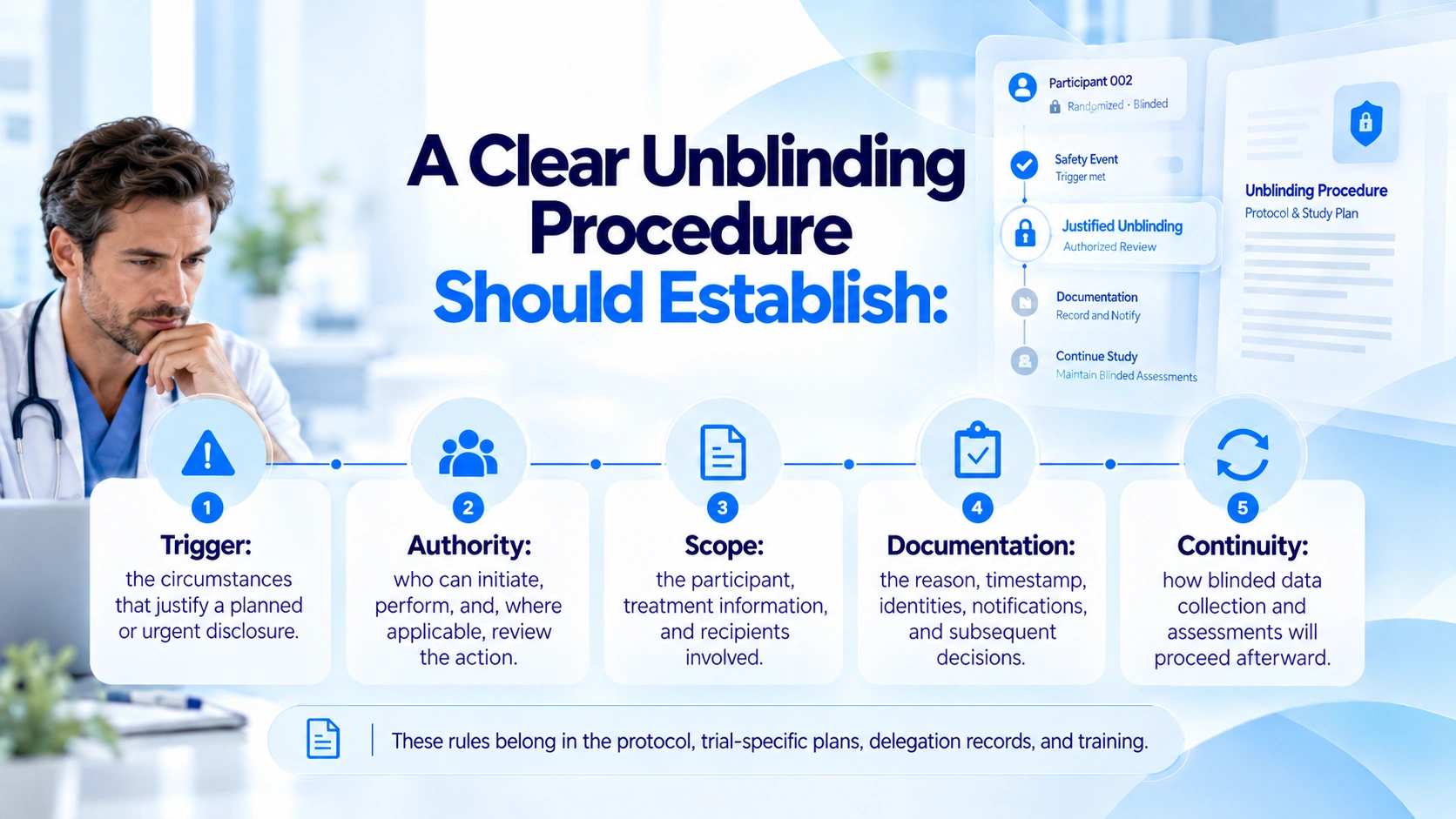
A clear procedure should establish:
- Trigger: the circumstances that justify a planned or urgent disclosure.
- Authority: who can initiate, perform, and, where applicable, review the action.
- Scope: the participant, treatment information, and recipients involved.
- Documentation: the reason, timestamp, identities, notifications, and subsequent decisions.
- Continuity: how blinded data collection and assessments will proceed afterward.
These rules belong in the protocol, trial-specific plans, delegation records, and training.
Build Emergency Access Around Real Clinical Conditions
Emergency code breaking must be operationally available when it is clinically needed. ICH E6(R3) section 3.15.2(d)(ii) calls for a mechanism through which an investigator can rapidly identify the relevant investigational product in a medical emergency while preserving other participants’ assignments. [1]
Consider a hypothetical multicenter blinded trial in which a participant develops a serious medical complication overnight. The treating investigator determines that knowledge of the assigned product is necessary for treatment.
An effective process should permit the appropriate participant-level disclosure, capture the reason, and support prompt sponsor notification without opening the entire allocation list.
A contingency route is also needed if the system is unavailable. Depending on the protocol, this may involve an alternative contact or protected emergency documentation.
Before activation, teams should test authorized access, denied access, outages, and review of completed events.
Access restrictions need to extend beyond the code-break screen. Exports, dashboards, electronic case report forms (eCRFs), automated alerts, and safety listings can reveal treatment assignments indirectly if roles and data flows are not configured consistently.
The operational goal is targeted disclosure, not broader visibility. A carefully scoped workflow may support clinical decisions while limiting unnecessary exposure of treatment information elsewhere in the study.
Compare Disclosure Pathways Before Study Startup
Different disclosure scenarios require different controls. The following comparison can support protocol discussions, requirements gathering, and user acceptance testing for interactive response technology (IRT) randomization workflows.
| Situation | Typical trigger | Appropriate access approach | Key record or follow-up |
| Individual medical emergency | Treatment identity is necessary for participant care | Rapid, participant-specific investigator access under the protocol | Reason, time, recipient, sponsor notification, impact review |
| Planned interim assessment | Prespecified independent safety or efficacy review | Restricted access for the authorized unblinded analysis group | Authorized recipients, data cut, access records, committee process |
| Expedited safety reporting | A suspected unexpected serious adverse reaction (SUSAR) requires expedited regulatory reporting | Participant-level unblinding by the authorized safety function, with other study personnel kept blinded as appropriate | Who was unblinded, reporting timeline, confirmation of continued blinding |
| Planned final code break | Protocol-defined data readiness and analysis milestones | Controlled release to the designated analysis team | Authorization, versioned datasets, timing, access history |
| Accidental disclosure | Unintended visibility of allocation information | Contain exposure and restrict further access as appropriate | Incident details, affected roles, bias assessment, corrective action |
Use this comparison as a starting point, then tailor each pathway to the protocol and applicable requirements.
For example, a planned final code break ordinarily follows predefined data review and analysis readiness activities. An emergency event is fundamentally different: clinical urgency drives access, and any administrative review must be organized around participant safety.
How Catchtrial EDC+ Supports Controlled Code-Breaking Workflows
Digital code breaking works best when it is designed as part of the wider study workflow. Catchtrial EDC+, within Medigen Suite, is positioned around protocol-specific data capture, dynamic eCRFs, role-based controls, and audit trails.
Its publicly described forms can adapt to randomization groups, which is relevant when different treatment assignments require different data-entry paths.
For double-blind studies, Catchtrial EDC+ offers a digital code-breaking add-on built for strictly controlled emergency situations.
Standard role management lets study teams set access privileges at every level of the study structure, and custom roles can be added where a protocol needs finer control.
For sponsors and clinical operations teams, these capabilities are designed to address the need to manage study access without treating every user or every disclosure scenario in the same way.
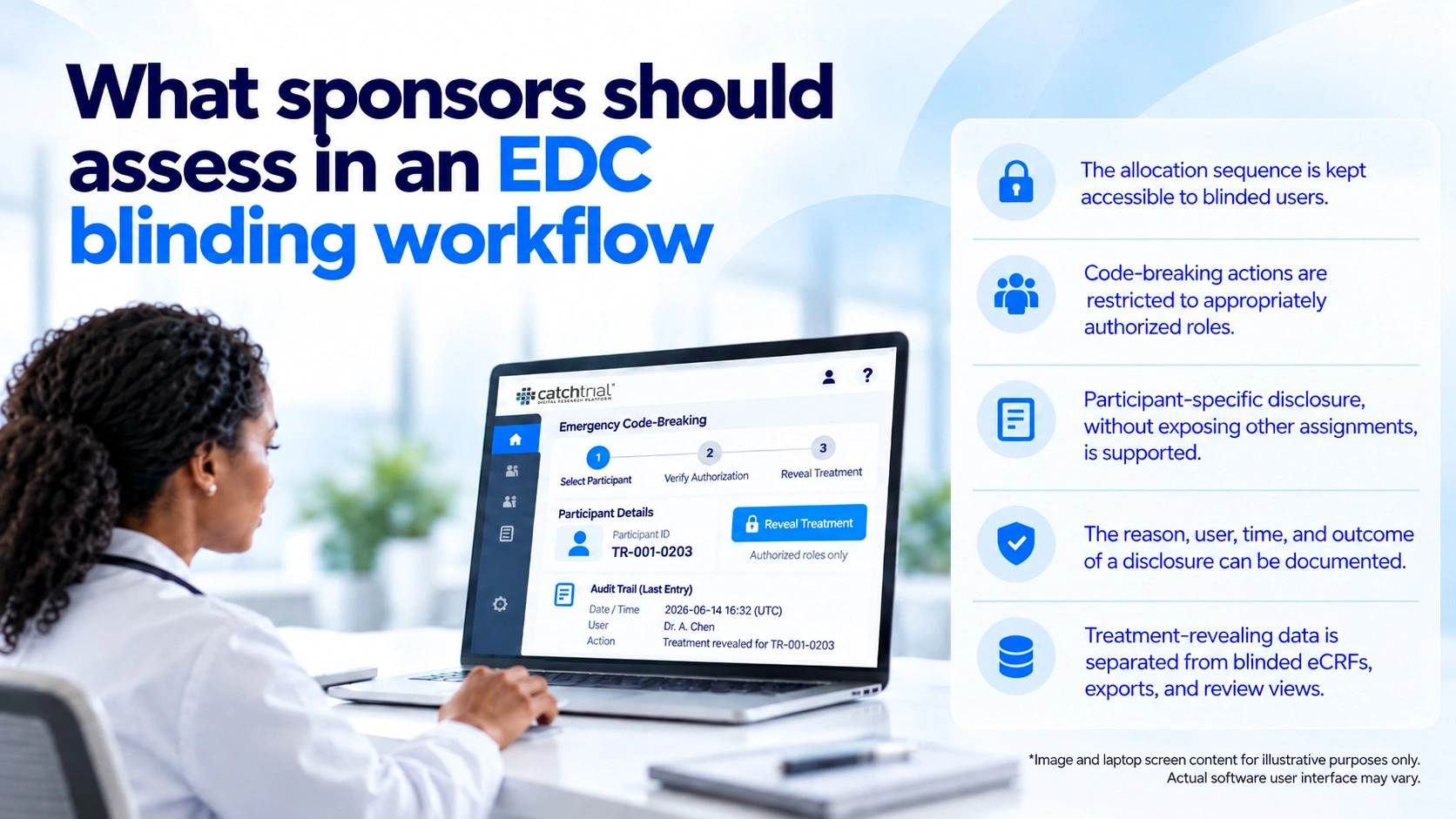
A sponsor assessing this approach should consider whether the configured workflow can:
- Keep the allocation sequence inaccessible to blinded users.
- Restrict code-breaking actions to appropriately authorized roles.
- Support participant-specific disclosure without exposing other assignments.
- Document the reason, user, time, and outcome of a disclosure.
- Separate treatment-revealing data from blinded eCRFs, exports, and review views.
Together with a validated setup, clear procedures, and site training, these criteria offer sponsors a practical checklist for configuring the right workflow.
The Catchtrial EDC+ product page introduces the platform’s broader clinical data workflows and available capabilities.
Regulatory Expectations for Blinding and Electronic Records
ICH E6(R3) treats protection of the blind as a process and data-governance responsibility. Section 3.15.2(d) addresses prevention of inappropriate disclosure, rapid emergency product identification, and continued protection of other treatment assignments. [1]
It also calls for a mechanism that protects the blind when a participant’s assignment is disclosed for safety reporting to regulatory authorities or institutional review boards/independent ethics committees (IRBs/IECs), where appropriate.
Section 3.16.1 calls for sponsor procedures describing applicable unblinding activities, including who was unblinded, when and for what purpose, who should remain blinded, and the safeguards used to preserve the blind.
Section 4.1, “Safeguard Blinding in Data Governance,” further addresses role assignments, data access, planned and unplanned disclosures, and assessment of unintended exposure. This extends the discussion beyond an IRT screen to database review, reporting, and operational communications.
ICH E6(R3) Principles and Annex 1 became effective in the European Union on July 23, 2025; the FDA issued its E6(R3) guidance in September 2025. Application depends on the jurisdiction and study. [2] [3]
For electronic records within the scope of 21 CFR Part 11, section 11.10 addresses controls including authorized access, authority checks, and time-stamped audit trails. The FDA’s scope-and-application guidance clarifies how the agency interprets and applies Part 11, including its enforcement discretion for certain provisions. Using electronic software does not, by itself, establish Part 11 compliance. [4]
These expectations make requirements traceability important: the protocol identifies the rule, the configured system implements the intended access pathway, and the study records document what occurred. Controls should reflect risk, record type, and intended use.
Choose a Process That Can Be Tested and Defended
A workable design for unblinding in clinical trials begins with the clinical decision, then maps permissions and evidence around it. Sponsors should identify every planned disclosure scenario, agree on emergency authority with investigators, specify who remains blinded, and document how the process will be checked before first participant enrollment.
Next, they should test the actual configured study, including after-hours access, unauthorized attempts, audit records, data exports, and contingency arrangements. Post-event review should address containment, blinded duties, and any protocol-related action.
For multicenter trials, consistency across participating sites is especially important. A common procedure and clearly assigned responsibilities may support more predictable execution, while allowing individual investigators to make time-sensitive clinical decisions.
When these decisions are made early, digital workflows may support a more consistent balance between participant safety and the integrity of blinded assessments.
Visit the Catchtrial EDC+ product page or request a Medigen Suite demo to discuss how controlled code breaking, role-based access, and clinical data workflows could be configured for your next trial.
Frequently Asked Questions
What is the difference between emergency and planned unblinding?
Emergency unblinding involves disclosing a participant’s treatment assignment when that information is necessary for appropriate medical care. Planned unblinding occurs at a prespecified stage of the trial, such as an authorized interim analysis or final analysis. Both require documented procedures, but emergency access must be arranged around participant safety and must not be hindered by unnecessary administrative delays.
Does IRT randomization automatically include emergency code-breaking functionality?
No. An IRT randomization capability does not automatically establish that a particular system or configuration supports emergency code breaking. Sponsors should confirm which functions are available, how treatment assignments are protected, what permissions apply, and how emergency disclosure is documented. The configuration and validation activities should reflect the protocol and the intended use of the system.
How does SUSAR reporting affect blinding in clinical trials?
SUSAR reporting may require disclosure of an individual participant’s treatment assignment to the authorized safety function. ICH E6(R3) calls for a mechanism that protects trial blinding when assignments are disclosed for safety reporting to regulatory authorities or ethics committees, where appropriate. Sponsors should establish procedures to manage these disclosures and prevent unnecessary exposure of treatment information to blinded study personnel.
Can a participant continue in a clinical trial after their treatment assignment is disclosed?
Yes, continued participation may be possible after treatment assignment disclosure, depending on the protocol, the participant’s clinical circumstances, and the investigator’s judgment. Disclosure does not automatically require withdrawal. The study team should document the event, assess its implications for blinded assessments, and determine how subsequent treatment, follow-up, and analysis will be handled.
What information should be documented after emergency unblinding?
The record should identify the participant, the reason for disclosure, when it occurred, who received the treatment information, and the notifications and actions that followed. ICH E6(R3) section 3.16.1 also addresses documenting who remains blinded and the safeguards used to preserve the blind. Study-specific procedures should determine where these records are maintained and how they are reviewed.
Does electronic unblinding automatically meet FDA 21 CFR Part 11 requirements?
No. Using an electronic code-breaking system does not automatically establish compliance with 21 CFR Part 11. Applicability depends on the records and regulatory context. Where Part 11 applies, relevant controls include authorized access, record integrity, and appropriate audit trail provisions, taking account of FDA guidance. Sponsors must also assess the system’s suitability, validation, procedures, and intended use.
Sources and Regulatory References
- International Council for Harmonisation (ICH). ICH E6(R3) Guideline for Good Clinical Practice. Final version, January 6, 2025. Sections 2.11, 3.15.2(d)(ii), 3.15.2(d)(iii), 3.16.1, and 4.1.
- European Medicines Agency. ICH E6 Good Clinical Practice. Regulatory implementation and effective dates.
- US Food and Drug Administration. E6(R3) Good Clinical Practice (GCP). Guidance for Industry, September 2025.
- US Food and Drug Administration. Part 11, Electronic Records; Electronic Signatures – Scope and Application.
- 21 CFR § 11.10, Controls for Closed Systems.
Table of Contents
Latest Articles
Unblinding in Clinical Trials Done Right, One Patient at a Time
A treatment assignment must remain concealed until disclosure is [...]

Where the Benefits of Electronic Data Capture Really Come to Life
Replacing paper case report forms does not automatically improve [...]
Practical Clinical Trial UAT Before Study Go-Live
A study database can pass technical checks and still [...]
This article provides general information and does not constitute regulatory, legal, clinical, or compliance advice. Requirements and appropriate processes may vary by study, product, jurisdiction, and organization. Medigen Suite functionality should be used in accordance with applicable regulations, study documentation, and internal procedures.