Summary: As clinical trials become increasingly complex, training management can no longer be treated as a purely administrative function. Study teams need reliable processes that ensure personnel are trained, qualified, and prepared to execute study responsibilities consistently.
A dedicated validated LMS provides the structure, visibility, and documentation necessary to support protocol compliance, data quality, inspection readiness, and operational oversight. Equally important, a purpose-built 21 CFR Part 11 LMS helps organizations maintain compliant electronic training records while reducing the burden of manual tracking and documentation.
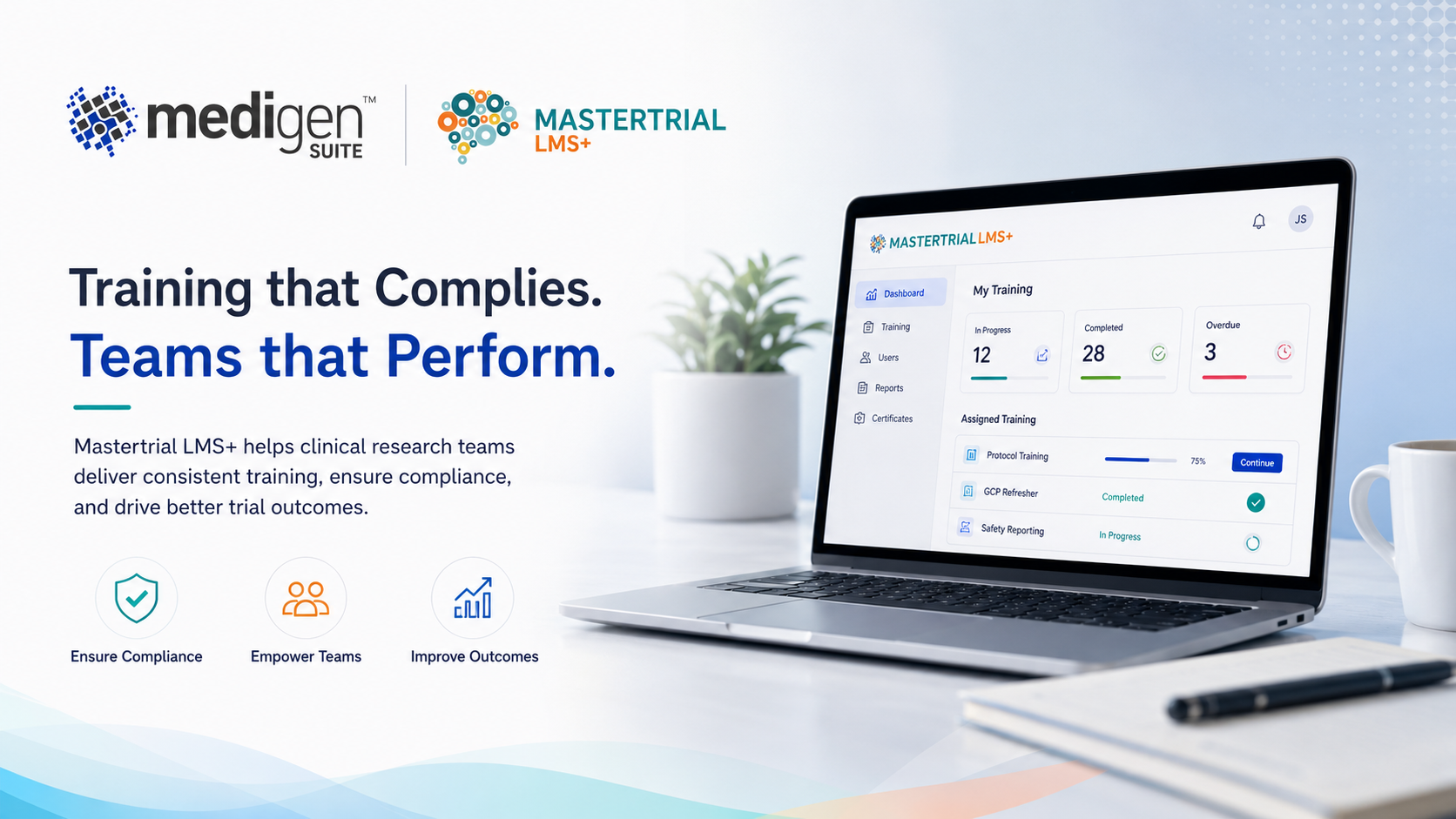
For sponsors, CROs, and research sites seeking a more structured approach to clinical trial education, Mastertrial LMS+ offers a framework designed around the realities of regulated clinical research, helping organizations manage training requirements efficiently while supporting quality and compliance objectives throughout the study lifecycle.
What Is a Training Management System in Clinical Research?
A Training Management System, often referred to as a Learning Management System (LMS), is a software platform used to create, assign, deliver, track, and document training activities.
In clinical research, an LMS serves a broader purpose than employee education. It becomes part of the quality and compliance framework that demonstrates personnel qualification and protocol readiness.
Key Training Types Managed in Clinical Trials
A dedicated LMS may be used to manage:
- Protocol-specific training
- Good Clinical Practice (GCP) training
- Investigator meetings
- Safety reporting procedures
- Electronic system training
- Standard Operating Procedures (SOPs)
- Regulatory compliance requirements
- Study amendments and updates
A dedicated clinical research LMS provides evidence that personnel have completed required training and understood the content before performing study activities.
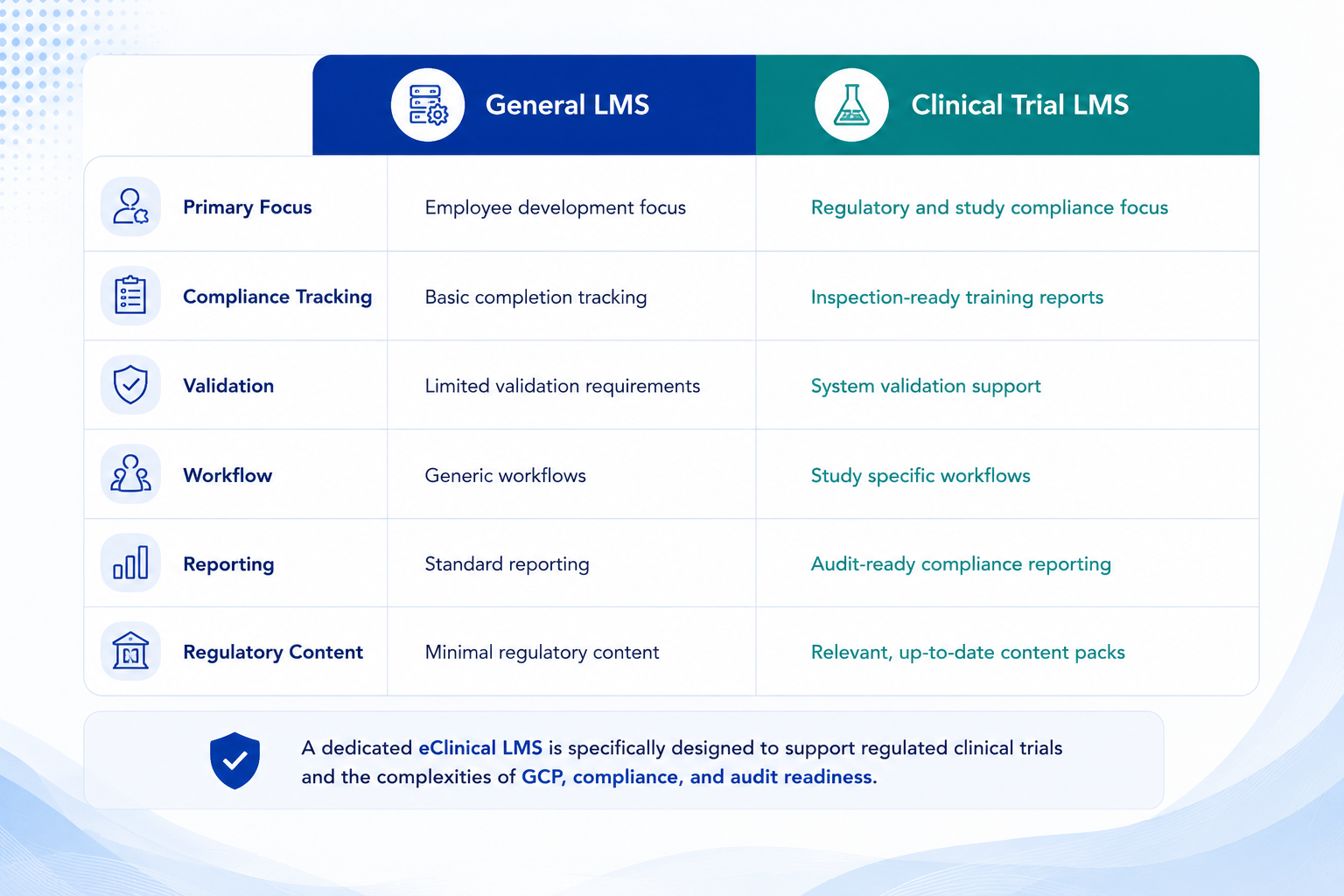
Clinical Trial LMS vs. General Learning Platforms
How a Dedicated LMS Supports Clinical Trial Operations
Training management affects nearly every aspect of study execution.
When a protocol amendment is released, sites may require immediate retraining. When a new coordinator joins a site, role-specific training must be assigned before study activities begin. When an inspector asks for evidence of investigator qualification, records must be available quickly and completely.
A dedicated LMS helps organizations manage these requirements through structured workflows. Training can be assigned automatically based on study participation, site affiliation, job role, geography, functional responsibility. For example, a Principal Investigator may require protocol training, safety reporting training, and device certification, while a Clinical Research Coordinator may require additional EDC training. Role-based automation reduces administrative burden and helps ensure consistency.
Training materials can include videos, presentations, interactive modules, assessments, certifications and study documentation. Centralized delivery ensures that all participants access the same approved content.
In addition, study teams can monitor training status, completion dates, assessment scores, certification expiration dates and outstanding assignments. This visibility helps identify potential compliance risks before they affect study execution.
Every training event generates documentation that can support sponsor oversight, CRO oversight, monitoring activities, internal audits and regulatory inspections. The ability to retrieve complete training histories quickly is particularly important during inspections.
Key Benefits of a Dedicated Training Management System
Consistency Across Sites and Roles
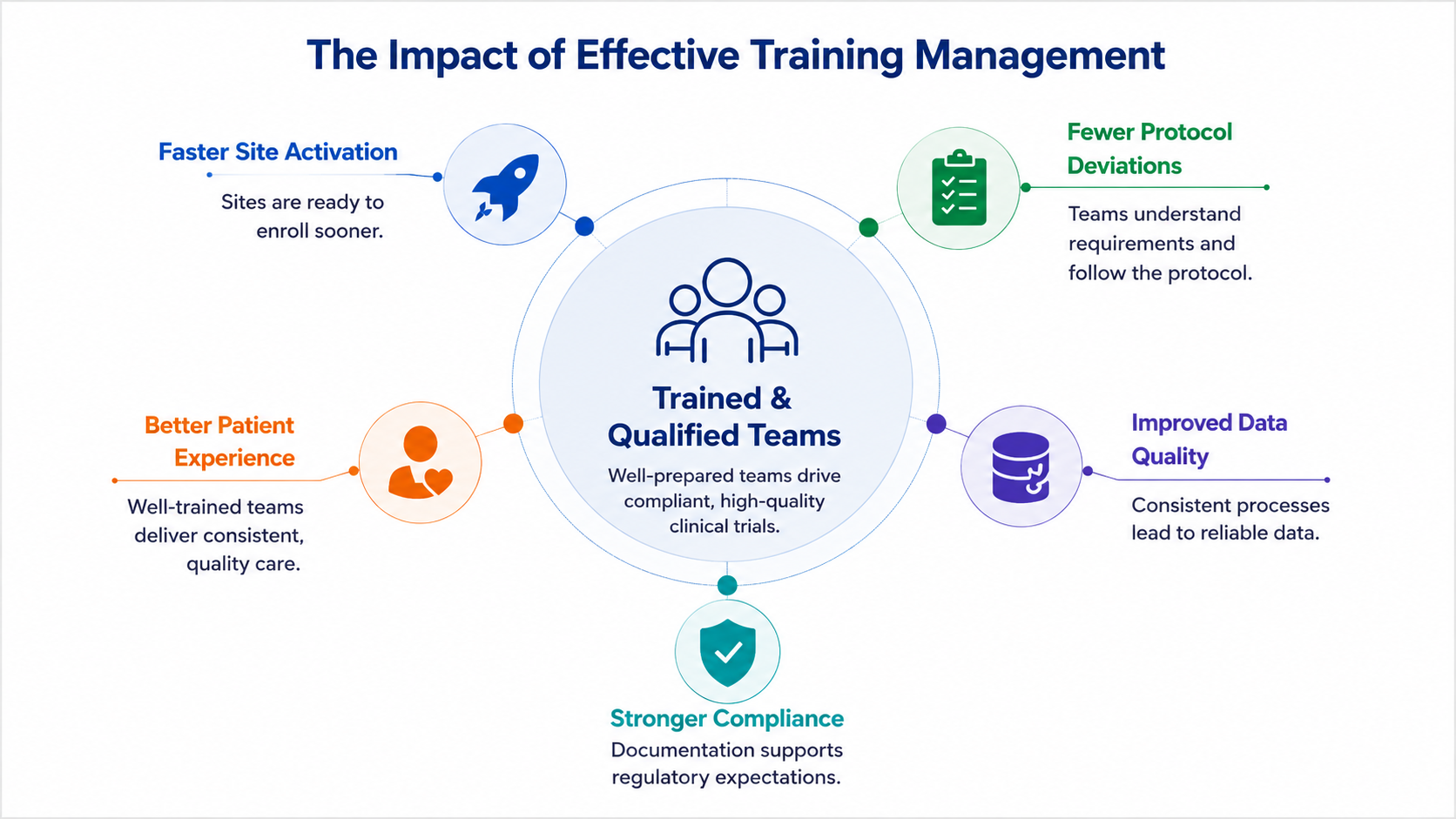
Variability in training delivery is a frequent source of protocol deviations. One site might receive detailed verbal explanations during a monitoring visit, while another relies on a recorded webinar. A dedicated system ensures every participant encounters the same core content, presented clearly and uniformly. This consistency strengthens protocol adherence and reduces risks to data quality.
Accelerated Site Activation and Study Startup
Training delays are a well-known bottleneck in study startup. Traditional methods require coordinating live sessions, which can push first-patient-in timelines. With on-demand access, sites can complete required training as soon as they are selected, often shortening activation from weeks to days. This operational efficiency compounds across large, multi-center programs.
Scalability for Global and Long-Term Studies
Modern trials frequently involve hundreds of sites and thousands of personnel, with staff changes occurring throughout. A robust system scales without proportional increases in administrative effort. New coordinators can be onboarded quickly, and refresher training on amendments can be deployed efficiently.
Improved Oversight and Regulatory Readiness
Sponsor oversight includes verifying that site personnel are appropriately trained. A 21 CFR Part 11 LMS maintains electronic records with audit trails, access controls, and secure storage, elements that manual logs or unvalidated tools struggle to provide reliably. This supports smoother monitoring and inspection processes.
Risk Reduction and Data Quality
Well-trained teams make fewer errors in eligibility assessment, data entry, safety reporting, and investigational product management. While training alone cannot eliminate all risks, it forms a foundational control that complements monitoring, quality assurance, and other oversight activities.
What to Look For in a Clinical Trial Training Management System
When evaluating solutions, focus on criteria that directly impact operational outcomes rather than surface features:
- Validation and Compliance: Look for documented validation supporting 21 CFR Part 11 requirements, including audit trails, electronic signatures, and data integrity controls. Ask for evidence of prior use in inspected studies.
- Protocol-Centric Design: The system should support easy creation of study-specific curricula, version control for amendments, and role-based assignment. Generic corporate LMS platforms often require heavy customization that increases validation burden.
- Usability for Site Personnel: Interfaces must be intuitive for busy clinical staff with varying levels of technical comfort. Mobile accessibility and offline capabilities (where appropriate) add practical value.
- Integration and Interoperability: Seamless connections with CTMS, EDC, and ePRO systems reduce duplicate data entry and support unified user experiences.
- Analytics and Oversight Tools: Real-time dashboards, completion reports, and risk-based monitoring indicators help sponsors and CROs focus attention where needed.
- Scalability and Performance: The platform should handle large global programs without degradation in speed or reliability.
- Support and Service: Implementation support, content development assistance, and responsive technical help prove critical during rollout and ongoing use.
Strong solutions differentiate themselves through deep understanding of clinical research workflows rather than broad feature sets. They prioritize traceability, consistency, and ease of oversight.
How Mastertrial LMS+ Supports Clinical Trial Training Management
Training challenges in clinical research rarely stem from a lack of content. More often, organizations struggle with assignment management, documentation, visibility, and maintaining inspection-ready records across diverse study teams.
Mastertrial LMS+ addresses these challenges by providing a training environment designed specifically for regulated clinical research operations.
Rather than functioning as a generic corporate learning platform, Mastertrial LMS+ supports study-driven workflows that align training activities with protocol requirements, personnel qualifications, and compliance expectations.
For study teams, this means training can be managed within a structured framework that supports:
- Role-based training assignments
- Protocol-specific education programs
- Automated tracking and reminders
- Centralized training records
- Qualification documentation
- Audit-ready reporting
When protocol amendments occur, training updates can be distributed consistently while maintaining documentation of completion and version control.
For sponsors and CROs, Mastertrial LMS+ improves visibility into study readiness by providing oversight of training status across sites, countries, and functional groups.
The result is greater workflow consistency, improved compliance documentation, and stronger oversight of clinical trial education activities throughout the study lifecycle.
Frequently Asked Questions
Why is a dedicated training management system better than spreadsheets?
Spreadsheets can track completion status but often lack automation, audit trails, version control, reporting capabilities, and compliance features required for regulated clinical research environments.
When should training be assigned during a clinical trial?
Training should begin before personnel perform study-related activities and continue throughout the trial as protocols, systems, and procedures evolve.
What is the difference between a validated LMS and a standard LMS?
A validated LMS has undergone documented verification to demonstrate that it performs as intended and supports regulatory requirements for controlled environments.
Does a 21 CFR Part 11 LMS automatically make an organization compliant?
No. Technology supports compliance, but organizations must also establish appropriate procedures, governance, validation activities, and operational controls.
How can sponsors monitor site training readiness?
A centralized training management system provides dashboards and reports that show training completion status, qualification records, and outstanding requirements across participating sites.
Can training management systems support protocol amendment training?
Yes. Many clinical-focused LMS platforms allow organizations to assign amendment-specific training, track acknowledgments, and document completion for audit purposes.
To learn more about how Mastertrial LMS+ supports training management in regulated clinical research, go to www.medigensuite.com/mastertrial or request a demo today.